Author: Serge

  • The Hidden Bottleneck: A Supply-Chain Risk Framework for Critical Minerals Refining

    The Hidden Bottleneck: A Supply-Chain Risk Framework for Critical Minerals Refining

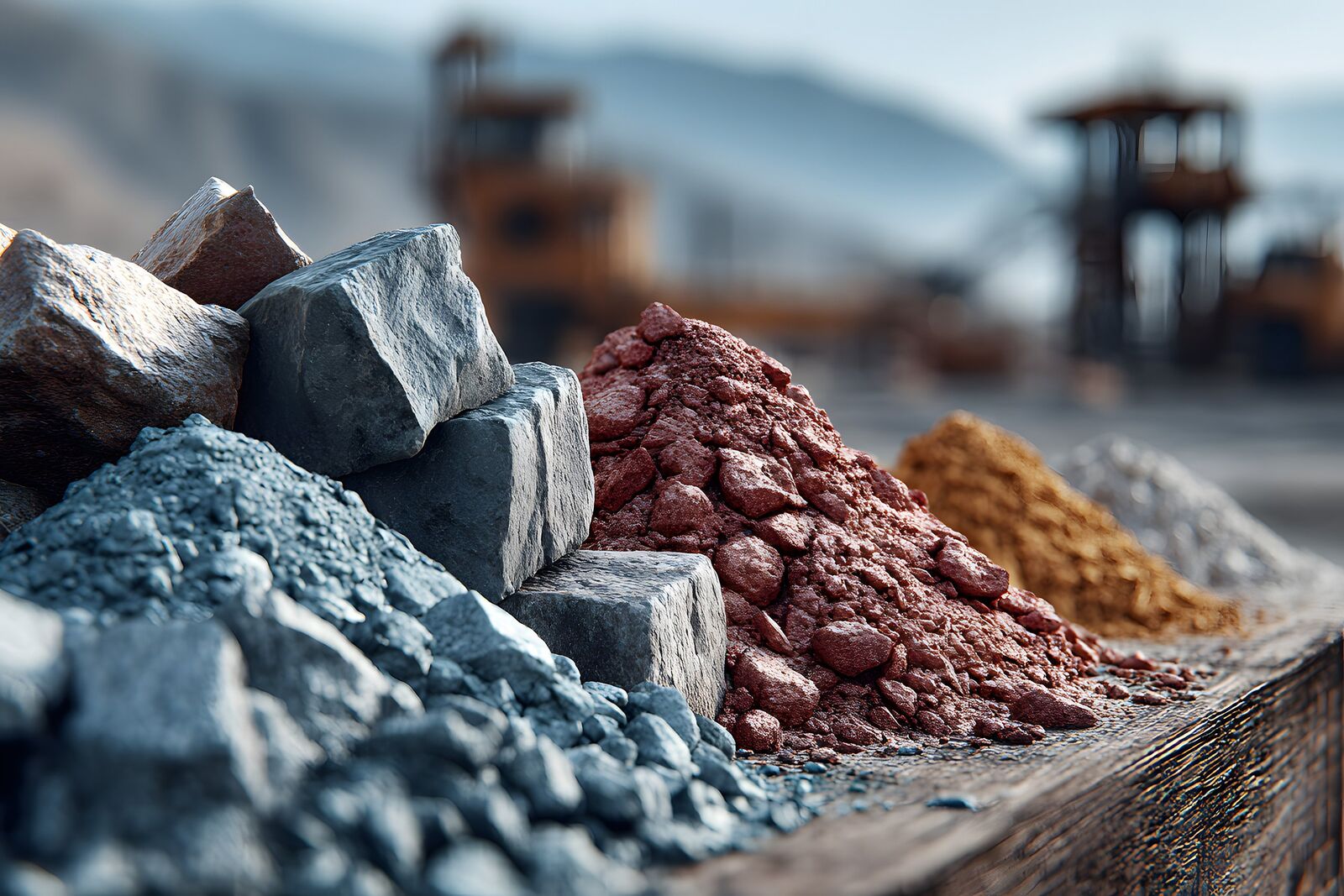
    In disruption reviews across battery and magnet supply chains, the break rarely appears at the mine gate. It usually appears later, when a concentrate with acceptable grade cannot be converted into a qualified chemical, separated oxide, sulfate, or anode material on the timetable assumed by downstream plants. That operating reality explains why critical minerals refining carries more geopolitical weight than mine ownership alone.

    • Commonly cited public estimates place China at around 90% of rare earth separation, about 60-70% of lithium chemical refining, and roughly 75-80% of cobalt refining, alongside a dominant position in graphite anode material processing.
    • The recurring chokepoint is not geology by itself, but conversion: solvent extraction, purification, precipitation, crystallization, spheronization, coating, and qualification.
    • Mine headlines can overstate resilience. A new source of feedstock does not remove dependence if the material still travels into Chinese conversion plants or precursor lines.
    • Observed failure modes cluster around impurity control, reagent and utility dependence, environmental permitting, residue handling, and slow downstream qualification.

    Why refining defines control more clearly than mining

    Mining creates feedstock. Refining creates usable material. Between those two points sits the industrial layer that removes impurities, separates chemically similar elements, controls particle morphology, and produces the exact specification a battery, magnet, alloy, or electronics manufacturer can qualify. In practice, that layer is often the hardest part to replicate because it depends on cumulative process know-how, stable utilities, high-purity acids and reagents, compliant waste treatment, and customers willing to qualify output at ppm, or parts-per-million, impurity thresholds.

    A recurring discovery in operational assessments is that mine-level metrics such as TREO grade in rare earths or LCE headlines in lithium say less than expected about resilience. TREO, or total rare earth oxides, can look attractive while the distribution of magnet rare earths and the burden of separation remain unfavorable. LCE, or lithium carbonate equivalent, can signal scale at the resource level while conversion into battery-grade hydroxide or carbonate remains constrained elsewhere. The center of gravity shifts from resource abundance to process capability.

    How the chokepoint appears in four mineral chains

    Rare earth refining shows the pattern most clearly. China rare earth processing retains the dominant position in separation, with public estimates commonly clustering around 90% of global separation capacity. That share matters because mined mixed rare earth concentrate is not yet a magnet input. The difficult step is separating near-identical lanthanides through long solvent extraction circuits, then converting selected oxides into metals, alloys, and magnets. In practice, a rare earth mine outside China can still leave the system dependent on Chinese separation if no alternative route exists for NdPr and heavier elements such as dysprosium and terbium.

    Lithium refining follows the same logic. Spodumene concentrate from Australia or brine-derived intermediates from South America do not directly supply a cathode plant. They first move through chemical conversion into battery-grade lithium carbonate or lithium hydroxide. Public estimates often place Chinese lithium refining in the 60-70% range, with variation by product and reporting year. A common discovery during supply-chain reviews is that mine commissioning receives more attention than conversion ramp-up, yet qualification failures in lithium refining can delay usable output even when mined feedstock is available.

    Cobalt refining adds a different layer of concentration. Mine production is tied heavily to copper and nickel systems, especially in the Democratic Republic of Congo, but refining into battery-grade cobalt sulfate is concentrated in China. Public estimates commonly place China’s cobalt refining share around 75–80%. The operational choke point is purification and crystallization to a specification accepted by precursor manufacturers. Traceability, jurisdictional risk, and transport complexity matter, but chemical conversion remains the decisive point where feedstock becomes usable battery material.

    Refining processes as the chokepoint in critical minerals supply chains (no text labels).
    Refining processes as the chokepoint in critical minerals supply chains (no text labels).

    Graphite is often underestimated because the strategic issue is farther downstream than mining. Battery makers do not consume flake graphite as-mined. They consume anode material: purified spherical graphite, coated spherical graphite, or synthetic graphite products meeting demanding morphology and purity standards. China dominates graphite anode material refining through purification, spheronization, coating, and integration with battery-material manufacturing. This is one of the clearest examples of a chain where new mining outside China does not, by itself, solve the bottleneck.

    Why China dominates critical minerals refining

    The concentration is not explained by geology alone. China built durable advantages in process industries that become stronger with repetition and scale. Solvent extraction circuits in rare earth refining, impurity control in lithium refining, sulfate production in cobalt refining, and anode finishing in graphite all benefit from years of plant learning. The more often a plant solves filtration issues, reagent balance problems, residue handling, or product-spec drift, the harder it becomes for a new entrant to match consistency.

    Industrial clustering also matters. Refining plants operate more reliably when acids, alkalis, reagents, power, water treatment, waste disposal, laboratories, and downstream customers sit within the same industrial ecosystem. China assembled those ecosystems around magnets, cathodes, precursor materials, anodes, electronics, and electric-vehicle manufacturing. That clustering shortened the distance between chemical conversion and final qualification. It also reduced the operational penalty when a process line needed troubleshooting or a product needed reformulation for a specific customer.

    Another discovery from actual supply disruptions is that documentary readiness can be as important as metal content. Export controls, customs classifications, chain-of-custody declarations, safety data sheets, environmental permits, and traceability files can interrupt shipments even when physical production is available. China’s mature processing base often sits inside established documentation routines for these flows, whereas emerging plants in other jurisdictions may still be building those systems.

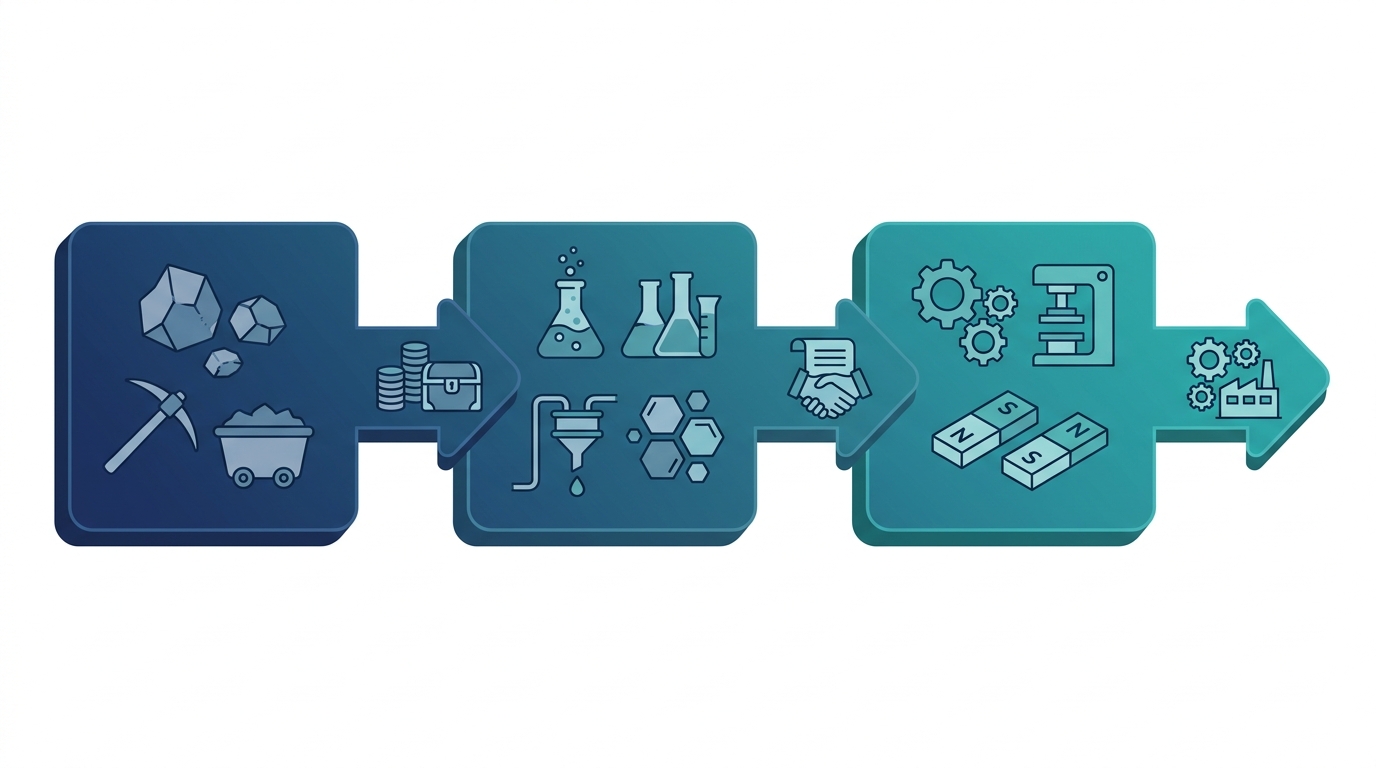
    Conceptual framework showing refining as the hidden bottleneck.
    Conceptual framework showing refining as the hidden bottleneck.

    Why Western mining projects do not remove the dependence

    The phrase “mine supply” can obscure where vulnerability actually sits. A lithium mine in Australia, a rare earth project in the United States, a graphite mine in Africa, or a cobalt source outside China improves optionality at the feedstock level. It does not automatically create separated oxides, battery-grade lithium chemicals, cobalt sulfate, or coated spherical graphite in the same jurisdiction. If those conversion steps still occur in China, dependence remains embedded in the chain.

    This gap appears repeatedly when upstream projects reach production before downstream refining is ready. Concentrate can be shipped, but product qualification lags. Residue management systems may still be under review. Reagent purity or utility stability may not match process assumptions. In rare earths especially, the route from mine concentrate to separated oxides and then to magnet metal is long enough that one missing processing stage can preserve the original chokepoint almost intact.

    Assessment frame: the signals that matter in refining risk

    A practical assessment of critical minerals refining usually turns on five layers. The first is process complexity: the number of stages between feedstock and final specification, including solvent extraction, roasting, leaching, precipitation, crystallization, purification, calcination, spheronization, and coating. The second is dependency on inputs such as sulfuric acid, caustic soda, specialty reagents, water quality, and uninterrupted power. The third is environmental and residue management, since wastewater, tailings, fluorine-bearing streams, or other by-products can become the real source of delay.

    The fourth layer is qualification risk. Battery, magnet, and specialty-alloy manufacturers often require long validation cycles before new material enters a production line. A refinery can so exist physically while remaining commercially irrelevant to the downstream system if output is not yet qualified. The fifth layer is route concentration: whether a material flow still depends on one country, one processing cluster, one port, or one customs channel. Australia-to-China spodumene flows and Congo-to-China cobalt intermediate flows illustrate how mining diversity can coexist with refining concentration.

    Downstream material specificity (anode material / refined outputs) at the micro scale.
    Downstream material specificity (anode material / refined outputs) at the micro scale.

    Observed failure modes are also fairly consistent across minerals. Product purity can drift outside accepted ppm limits. Recovery rates can vary by feedstock blend. Waste circuits can limit throughput before the core chemical line does. Qualification can fail because particle size distribution, morphology, or trace contaminants differ from an incumbent supplier’s output. Documentary gaps can hold cargo even when plant operations are stable. These are refining problems, not mining problems, and they often determine whether a nominally diversified chain is truly resilient.

    Observed responses in practice

    Across jurisdictions, several management patterns have appeared without eliminating the underlying difficulty. Some chains pursue integrated mine-to-chemical projects so that feedstock and conversion develop together. Others build partial regional capacity first, such as mixed rare earth carbonate processing, intermediate lithium conversion, or graphite purification ahead of full anode production. Some systems rely on allied-country processing networks rather than a single domestic site. Recycling and scrap recovery also appear more often in planning because they can supply refined units with less exposure to raw feedstock concentration, although recycled streams still require sophisticated separation and purification.

    Catch-up outside China looks most plausible where an existing chemical industry, stable utilities, waste-treatment infrastructure, and downstream manufacturing already coexist. Even then, the hard part is consistency rather than construction alone. A refinery can be commissioned long before it becomes a trusted source for a cathode line, a magnet producer, or an anode plant. That distinction is central to any reading of critical minerals refining: capacity on paper and qualified supply in practice are not the same thing.

    The hidden bottleneck, then, is not hidden because it is obscure. It is hidden because mining still dominates the public narrative while refining determines the practical balance of power. In lithium, rare earth refining, cobalt refining, and graphite anode material processing, the decisive leverage sits in conversion, separation, and qualification. That is where concentration persists, where disruptions spread fastest, and where supply-chain resilience is either confirmed or disproved.

  • Rare Earth Supply Chain Resilience: Mine-to-Magnet Bottlenecks, Qualification Evidence, and Failure

    Rare Earth Supply Chain Resilience: Mine-to-Magnet Bottlenecks, Qualification Evidence, and Failure

    Operationally, rare earth disruptions rarely begin with the headline narrative around electrification, defense demand, or strategic materials. They usually begin much earlier: a concentrate that behaves differently in pilot work than in the flowsheet, an impurity profile that complicates solvent extraction, an oxide that misses customer purity expectations, or a magnet qualification program that runs longer than the upstream project assumed. In practice, the central distinction is not “rare earth demand is strong” versus “rare earth demand is weak.” The meaningful distinction is whether a supply chain node has moved from geological promise into repeatable industrial performance.

    Key takeaways

    • Rare earth resilience is usually determined less by resource size than by recoverable NdPr content, impurity handling, separation capability, and qualification with downstream users.
    • Mine-to-magnet integration can reduce dependency on external processors, but each additional step introduces new commissioning, compliance, and quality-control risk.
    • Many juniors stall between pilot data and commercial supply because metallurgy, permitting, radionuclide management, or financing assumptions fail to scale together.
    • Offtake agreements and government backing are informative only when linked to product specification, qualification status, documentary obligations, and a credible project sequence.

    Analytical scope: what is actually being evaluated

    A useful analytical frame treats a rare earth company or project as a chain of dependent industrial steps rather than as a single mining asset. The relevant unit of analysis is often the full path from ore to separated oxides, then to metals, alloys, and in some cases magnets. That path matters because total rare earth oxides, or TREO, can overstate commercial relevance when the recoverable magnet basket is narrow or when heavy processing is needed before saleable material exists. In most industrial applications, the focus remains on NdPr for permanent magnets, with dysprosium and terbium adding value where heat resistance matters.

    In observed supply chains, the main jurisdictions often play different roles. China remains central in separation and magnet manufacturing. Australia has hosted important mine development and concentrate supply. Malaysia has appeared in intermediate processing routes. The United States, Japan, and the European Union have increasingly emphasized downstream qualification, public support, and alternative processing capacity. That geographic split means the same project can appear robust at mine level yet remain exposed at the separation or magnet stage.

    The most informative review generally breaks the system into five criteria: ore quality and mineralogy, processing proof, compliance and documentation, downstream qualification, and geopolitical exposure. A recurring discovery moment in practice comes when an attractive TREO figure is revisited after recoveries, gangue behavior, radionuclide handling, and customer purity requirements are layered onto the original story. The commercially relevant stream often becomes much narrower than the early resource narrative suggested.

    Criteria that separate a supply-ready asset from a promotional one

    The first criterion is mineralogical tractability. Rare earth chemistry is rarely forgiving. Monazite, bastnäsite, ionic clay feed, and other host types do not scale in the same way, and the presence of thorium, uranium, phosphate, or iron can reshape the whole processing route. Laboratory recoveries are informative, but pilot-scale continuity often reveals the real difficulty: reagent intensity, phase instability, residue management, and oxide purity drift. Where only bench data exists, operational uncertainty usually remains high.

    The second criterion is separation evidence. Mining and concentration are only the beginning. Commercial readiness depends on whether mixed rare earth streams can be separated into saleable oxides at consistent purity. This is where many projects encounter the hidden bottleneck. Solvent extraction circuits are complex, contamination can migrate across stages, and small deviations in feed chemistry can alter product quality. In practice, a project with modest mining simplicity but strong separation proof can be more resilient than a larger deposit that still relies on third-party processing assumptions.

    The third criterion is documentary and compliance readiness. Observed burdens often include certificates of analysis, chain-of-custody records, origin documentation, radionuclide handling plans, transport classification, chemical registrations such as REACH in Europe where relevant, and customer-specific traceability packages. For defense-linked or strategic applications, end-use scrutiny may also expand. Rare earth projects sometimes appear technically ready but remain commercially constrained because product traceability and compliance records lag behind physical production.

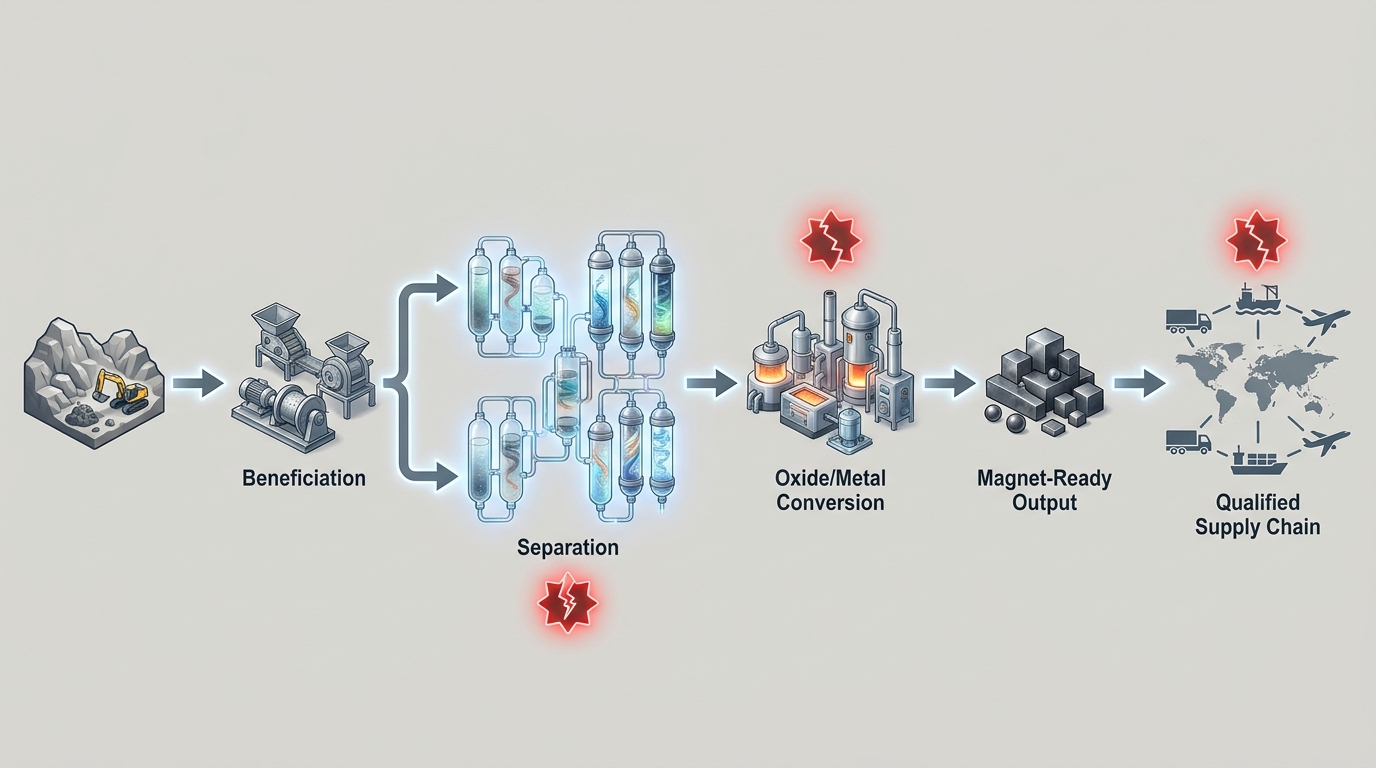
    Visual map of the full mine-to-magnet value chain and key bottlenecks
    Visual map of the full mine-to-magnet value chain and key bottlenecks

    The fourth criterion is downstream qualification. Magnet supply chains are specification-driven. An oxide can meet an internal assay target and still fall short in a metal, alloy, or magnet plant because impurity tolerances are tight and process stability matters as much as headline purity. One of the clearest practical dividing lines is whether material has moved beyond engineering samples into sustained qualification with named downstream counterparties. That evidence usually carries more weight than broad statements about future demand.

    The fifth criterion is structural exposure across jurisdictions. A mine in a stable jurisdiction may still depend on separation capacity in another region, shipping routes with export-control sensitivity, or a magnet customer base concentrated in one country. The supply chain so needs to be mapped by node, not by mine location alone. Concentrate routes, toll processing arrangements, and final magnet conversion can each reintroduce geopolitical risk even after upstream diversification appears complete.

    Failure modes repeatedly observed in rare earth development

    Several failure modes recur with unusual consistency. The first is the metallurgy gap: a project moves from attractive geology into pilot work and discovers lower recoveries, more difficult impurity rejection, or a less favorable NdPr yield than the original narrative implied. The second is the scaling gap: unit operations function individually but fail to integrate into a stable commercial sequence. Rare earth projects often look coherent on a flowsheet long before they look coherent in a continuous plant.

    A third failure mode is radionuclide and residue management. Monazite-linked projects in particular can carry thorium or uranium handling burdens that reshape permitting and waste strategy. This is not a side issue. It can influence site design, transport approvals, community acceptance, and the choice between domestic processing and export to an established processor.

    Separation bottleneck and impurity removal in staged processing
    Separation bottleneck and impurity removal in staged processing

    A fourth failure mode is the qualification lag. In many industrial materials chains, commercial announcements arrive before the product is truly interchangeable with incumbent supply. Rare earths are a clear example. Oxides, metals, and magnets may each require distinct qualification. Where the public narrative focuses on “production” but downstream acceptance still sits in testing, the supply chain remains exposed to delay. This is one reason many juniors never reach meaningful production despite years of apparent progress: the process plant, the documents, and the customer qualification path do not mature at the same pace.

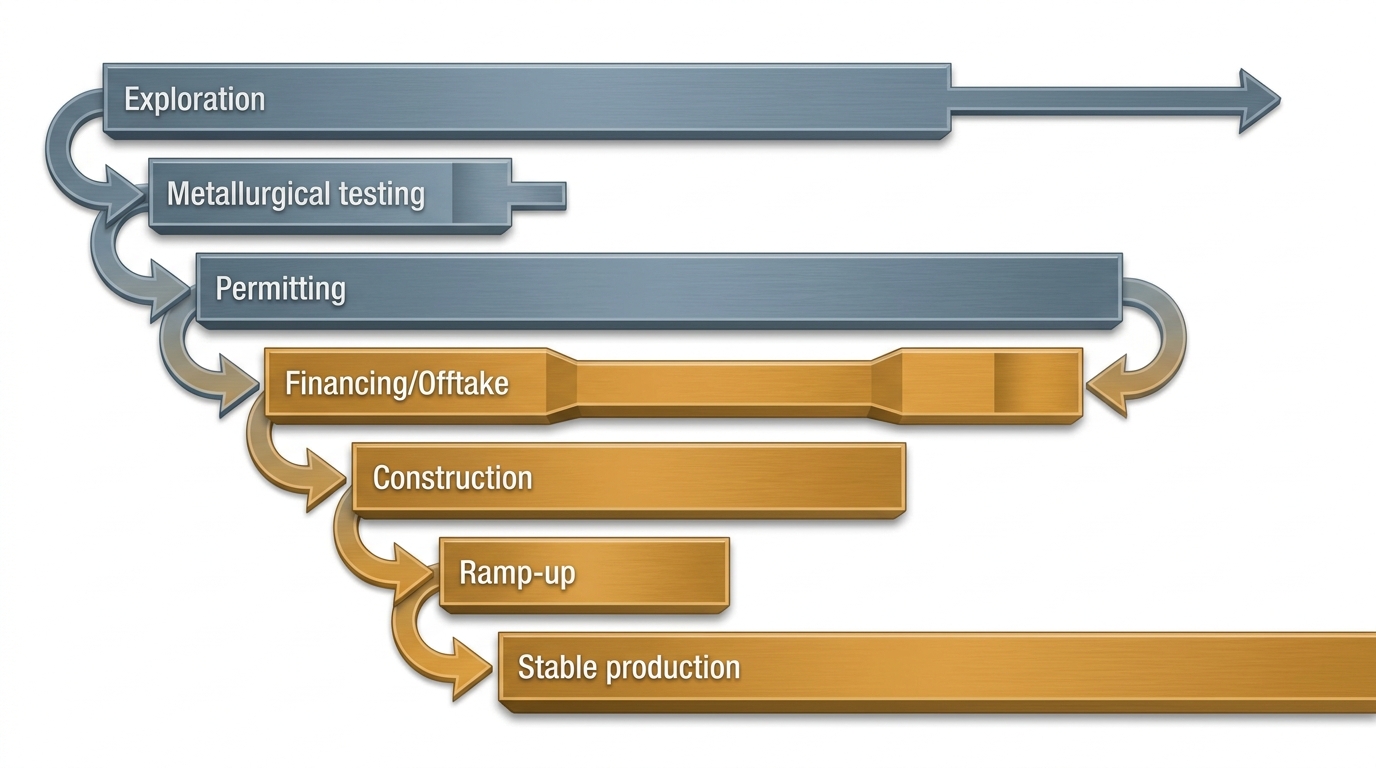
    A fifth failure mode is capex timeline reality. Rare earth projects frequently expand in scope as they move from mine-only plans to separation, metal making, or full mine-to-magnet integration. Each expansion can be strategically understandable, yet it also changes plant complexity, construction sequencing, and commissioning burden. In operational terms, the difficulty is not merely the size of capex; it is the widening gap between an early development timetable and the later reality of engineering, permitting, commissioning, and product qualification.

    Offtake agreements, government backing, and the meaning of “strategic”

    Offtake agreements are often treated as shorthand for validation, but their analytical value varies widely. In practice, the main distinctions are whether the arrangement is binding or non-binding, whether product specifications are defined, whether qualification remains a condition precedent, and whether the counterparty is a true end user, a trader, or a strategic intermediary. A recurring discovery moment appears when an announced offtake is reviewed closely and turns out to be contingent on future permits, future plant completion, or future product testing. The label alone rarely resolves commercial risk.

    Government backing also requires nuance. Public support in the United States, Japan, Australia, and the European Union has increasingly appeared in critical minerals and strategic processing initiatives. The resilience impact is strongest when backing is specific: project financing support, grants for downstream buildout, strategic procurement, export-credit participation, or public facilitation of permitting and infrastructure. The resilience impact is much weaker when the support is rhetorical or politically visible but operationally undefined.

    The term “strategic” is therefore best interpreted carefully. Strategic relevance can improve access to institutions and counterparties, but it does not erase technical risk. A project may be highly relevant to non-China supply diversification and still remain fragile if separation evidence is limited, if qualification is incomplete, or if documentary compliance is underdeveloped.

    How delays compound across project development stages
    How delays compound across project development stages

    Observed risk-management configurations in the sector

    Several operating patterns appear repeatedly where resilience has improved. One is staged integration: concentrate first, then separation, then metals or magnets after customer qualification strengthens. Another is toll processing or partner processing during early years, which can reduce exposure to building every downstream step at once, although dependency on third-party capacity remains. A third pattern is jurisdictional diversification, where mining, separation, and magnet conversion are distributed across allied or lower-risk regions rather than concentrated in one country.

    Additional configurations include mixed customer portfolios across industrial and strategic users, downstream joint ventures for metal or magnet conversion, and public-private structures where government backing supports a difficult early phase that private capital alone often avoids. Inventory buffering and dual-route qualification also appear in some supply chains, especially where one route relies on China-linked processing and another route is being developed in the United States, Japan, Europe, or Australia. None of these configurations removes technical risk; they mainly redistribute it across time, counterparties, and jurisdictions.

    Mine-to-magnet integration deserves separate treatment because it is frequently presented as the end-state for resilience. Operationally, it can indeed improve traceability, reduce third-party dependence, and make a supplier more relevant to industrial policy. Yet each added step creates a new failure surface: oxide purity, metal losses, alloy consistency, sintering behavior, coating performance, and end-product qualification. The integrated story is strongest when each stage is evidenced independently rather than assumed to follow automatically from an upstream resource.

    Closing frame

    The rare earth sector tends to reward analytical discipline more than thematic enthusiasm. The practical question is rarely whether rare earths matter. Their role in magnets, defense systems, robotics, and electrification is already well established. The practical question is whether a given project or supplier has crossed the industrial thresholds that convert TREO in the ground into qualified material in a customer process. Once the analysis is framed that way, the decisive signals usually become clear: recoverable magnet content, separation proof, documentary readiness, real qualification, credible offtake structure, specific government backing, and a project sequence that respects capex timeline reality.

  • What Is Neodymium? A Supply Chain Framework for the Magnet Metal Behind EVs and Wind

    What Is Neodymium? A Supply Chain Framework for the Magnet Metal Behind EVs and Wind

    In day-to-day manufacturing reviews, neodymium rarely appears first as a polished metal sample. It usually appears as NdPr oxide feed availability, metal conversion capacity, magnet grade qualification, and thermal requirements inside a traction motor or wind generator. That operating context explains why the question “what is neodymium” is wider than a chemistry definition. In industrial terms, neodymium is the rare earth element best known for enabling high-performance permanent magnets, and its importance comes from the chain around it: separated oxides, refined metal, alloy production, finished NdFeB magnet output, and then the motor, generator, sensor, or actuator that turns material science into usable force.

    • Commercial relevance usually sits in NdPr oxide, metal conversion, and NdFeB magnet manufacturing rather than in pure neodymium metal alone.
    • A common point of confusion is the difference between NdPr oxide, neodymium metal, and the finished neodymium magnet; each sits at a different supply-chain stage.
    • EV traction motors and direct-drive wind turbines concentrate demand because they value compact, high-torque permanent magnets.
    • Observed failure modes often come from downstream bottlenecks such as separation, metal-making, heavy rare earth additions, and magnet qualification rather than from mine output alone.

    What neodymium is in industrial terms

    Neodymium, symbol Nd and atomic number 60, is a lanthanide rare earth element. In physical terms it is a soft, silvery metal, but that description only captures a small part of its commercial role. The industrial significance of neodymium comes from magnet performance. When combined with iron and boron in the NdFeB system, it helps create the strongest widely used permanent magnets in modern manufacturing.

    A recurring discovery in supply-chain discussions is that “rare earth availability” and “magnet availability” are not the same thing. Ore bodies may be described in TREO, or total rare earth oxides, yet a high TREO figure does not automatically translate into a strong neodymium or praseodymium output profile. Another discovery is that neodymium is often discussed as a stand-alone metal even though many commercial transactions and plant configurations are organized around intermediates and alloys rather than around pure metal inventories.

    Where the commercial value sits: NdPr oxide, metal, and finished magnets

    For most readers asking what is neodymium, the most useful clarification is that the supply chain has several distinct material forms.

    • NdPr oxide is the separated rare earth oxide stream that usually contains neodymium and praseodymium together. In practical market terms, this is the main feedstock used in magnet supply chains.
    • Neodymium metal is the refined metal form used in downstream alloying and specialty applications. It sits further along the chain and reflects metallization capability, not just mine or separation output.
    • NdFeB magnets are the finished magnetic materials made from neodymium, iron, and boron, often with small additions of dysprosium or terbium in higher-temperature grades.

    This distinction matters because a disruption at one stage does not always appear at another stage immediately. An operation can have mine output and still lack separated NdPr oxide. Another operation can have oxide but lack metal conversion or alloying capacity. A motor producer can have access to magnets yet remain exposed to a narrow set of qualified grades or coatings. In practice, the phrase “neodymium supply” often compresses several bottlenecks into one label, even though the stress point may sit in separation chemistry, metallization, or magnet finishing.

    NdFeB magnet basics: why a neodymium magnet is not just “a strong magnet”

    The standard industrial magnet family here is NdFeB, short for neodymium-iron-boron. The magnetic phase is commonly associated with Nd2Fe14B, which gives the material its very high magnetic strength relative to size. That strength-to-volume advantage is the reason a neodymium magnet has become central in compact motors, actuators, speakers, robotics, and automation systems.

    Two production routes dominate commercial discussions.

    • Sintered NdFeB is produced through powder metallurgy. It generally delivers the highest magnetic performance and is the form most closely associated with demanding applications such as EV traction motors and many permanent-magnet generator designs.
    • Bonded NdFeB mixes magnetic powder with a polymer binder and shapes it by molding or similar routes. It is useful where design flexibility and complex geometries matter, but its magnetic performance is usually lower than sintered material.

    That sintered-versus-bonded distinction is important because public discussion often treats all neodymium magnets as interchangeable. In real industrial use, they are not. A bonded magnet used in a compact sensor or automotive auxiliary system does not solve the same engineering problem as a sintered magnet in a high-performance traction motor. The end-use sector so shapes the relevant supply-chain risk: powder characteristics, thermal behavior, coating quality, and high-temperature rare earth additions can matter as much as raw oxide availability.

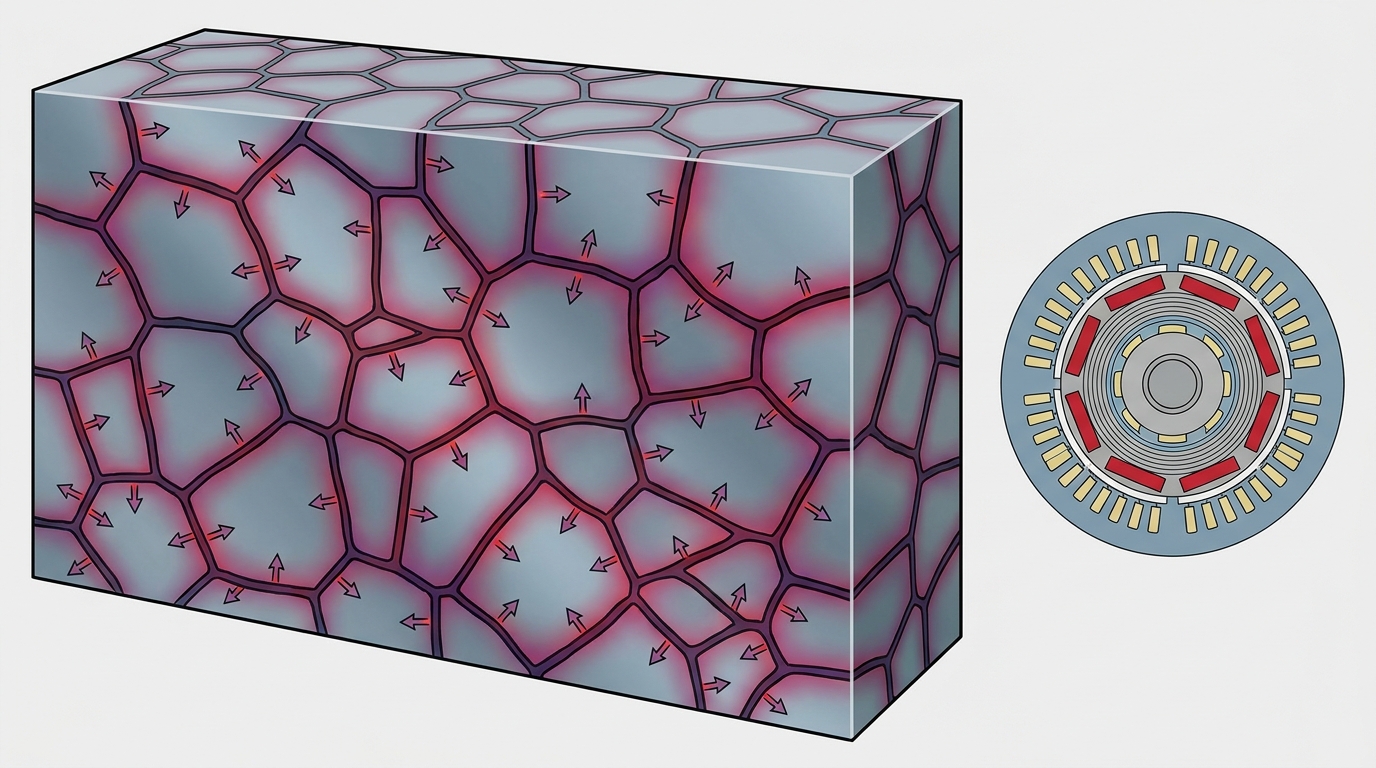
    How NdFeB magnets are built for high-performance motors and generators.
    How NdFeB magnets are built for high-performance motors and generators.

    Neodymium uses: from electronics to heavy industrial systems

    The simplest answer to “what is neodymium used for?” is that it is used primarily in permanent magnets. Those magnets then appear across a very wide range of products. Common neodymium uses include speakers, headphones, hard disk drives, power tools, industrial servomotors, pumps, sensors, actuators, robotics, automation equipment, EV traction motors, and wind turbine generators.

    The scale shift now attracting the most attention comes from electrified transport and renewables. Earlier consumer electronics demand was spread across many small units. EVs and wind, by contrast, concentrate magnet demand into large industrial systems where qualification standards, traceability, thermal margins, and manufacturing consistency become more visible. That is one reason public industrial policy in jurisdictions such as the United States, the European Union, Japan, South Korea, and Australia increasingly treats magnets as a strategic manufacturing input rather than as a niche specialty material.

    Why neodymium is so closely linked to EVs

    The phrase neodymium EV appears so often because many electric vehicles use permanent-magnet motors that value compact size, torque density, and efficiency. In those architectures, NdFeB magnets allow a motor to deliver strong performance in a limited package envelope. That matters in passenger vehicles where mass, space, thermal control, and drive efficiency all interact with vehicle design.

    General industry observations often place rare earth content for an EV traction motor in a range from hundreds of grams to a few kilograms, depending on motor architecture, vehicle size, and whether the platform uses one motor or multiple motors. That is not a universal number. Some EVs use induction or other magnet-light architectures, and magnet formulations can vary depending on praseodymium balance and the use of dysprosium or terbium in higher-temperature grades. Still, the broad pattern is clear: EV demand links neodymium not just to the motor itself, but to a chain of oxide separation, metal conversion, alloying, sintering, machining, coating, and final motor assembly.

    Another recurring discovery is that the phrase “neodymium magnets are in every EV” overstates the case. They are in many EVs, not all EVs. The reason that distinction matters is analytical rather than semantic. A market with several motor architectures behaves differently from a market with only one dominant architecture. Substitution exists, but performance trade-offs and redesign burdens also exist, which is why magnet demand remains structurally important even when alternative motor choices are available.

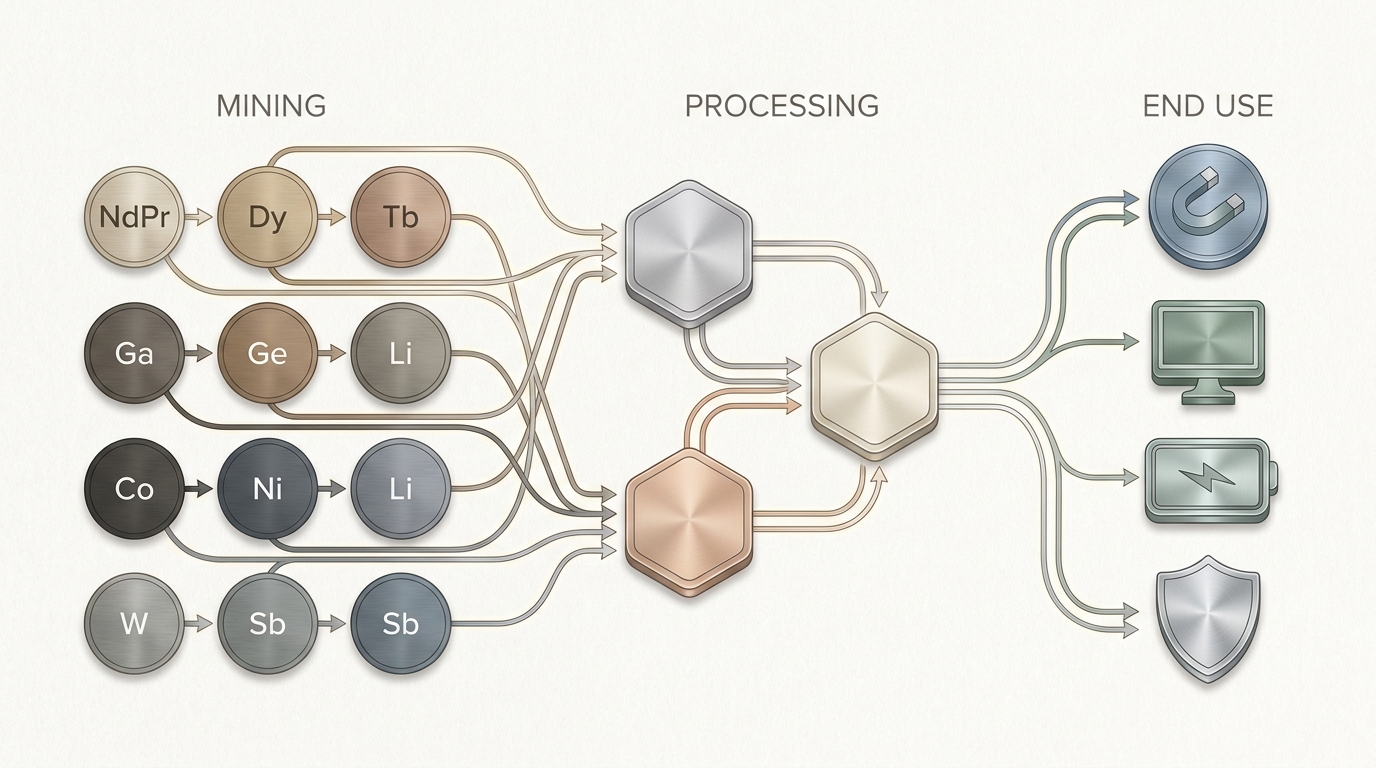
    Neodymium-to-magnet supply chain pathways feeding EVs and wind.
    Neodymium-to-magnet supply chain pathways feeding EVs and wind.

    Wind demand and the special role of direct-drive turbines

    Wind power is the other major demand pillar. Here the central distinction is between geared turbines and direct-drive turbines. Direct-drive designs typically rely more heavily on permanent magnets because they eliminate the gearbox and use a large generator operating at lower rotational speeds. In practical terms, that makes direct-drive installations far more relevant to neodymium demand than a simple count of turbines alone would suggest.

    Public technical discussion varies on exact material intensity because turbine rating, generator design, and supplier choices differ. What remains consistent is the structural effect: direct-drive wind can create large, concentrated orders for magnet material. That concentration changes how demand is felt across the chain. A consumer-electronics market spreads usage across many small units, while a wind program can pull material through alloying and magnet capacity in large project waves.

    Structural supply context: where the real bottlenecks tend to appear

    Neodymium supply risk is often described as a mining story, but in practice it is a processing and manufacturing story as well. The full chain usually includes mining, concentration, cracking and leaching, solvent extraction and separation, NdPr oxide production, metal-making, alloying, magnet manufacturing, and then integration into motors or generators. Each stage has its own technical barriers and qualification demands.

    A frequent public-market observation is the geographic concentration of downstream capability. Mining and concentrate production exist across several jurisdictions, including China, Australia, and the United States. However, separation, metal conversion, alloying, and magnet production have historically remained far more concentrated, especially in China. Japan also retains long-standing materials and magnet expertise, while Europe and North America are major end-demand regions in automotive and energy equipment. One trade pattern that appears repeatedly in public disclosures is material leaving one jurisdiction as concentrate or intermediate, passing through East Asian processing and magnet ecosystems, and then returning to Western manufacturing bases as finished magnet material or integrated components.

    That structure creates several recognizable failure modes. One is the assumption that diversified mine supply automatically equals diversified magnet supply. Another is the belief that oxide availability resolves all downstream exposure, when metallization, high-purity alloy control, sintering, machining, coating, and grade qualification may still be concentrated. A further complication comes from dysprosium and terbium, which are often added to some high-temperature NdFeB grades. In that setting, the neodymium story is not only about neodymium; it is also about access to heavy rare earth inputs that help magnets retain performance under higher thermal loads.

    Real-world context: neodymium magnets inside wind and EV hardware.
    Real-world context: neodymium magnets inside wind and EV hardware.

    Recycling adds a second structural theme. End-of-life magnets from electronics, industrial equipment, EVs, and wind systems represent a potential secondary source, and public discussion increasingly treats recycling as part of long-term supply resilience. Yet recycling has its own constraints: collection, disassembly, contamination control, and processing routes all determine whether magnet scrap becomes reusable feedstock. The operational lesson is that recycling is highly relevant, but it does not erase the complexity of the primary chain.

    Questions that often surface in neodymium coverage

    What is neodymium used for?

    Neodymium is used mainly in permanent magnets, especially NdFeB magnets, which then go into motors, generators, sensors, audio equipment, robotics, automation systems, and many compact high-performance devices. Its commercial importance comes from magnetic performance rather than from broad use of the pure metal by itself.

    Why are neodymium magnets in every EV?

    That phrasing is too broad. Neodymium magnets are in many EVs, not every EV. Where they are used, the logic is straightforward: permanent-magnet motors offer strong torque density and efficient packaging. Where they are not used, an alternative motor architecture usually reflects a different engineering trade-off rather than an absence of demand for high-performance motors.

    How much neodymium does a wind turbine use?

    There is no single number that fits all turbines. Material intensity depends heavily on turbine rating and generator design. The most important analytical distinction is whether the turbine uses a direct-drive permanent-magnet system. Direct-drive designs generally make wind far more relevant to neodymium demand than geared designs do.

    In one sentence, neodymium is a rare earth element whose industrial value comes mainly from enabling NdFeB magnets, and those magnets now sit at the center of many EV, wind, automation, and electronics supply chains. That is why the simplest definition of what is neodymium quickly becomes a broader explanation of processing stages, magnet forms, demand concentration, and manufacturing dependencies.

  • DPA Title III Critical Minerals Funding: How the Pentagon’s Industrial Base Tool Actually Works

    DPA Title III Critical Minerals Funding: How the Pentagon’s Industrial Base Tool Actually Works

    DPA Title III has become a core U.S. mechanism for expanding critical minerals capacity where commercial markets alone have not delivered sufficient domestic or allied supply. The substantive shift is not simply more public funding; it is the use of a national security statute to support mining, processing, separation, refining, and magnet or battery-material capacity through tailored financial instruments rather than standard procurement alone.

    For policy and institutional readers, the significance is structural. Title III is designed to address industrial shortfalls that affect defense readiness and supply-chain resilience. In critical minerals, that usually means support for bottleneck stages of the value chain, especially midstream processing, where the United States has often remained dependent on foreign capacity even when upstream resources exist.

    Key Takeaways

    • DPA Title III is a legal authority under the Defense Production Act used to expand industrial capacity tied to national defense, including critical minerals and related processing.
    • The program can use grants, loans, loan guarantees, purchase commitments, and direct capital support depending on the project structure and the identified supply shortfall.
    • Publicly announced awards show a clear emphasis on downstream and midstream bottlenecks such as rare earth processing, magnets, and battery materials, not only mine development.
    • DoD stated that since mid-2023 it awarded a total of $250 million to twelve recipients using IRA-appropriated funds through the DPA Purchases office for strategic and critical materials tied to battery supply chains.
    • The main execution signals to monitor are permitting progress, construction milestones, qualification of output, compliance conditions, and whether supported projects secure durable non-federal commercial demand.

    What DPA Title III Is

    Title III of the Defense Production Act is the part of the statute focused on domestic industrial base expansion. It is meant for situations where a material, component, or capability is considered important to national defense and the private market is not supplying enough capacity, fast enough, or in the required form. That makes it particularly relevant to critical minerals, where long project lead times, high capital intensity, difficult qualification processes, and concentrated foreign processing can leave major supply gaps unresolved for years.

    In practical terms, Title III is not a conventional purchasing program for finished goods. It is an industrial policy tool that allows the U.S. government, usually through the Department of Defense, to support new capacity creation. The emphasis is often on building or scaling facilities that can convert raw materials into defense-usable products.

    Legal Authority and Trigger Conditions

    The legal foundation matters because Title III is not an open-ended subsidy program. Its use is tied to a formal determination that an industrial shortfall exists and that government action is necessary to create, maintain, protect, expand, or restore domestic industrial base capabilities essential for national defense. Authority can be delegated to the Secretary of Defense and implemented through the offices responsible for DPA Purchases and related industrial base programs.

    This framework gives the Pentagon flexibility, but it also imposes discipline. Support is supposed to be linked to a defined capability gap rather than broad sector promotion. In critical minerals, that distinction explains why awards often focus on separation, refining, precursor production, metallization, or magnet manufacturing rather than undifferentiated upstream activity.

    Diagram of how Title III determination and funding mechanisms connect to industrial capacity expansion.
    Diagram of how Title III determination and funding mechanisms connect to industrial capacity expansion.

    How Awards Are Structured

    DPA Title III awards can take several forms. Grants are the most visible. They reduce upfront capital risk and are often used when a facility has strategic importance but uncertain near-term commercial returns. Loans and loan guarantees are another option, particularly where a project has identifiable future cash flow but cannot easily secure private debt on acceptable terms. Purchase commitments can also be used to create demand certainty, which is often as important as capital support in minerals markets with limited domestic offtake depth.

    Direct capital support can have an equity-like effect even when it is not common equity in the corporate sense. The government may fund plant buildout, equipment, or expansion in ways that materially strengthen a project’s financing stack. In many cases, awards are milestone-based rather than fully disbursed at signature. That means engineering, permitting, construction, commissioning, or qualification milestones can determine the release of funds.

    These structures matter because critical minerals projects often fail at the transition between concept, financing, and operational qualification. A Title III award can bridge that gap by combining public capital, signaling strategic priority, and improving a project’s ability to attract complementary private financing.

    Illustration of the industrial processing and separation bottleneck supported by Title III.
    Illustration of the industrial processing and separation bottleneck supported by Title III.

    Why Critical Minerals Fit the Program

    The critical minerals case is driven by concentration risk. For several minerals and processed products, mining may be geographically distributed while refining, separation, or manufacturing remains heavily concentrated in a small number of jurisdictions. That creates exposure not only to trade friction and logistics disruption, but also to technology transfer limits, sanctions risk, export controls, and qualification delays for defense-grade materials.

    Rare earths are the clearest example. The strategic issue is not only ore production. The more sensitive choke points are chemical separation, metal production, alloying, and magnet manufacturing. The same logic applies across battery materials, where precursor and processing stages can be more difficult to localize than mining itself. Title III is so well matched to bottlenecks that are commercially difficult but strategically important.

    What Announced Awards Show

    Public announcements do not provide a full tracker of all DPA activity, and they rarely disclose every contractual term. Even so, they offer a useful picture of policy direction. The Department of Defense has stated that since mid-2023 it awarded a total of $250 million to twelve recipients using Inflation Reduction Act appropriated funds through the DPA Purchases office to support domestic manufacturing capability for strategic and critical materials tied to large-capacity batteries. That indicates breadth across materials and a clear effort to connect defense resilience with industrial capacity relevant to electrification.

    The MP Materials partnership is another widely cited example of Pentagon rare earth investment associated with Title III authorities. Its significance is less about mining alone than about downstream rare earth processing and magnet-related capacity. That is consistent with the broader pattern in U.S. critical minerals funding: the federal government is increasingly focused on the stages that determine whether mined material can actually become qualified domestic supply.

    Milestone-based financing stack concept for how awards are structured.
    Milestone-based financing stack concept for how awards are structured.

    Operational and Compliance Implications

    For supply-chain and institutional analysis, a DPA award is best understood as a capability signal rather than proof of immediate output. Announced support can reduce financing risk, but execution remains exposed to permitting timelines, equipment delivery, technical ramp-up, feedstock availability, and customer qualification. In critical minerals, commercial success also depends on whether the supported facility can integrate with upstream feed sources and downstream buyers in a stable way.

    Compliance considerations are equally important. Projects operating under Title III support may face reporting obligations, domestic sourcing conditions, audit requirements, and other federal oversight mechanisms. Those factors can strengthen traceability and resilience, but they can also lengthen execution timelines relative to purely private projects.

    What to Watch

    The most important signals are not limited to award announcements. Market participants typically watch whether funded projects reach construction and commissioning milestones, whether output qualifies for defense or industrial use, whether additional federal instruments are layered onto the initial award, and whether supported capacity develops durable commercial demand outside direct government backing. Those indicators show whether Title III is merely allocating funds or actually changing the shape of the U.S. critical minerals base.

    The central conclusion is straightforward: DPA Title III critical minerals funding is a targeted industrial expansion mechanism built for strategic bottlenecks. Its role is not to replace markets, but to intervene where markets have left defense-relevant mineral capacity underbuilt. The announced awards suggest a consistent policy logic focused on midstream processing, downstream manufacturing, and reduction of concentrated foreign dependency rather than simple headline support for extraction alone.

  • Top 10 Structural Differences in Critical Minerals ETFs: REMX, LIT, COPX, BATT Compared

    Top 10 Structural Differences in Critical Minerals ETFs: REMX, LIT, COPX, BATT Compared

    For retail investors and RIAs using a critical minerals ETF as a thematic sleeve, the real decision is rarely about last quarter’s return chart. It is about structure: what the fund actually owns, where those companies operate, and whether the portfolio is tied to ore bodies, chemical conversion, or the wider battery-industrial stack. That sounds technical, but it is the difference between buying exposure to mine permitting in Chile, rare earth separation in China, or battery manufacturing demand in Korea and Japan.

    That is why REMX, LIT, COPX, and BATT should not be treated as interchangeable. One rare earth ETF can carry more processing risk than mining risk. One lithium ETF can end up looking partly like an industrial technology basket. A copper miners fund may be cleaner than the others, but it also comes with brutal single-commodity and jurisdiction concentration. And a battery materials ETF can be broad enough to dilute the minerals thesis investors thought they were getting.

    The ranking below focuses on ten structural differences that matter most in practice: methodology, country exposure, mine-versus-processor weighting, concentration, and holdings overlap. It avoids performance contests and tax advice. Instead, it answers the more useful question for allocation work: what kind of supply-chain risk each product is really underwriting.

    1. Critical Minerals ETF Is a Label, Not a Uniform Asset Class

    The first surprise in this category is how little standardization actually exists. “Critical minerals ETF” sounds like a coherent bucket, but in portfolio construction it can mean at least four very different things: upstream mining equities, processors and refiners, integrated battery-material supply chains, or broad industrial technology portfolios with some mineral sensitivity embedded inside. That is the starting point for understanding why REMX, LIT, COPX, and BATT can all fit the theme while behaving like different tools.

    From a supply-chain perspective, the distinction is not cosmetic. Upstream miners are tied to reserve quality, capex overruns, royalty changes, water access, community relations, and permitting timelines. Processors are more exposed to chemical conversion bottlenecks, environmental compliance, power pricing, and export policy. Downstream battery names lean on manufacturing utilization, battery chemistry trends, OEM procurement cycles, and industrial-policy support. When an ETF blends those layers, the investor is no longer taking a simple commodity view; they are underwriting several parts of the chain at once.

    That is also why the frequently asked question, “What is the best critical minerals ETF?” has no universal answer. The cleaner answer is that the “best” structure depends on what exposure is actually needed. A rare earth ETF like REMX is closer to a strategic-metals bottleneck trade. LIT is better described as a lithium-and-battery ecosystem vehicle. COPX is the most miner-centric of the group. BATT is often the broadest expression of battery materials and adjacent manufacturing. For advisors and self-directed investors alike, classification comes before conviction. Skip that step and the portfolio thesis drifts almost immediately.

    2. REMX Leans Closest to the Strategic Metals Bottleneck

    Among the four, REMX is the fund most likely to be mistaken for a simple mining product when it is actually broader and, in some ways, more sensitive to industrial chokepoints. The VanEck rare earth strategy tracks a rare earth and strategic metals universe rather than a narrow list of ore producers. In practice, that means the portfolio can include miners, refiners, processors, and companies with meaningful exposure to metals such as rare earth elements, lithium, cobalt, titanium, and other strategic inputs depending on index eligibility and periodic rebalances.

    That methodology matters because rare earth economics are not controlled only at the mine gate. Separation and refining are where a huge amount of practical power sits. A deposit can be geologically attractive and still fail to translate into secure supply if the processing route is costly, environmentally constrained, or politically exposed. So when investors ask whether the remx etf includes processors or only miners, the better answer is that processors are part of the point. It is designed to capture the rare earth and strategic metals value chain, not just pit-to-port extraction.

    The verdict is clear: REMX is one of the purer expressions of critical materials scarcity, but it is not a clean “mine leverage only” instrument. It carries concentration risk because the eligible universe is narrow, country risk because strategic metals supply chains remain unevenly distributed, and processing risk because downstream conversion often matters more than volume headlines suggest. For investors specifically seeking a rare earth ETF or vaneck rare earth exposure, that impurity is not a flaw. It is the core structural feature. The catch is that the same feature makes REMX especially sensitive to policy shocks, export controls, and processing concentration rather than just raw mining sentiment.

    3. LIT Is a Lithium ETF, but Only Partly a Miner Fund

    LIT is often the first ticker people reach for when they want lithium exposure, and that instinct is understandable. But structurally, LIT is not a pure upstream bet on brine assets, spodumene supply, or conversion shortages. Its methodology is built around the lithium and battery technology ecosystem, which broadens the portfolio beyond miners into chemical converters, battery material firms, and downstream companies that benefit from battery adoption. That broader footprint is exactly why investors sometimes feel they bought lithium and got something closer to a battery supply-chain blend.

    There is a practical reason for this design. Lithium rarely reaches end markets in the form investors picture when they hear “mining.” Conversion into lithium carbonate, hydroxide, or other battery-grade chemicals is where quality, pricing, and strategic control begin to diverge. A lithium ETF that excludes processors would miss a meaningful part of the bottleneck. LIT so tends to carry exposure to companies whose economics depend on chemical conversion margins, contract structures, and downstream battery demand as much as on raw extraction. In other words, it is closer to a lithium platform than a lithium pit.

    That makes LIT a useful vehicle, but not the simple one-line commodity proxy it is often marketed as in casual conversations. Its country mix can include China, Australia, the United States, Japan, and South Korea, reflecting the reality that lithium is mined in one set of places and turned into battery materials somewhere else. The fund’s structural advantage is that it captures more of the commercial chain. The trade-off is dilution: when battery technology or manufacturing names dominate sentiment, the lithium etf thesis can start behaving less like raw materials exposure and more like an industrial growth basket. That is not necessarily a problem. It just needs to be acknowledged upfront.

    4. COPX Is the Cleanest Commodity-Equity Link, and That Cuts Both Ways

    If the question is which of these funds most directly maps onto a single mined commodity through listed equities, COPX is the cleanest answer. Its methodology centers on copper miners and diversified mining companies with meaningful copper exposure. Unlike LIT or BATT, it does not need an ecosystem story to justify itself. Unlike REMX, it is less dependent on a strategically complex processing chain. Its identity is much simpler: a basket of companies whose earnings power is closely tied to copper mine economics.

    That simplicity is a strength, especially for advisors who want clearer factor attribution. The portfolio is generally driven by mine life, grade quality, reserve replacement, brownfield and greenfield project execution, labor relations, and local permitting. It also means the operational reality is harsher than many thematic summaries suggest. Copper supply growth is slow, project lead times are long, water stress is material in several producing regions, and fiscal regimes can change right when capital intensity rises. A copper miners ETF is never just a demand story; it is also a timeline story, and timelines in mining almost always slip.

    The verdict on COPX is straightforward. It is not a broad critical minerals ETF so much as a specialist sleeve inside the theme. That makes it powerful but less diversified. Country exposure tends to lean toward jurisdictions such as Chile, Peru, Canada, the United States, and Australia, with all the permitting, social license, and labor friction that implies. For investors seeking the purest mine-heavy structure of the four, COPX is the least ambiguous. The cost of that purity is concentration in one commodity and a handful of large producers. When copper works, the linkage is clearer than in the other funds. When the mining cycle turns or a major jurisdiction stumbles, the same clarity becomes unforgiving.

    5. BATT Is the Broadest Battery Materials ETF, and the Least Pure Minerals Bet

    BATT tends to attract investors who want the battery theme without committing to a single metal. On paper, that sounds like prudent diversification. In structure, though, BATT often sits furthest from a classic materials-only portfolio. Depending on the index methodology and rebalance mix, it can hold raw material suppliers, processors, cathode and anode participants, battery manufacturers, and adjacent technology or industrial names. That gives it breadth, but breadth is not the same thing as minerals purity.

    This is where many portfolio assumptions quietly break. A battery materials ETF can include enough downstream manufacturing and technology exposure that mineral pricing stops being the dominant driver. Utilization rates, EV production schedules, policy incentives, cell chemistry transitions, and industrial competition start to matter just as much. From a procurement-style lens, BATT is closer to a supply-chain architecture fund than to a mining basket. That makes it useful in periods when the whole battery complex is expanding, but it can also mute the upside that investors expected from direct commodity leverage.

    The strategic verdict is that BATT works best for those who want a diversified way to express the battery buildout rather than a concentrated view on a particular mineral shortage. Country exposure often leans heavily toward Asia because processing, component manufacturing, and cell production remain concentrated there. That introduces a different risk profile than COPX or even REMX: less reserve and permitting drama, more manufacturing concentration and industrial-policy sensitivity. As a battery materials etf, BATT is credible, but it is broad enough that the thesis can drift away from raw materials faster than many retail investors realize. In category terms, it may be the most forgiving operationally and the least precise thematically.

    6. The Real Divide Is Mine Weighting Versus Processor Weighting

    A more useful way to compare these ETFs is not by marketing label but by where they sit on the mine-to-processor spectrum. COPX is predominantly mine-weighted. REMX is mixed, but often more processor-sensitive than first impressions suggest. LIT sits in the middle, carrying both upstream resource and midstream conversion exposure while also pulling in battery-linked industrial names. BATT typically pushes furthest downstream, often making processors and manufacturers more important than extraction economics alone.

    That distinction is operationally decisive. Mine-heavy portfolios live and die by geology, stripping ratios, reserve replacement, freight, royalties, water permits, and community negotiations. Processor-heavy portfolios care more about feedstock security, reagent costs, environmental compliance, energy pricing, qualification standards, and conversion yields. When a government introduces export restrictions or local-content rules, processor-heavy funds can react very differently from mine-heavy funds even if both are technically exposed to the same material. Rare earths are the clearest example: controlling separation capacity can matter more than controlling ore tonnage.

    For allocation work, this is one of the few structural filters that immediately improves decision quality. Investors who believe the bottleneck is new mine supply usually end up closer to COPX, or to the miner components within REMX and LIT. Those who believe the real choke point sits in conversion, qualification, and downstream industrial policy are often talking about REMX, parts of LIT, or the broader battery-processing exposure embedded in BATT. The category looks crowded, but the underlying exposures are not redundant. The mine-versus-processor split explains far more than the product names do.

    7. Country Exposure Drives More Risk Than Most Fact Sheets Admit

    In practice, country concentration is where the supply-chain story becomes real. Two ETFs can both claim diversification because they hold dozens of stocks, yet still be structurally concentrated if those holdings cluster in the same operating geographies or depend on the same policy regimes. REMX and BATT frequently lean into Asian processing and manufacturing exposure. LIT often spans mining jurisdictions and processing hubs at the same time. COPX looks globally diversified on paper but can remain heavily dependent on a short list of copper-producing regions and the political realities attached to them.

    That matters because the risks are not interchangeable. China exposure may bring concerns around export controls, industrial policy, and state-linked competitive dynamics, but it can also reflect real dominance in processing and component manufacturing. Latin American exposure in a copper portfolio introduces royalty debates, water access, labor bargaining, and infrastructure constraints. Australian and North American exposure usually signals stronger rule of law, but it often comes with higher costs, slower permitting, and less tolerance for environmental shortcuts. There is no “safe” country mix here; there are only different trade-offs between cost, speed, and predictability.

    The practical conclusion is that country concentration should be read as a strategic feature, not a side note. A critical minerals ETF is often a disguised geopolitical allocation as much as an industrial one. That is especially true in REMX, where processing geography can dominate the investment case, and in LIT or BATT, where Asian battery supply chains remain central. Investors comparing these funds on ticker familiarity alone miss the more important question: which jurisdictions, and which policy environments, are being outsourced into the portfolio. In this theme, geography is not background noise. It is the thesis.

    8. Holdings Overlap Exists, but the Revenue Drivers Still Diverge

    One reason these funds are often grouped together is that some top holdings can overlap across themes. Large diversified miners, well-known lithium producers, or dominant battery-chain companies may appear in more than one portfolio. That overlap can create the illusion that REMX, LIT, and BATT are variations of the same trade. They are not. A shared holding does not mean shared exposure if that company represents different parts of the supply chain, carries different weight in each fund, or derives revenue from more than one commodity and geography.

    Consider the mechanics. A company with lithium operations may appear in LIT because it is central to battery materials, while a strategic metals or diversified materials name might enter REMX through broader eligibility screens tied to rare earths and adjacent strategic commodities. In BATT, the same issuer could serve as one node inside a larger manufacturing ecosystem. Weighting also matters. A stock that is a top-five holding in one ETF can be a minor supporting position in another. The risk contribution, therefore, is not comparable just because the name appears on both factsheets.

    This is a useful corrective for investors looking for hidden concentration. Top holdings overlap can raise correlation, especially during periods when the market treats all battery or resource names as one macro trade. But overlap is only half the story. The more revealing question is what share of each fund’s thesis rests on that company. In COPX, overlap is usually less about battery ecosystems and more about copper-heavy miners. In LIT and BATT, it may reflect broad battery-chain exposure rather than direct commodity leverage. So yes, there is overlap. No, it does not erase the structural differences.

    9. Concentration Risk Is Not Just About Position Size

    Investors often define concentration too narrowly, reducing it to the weight of the top ten holdings. That is part of the story, but not enough in thematic materials funds. True concentration shows up in three layers at once: issuer concentration, commodity concentration, and supply-chain-node concentration. COPX may be diversified by number of stocks and still be highly concentrated in copper economics. REMX may hold multiple names that ultimately depend on a narrow set of strategic-metals bottlenecks. BATT can look broad while remaining concentrated in one industrial theme and a handful of Asian manufacturing centers.

    This is why concentration can feel hidden in ETFs that appear more diversified than individual stocks. If several holdings respond to the same policy shock, the same refining bottleneck, or the same battery-demand cycle, the practical diversification is lower than the name count suggests. We have seen versions of this problem repeatedly across resource and industrial baskets: different tickers, same operational choke point. In critical minerals, processing concentration is the classic example. In copper, it is the slow cadence of mine development and dependence on a few major producers. In battery funds, it is the concentration of manufacturing capacity and demand sensitivity in a limited set of markets.

    The verdict is that concentration should be analyzed through the lens of failure modes, not just weights. What breaks the thesis? A permitting delay, a refinery bottleneck, a policy intervention, a chemistry shift, a labor dispute, a demand air pocket? Once framed that way, the structural differences between these ETFs become sharper. REMX concentrates strategic chokepoints. COPX concentrates mining execution and copper dependency. LIT spreads risk across the lithium chain but introduces ecosystem dilution. BATT diversifies the battery story while potentially reducing the purity that many investors thought they were buying.

    10. Which Structure Fits Which Mandate Depends on the Bottleneck Being Underwritten

    By this point, the hierarchy is less about which ticker sounds more “critical minerals” and more about what kind of bottleneck an investor wants exposure to. REMX is the strongest fit for those who want a rare earth ETF or broader vaneck rare earth style exposure centered on strategic materials scarcity, especially where processing and geopolitical concentration matter. LIT is the more balanced lithium etf for investors who accept that lithium today is inseparable from chemical conversion and battery demand. COPX is the cleanest expression of copper mining leverage. BATT is the broad battery materials ETF for investors who want the whole industrial chain, even if that means less direct minerals sensitivity.

    That also answers the commercial-intent FAQ in a more honest way. What is the best critical minerals ETF? There is no single winner because these funds are solving different exposure problems. How are critical minerals ETFs constructed? Usually as equity baskets built around extraction, processing, refining, and downstream industrial participation rather than direct ownership of physical minerals. Does REMX include processors or only miners? It includes both, and that is central to how the fund behaves. Those are not side questions. They are the core due-diligence questions for anyone comparing the category seriously.

    The final judgment is blunt. Investors who want cleaner commodity-equity linkage will usually find COPX easiest to explain and REMX most strategically distinctive. Investors who want a middle ground between raw material exposure and industrial adoption typically land in LIT. Those who want the broadest battery-chain participation, and can tolerate a less pure minerals thesis, will understand why BATT remains in the conversation. In other words, structure is the product. Once that is clear, the comparison stops being a branding exercise and becomes what it should have been from the start: a decision about which part of the critical minerals supply chain deserves capital, and which failure modes are acceptable along the way.

  • USGS 2025 Critical Minerals List Update: Copper, Uranium and Metallurgical Coal Added to Federal

    USGS 2025 Critical Minerals List Update: Copper, Uranium and Metallurgical Coal Added to Federal

    The 2025 us critical minerals list marks a substantive policy shift because the U.S. Geological Survey expanded the federal benchmark from the 2022 framework to a 60-mineral list and added materials that reach far beyond the usual battery-metals narrative. The most consequential additions are copper, uranium, and metallurgical coal, which connect the list more directly to grid buildout, nuclear fuel security, steelmaking capacity, and broader industrial resilience.

    According to the USGS final 2025 publication under the Department of the Interior, the updated critical minerals list now includes 60 minerals, including 15 rare earth elements. The final list added boron, copper, lead, metallurgical coal, phosphate, potash, rhenium, silicon, silver, and uranium relative to the 2022 list. That matters because the list is not a general inventory of important commodities; it is the federal reference point used to frame supply-chain vulnerability, research focus, and eligibility across several federal policy pathways.

    Key takeaways

    • USGS published a final 2025 list of 60 critical minerals, expanding the prior 2022 framework and adding 10 minerals.
    • The largest policy signal is the inclusion of copper, uranium, and metallurgical coal, which broadens criticality beyond batteries and rare earths into power, nuclear, and steel supply chains.
    • The methodology centers on supply disruption risk and estimated economic damage, not simply geological scarcity or market visibility.
    • Inclusion can shape federal research, stockpiling, permitting attention, and industrial-policy screening, although it does not create automatic funding or permitting outcomes.
    • Signals to watch include agency implementation, references to the list in grant and procurement frameworks, and how downstream sectors adjust compliance and sourcing narratives.

    What the US critical minerals list is

    The usgs critical minerals list is maintained under the Energy Act of 2020 and updated periodically by USGS. The underlying standard is whether a mineral is essential to the U.S. economy or national security and whether its supply chain is vulnerable to disruption. In practice, that makes the list a federal risk-screening tool rather than a production ranking or trade scoreboard.

    This distinction is important for policy and supply-chain analysis. A mineral can be abundant globally and still qualify as critical if U.S. imports are concentrated, if refining or processing capacity is located in a small number of jurisdictions, or if a disruption would have measurable economic consequences. By the same logic, a commercially important commodity may not qualify if the modeled disruption impact is limited or if substitution and domestic availability reduce systemic exposure.

    Who decides which minerals are critical

    USGS leads the process under the Department of the Interior, with interagency input and public comment informing the final outcome. That structure means the list is partly technical and partly strategic. It incorporates mineral economics and trade exposure, but it also reflects national-security and industrial-policy judgments from agencies with defense, energy, and manufacturing mandates.

    That is visible in the final 2025 outcome. Public reporting and congressional analysis indicate that interagency review influenced the final scope, including additions tied to energy security and defense relevance. As a result, the 2025 list should be read as a cross-government assessment of vulnerability rather than a narrow geoscience exercise.

    Generic supply-chain context for the 2025 critical minerals list.
    Generic supply-chain context for the 2025 critical minerals list.

    How USGS determines criticality

    The updated methodology focuses on the probability and impact of foreign trade disruptions. USGS has described the framework as one that estimates expected economic damage to the United States from supply interruptions and compares those risks in a more quantitative way than earlier versions. Congressional Research Service summaries describe a threshold based on an annualized, probability-weighted net decrease in U.S. GDP.

    In simplified terms, the model weighs several factors: net import reliance, concentration of production and processing, exposure to foreign trade disruption, and the likely effect of a supply interruption on the U.S. economy. The result is a list built around vulnerability and consequence. That helps explain why the 2025 update extends into sectors such as fertilizers, steelmaking, semiconductors, and nuclear fuel, not only electric vehicles or permanent magnets.

    What changed in the 2025 critical minerals list

    The principal change versus the 2022 list is expansion. The final 2025 publication added 10 minerals: boron, copper, lead, metallurgical coal, phosphate, potash, rhenium, silicon, silver, and uranium. The broad direction is clear: federal criticality now covers more of the physical economy, especially materials tied to grid infrastructure, construction, steel, electronics, fertilizers, and power security.

    Explains how USGS translates supply risk into policy criteria.
    Explains how USGS translates supply risk into policy criteria.

    Copper is the most visible addition. Its inclusion aligns the 2025 critical minerals list with electrification and transmission realities, since copper is embedded across grid equipment, motors, industrial wiring, defense systems, and data-center infrastructure. Uranium adds a direct nuclear-fuel dimension and links the list to reactor supply resilience as well as defense-related energy considerations. Metallurgical coal is significant for a different reason: it reflects the continued importance of blast-furnace steelmaking and the industrial dependence on steel inputs across transportation, heavy equipment, and construction supply chains.

    The remaining additions also widen the framework materially. Silicon is central to electronics, solar supply chains, and industrial processing. Phosphate and potash extend criticality into fertilizer inputs and agricultural productivity. Rhenium and silver point to high-performance industrial and electronics uses with potentially concentrated supply chains. Boron and lead broaden the list further into specialty materials and established industrial applications.

    Removals versus additions

    The 2025 update is defined more by additions than by removals. Based on the published final list and summary reporting, the 2022 core remained in place while the final 2025 version expanded the set of covered materials. That signals a broader federal view of mineral vulnerability rather than a narrowing or reprioritization away from earlier critical minerals categories.

    Why the list matters for federal funding pathways

    Inclusion on the us critical minerals list can affect how agencies frame projects and programs across research, demonstration, stockpiling, mapping, recycling, and supply-chain resilience. It can also shape the analytical basis for permitting attention or interagency coordination where statutes and program rules refer to critical minerals. The practical effect is not automatic funding and not automatic regulatory approval. The practical effect is that listed minerals sit inside a recognized federal priority framework.

    Visual emphasis on the newly added minerals (conceptual, non-branded).
    Visual emphasis on the newly added minerals (conceptual, non-branded).

    For supply chains, that matters because federal programs often use official designations as eligibility filters or as part of strategic justification. A broader list so expands the universe of upstream extraction, midstream processing, recycling, substitution, and downstream manufacturing activities that can plausibly be linked to national economic security. Copper’s addition is especially important in this context because it brings a foundational industrial metal inside that policy architecture.

    Operational and compliance implications

    The 2025 list also has compliance and disclosure relevance. Once a mineral is formally designated as critical, companies and public agencies often face greater scrutiny around sourcing concentration, jurisdictional exposure, and processing bottlenecks. That does not create a new legal regime by itself, but it strengthens the policy rationale behind domestic capacity studies, allied-sourcing frameworks, stockpile reviews, and procurement-risk assessments.

    The geopolitical context is equally important. Several listed minerals are characterized by concentrated mining, refining, or conversion capacity outside the United States. The list therefore functions as a public indicator of where trade friction, export restrictions, sanctions exposure, or logistics disruptions could cascade into manufacturing and infrastructure delays.

    Bottom line

    The 2025 US Critical Minerals List Explained in one sentence: USGS has broadened the federal definition of criticality from a narrower strategic-minerals lens to a wider industrial-systems lens. The addition of copper, uranium, and metallurgical coal is the clearest evidence of that shift. For policy watchers and professional market participants, the list is best read as a federal map of supply-chain vulnerability, economic consequence, and future program prioritization grounded in the published USGS framework.

  • Mine-to-Magnet Risk Mapping: Where Western Rare Earth Supply Chains Hold and Fail

    Mine-to-Magnet Risk Mapping: Where Western Rare Earth Supply Chains Hold and Fail

    In operational reviews of rare earth suppliers, a recurring discovery moment appears early: many projects described as “rare earth production” stop at ore, concentrate, or mixed chemical product. The difficult part of the chain starts after mining. In mine to magnet terms, resilience depends on five linked stages-ore extraction, solvent extraction separation, metal reduction, alloying, and magnet manufacturing-and the main Western gaps sit in the middle and downstream steps rather than in geology alone. That distinction explains why Mountain Pass in California and Mount Weld in Western Australia matter, yet still do not by themselves create a complete non-Chinese rare earth supply chain.

    • The ore extraction stage secures feedstock, but mineralogy, impurity profile, and radionuclide handling determine whether downstream rare earth processing is practical.
    • Solvent extraction separation remains the central bottleneck because chemically similar rare earths require long, tightly controlled processing cascades and demanding waste-management systems.
    • The metal reduction stage, NdFeB alloy strip casting, and sintered magnet production introduce yield, contamination, and qualification risks that many front-end mining narratives understate.
    • China dominates each stage not only through capacity, but through integration, operating experience, equipment ecosystems, and qualification history with end users.
    • Observed non-Chinese resilience patterns include partial vertical integration, alternate processing routes, staged qualification of intermediates, and selective redesign to reduce heavy rare earth dependence.

    What mine to magnet actually covers

    Mine to magnet is shorthand for a full rare earth value chain that turns mined material into finished permanent magnets, usually NdFeB products for motors, actuators, sensors, and high-performance industrial systems. In analytical terms, the chain is only complete when material moves through five distinct industrial transformations. Ore is extracted and beneficiated; mixed rare earths are separated into individual oxides or refined streams; oxides are reduced into metal; metal is alloyed into magnet feedstock; and that feedstock is turned into finished magnets through powder processing, pressing, sintering, machining, coating, and magnetization.

    A second discovery moment often follows from that definition: a country can host an active rare earth mine and still remain dependent on foreign processing at several points. That is the central structural issue in western rare earth discussions. Front-end capacity exists in several jurisdictions, but broad commercial depth across all five stages remains limited outside China.

    Stage 1: Ore extraction and concentrate production

    The ore extraction stage is the most visible part of the rare earth supply chain, but it is not the hardest to localize. Mountain Pass, California, remains the best-known active U.S. rare earth mine and a key Western source of ore and concentrate. Mount Weld, Western Australia, remains one of the highest-profile non-Chinese rare earth feedstock sources and is linked to Lynas’s downstream processing chain. Smaller or emerging projects exist in Canada, Sweden, Greenland, Brazil, and parts of Africa, although most are not yet integrated into a full mine-to-magnet route.

    Analytically, the useful question at this stage is not simply whether ore exists, but whether the ore can move cleanly into downstream chemistry. TREO, or total rare earth oxides, is only one part of that picture. Mineralogy determines liberation behavior, concentrate quality, and how readily the mixed rare earth stream can be processed later. Bastnaesite, monazite, xenotime, and ionic clay systems create different operational profiles. Waste streams also matter: thorium, uranium, and other regulated impurities can move a project from straightforward mining into complex compliance management under U.S., Australian, or European permitting regimes.

    Observed failure modes at the mining stage include unstable concentrate specification, overreliance on headline TREO without downstream recoverability evidence, and underestimation of residue handling where radioactive impurities are present. In practice, two projects with similar grade language can create very different downstream outcomes once impurity suite and mineralogy are examined closely.

    Stage 2: Solvent extraction separation

    Solvent extraction separation is often the least understood step in rare earth processing and the most important bottleneck in the chain. Rare earths are not exceptionally rare in geological terms; the difficulty lies in separating chemically similar elements through repeated extraction, scrubbing, and stripping stages. This is a plant-scale chemical operation with tight process control, sensitive reagent balance, and a heavy documentation burden around waste, emissions, and water treatment.

    Stage-by-stage mine-to-magnet pipeline overview
    Stage-by-stage mine-to-magnet pipeline overview

    China dominates this stage because it spent decades building integrated separation systems, operator know-how, reagent supply, and waste-treatment infrastructure. The Western position is narrower. Australia-linked production associated with Mount Weld and Lynas is one of the most visible non-Chinese channels. The United States has mining capability and has treated separation as a strategic build-out area, but the overall commercial base remains much smaller than China’s. In practical terms, a mine without reliable separation access remains exposed, even if ore production itself is strong.

    Common failure modes here include feed variability that destabilizes the extraction circuit, impurity carryover that affects downstream oxide specification, and delays linked to environmental controls rather than core chemistry alone. Commissioning risk is also unusually high: nameplate concepts often look linear on paper, while real plant tuning depends on many campaigns of operating data.

    Stage 3: Metal reduction and metallization

    The metal reduction stage is where separated oxides become usable rare earth metal. This step receives less public attention than mining or magnets, yet it is one of the sharpest industrial cliffs in the mine to magnet pathway. Rare earth metals are reactive, oxygen-sensitive, and demanding to handle. Purity is not a cosmetic issue: ppm-scale contamination can echo into alloy performance and magnet qualification later in the chain.

    Western rare earth capacity is comparatively thin at this point. The challenge is structural. Metallization depends on reliable separated oxide supply, specialized equipment, and a downstream customer base that can absorb metal or alloy at consistent specification. China benefits from proximity between oxide producers, metal makers, alloy plants, and magnet manufacturers. That integration reduces logistics friction and creates faster feedback when purity or yield drifts.

    Solvent extraction separation bottleneck visualization
    Solvent extraction separation bottleneck visualization

    Observed failure modes include oxidation during handling, inconsistent metal purity, and process economics that weaken when metallization sits far from both oxide production and alloy consumption. A recurrent discovery moment in supplier diligence is that a technically credible oxide producer may still have no practical bridge into stable metal production.

    Stage 4: Alloying and NdFeB alloy strip casting

    After metallization, rare earth metal is combined with iron, boron, and selected additives to make magnet alloy feedstock. For NdFeB systems, NdFeB alloy strip casting is a critical step because it shapes microstructure, oxidation behavior, and later powder characteristics. In operational terms, this is where chemistry starts to merge with materials engineering: a cast alloy that looks acceptable in bulk form can still create powder behavior that destabilizes pressing, sintering, or final magnetic performance.

    China’s dominance at this stage reflects cluster effects as much as capacity. Alloying sits next to metal supply on one side and magnet manufacturing on the other. That allows rapid correction when composition drifts, heavy rare earth loading changes, or customer specification tightens. Western capacity exists in narrower form, but it is less deeply networked, and that matters because alloying is highly sensitive to upstream purity and downstream qualification.

    Typical failure modes include microstructural inconsistency, oxygen pickup, and dependence on a single upstream metal route. Where dysprosium or terbium enters the design, exposure to heavy rare earth availability adds another layer of risk inside the rare earth supply chain.

    Stage 5: Sintered magnet production

    Sintered magnet production is the last industrial transformation and often the hardest to stand up at scale. Powder is milled, aligned, compacted, sintered, machined, coated, and magnetized into finished product. Performance depends on more than chemistry alone. Press behavior, grain boundary control, thermal profile, corrosion resistance, machining yield, and coating adhesion all influence whether a magnet can enter automotive, aerospace, defense, robotics, or industrial motor service.

    Why alloying and sintering are the hardest quality-critical steps
    Why alloying and sintering are the hardest quality-critical steps

    China dominates this stage through installed manufacturing base, specialized tooling, coating ecosystems, and qualification history with end users. Western rare earth efforts have increasingly focused on restoring magnet-making capability, but qualification remains a major barrier. Magnet customers often assess not only elemental composition, but route history: oxide source, metal purity, powder characteristics, sintering behavior, and consistency across production lots. That means a factory can exist before a dependable commercial magnet stream fully exists.

    Observed failure modes include insufficient lot-to-lot consistency, coating failures in end-use environments, and weak integration between alloy specification and finished magnet requirements. At this final stage, the value chain stops behaving like commodity processing and starts behaving like a qualified advanced-manufacturing system.

    Cross-stage evidence used in risk mapping

    • Orebody mineralogy, TREO distribution, and the split between light and heavy rare earth content.
    • Impurity profile, including thorium or uranium-bearing residues and the jurisdiction-specific compliance pathway for handling them.
    • Flowsheet maturity for solvent extraction separation, including sensitivity to feed variability and waste-treatment integration.
    • Metal purity evidence, oxygen-control practices, and traceability from oxide to reduced metal.
    • Alloy reproducibility, especially around NdFeB strip casting, powder behavior, and heavy rare earth additions.
    • Qualification status for sintered magnet production, including documentation, product consistency, and end-use acceptance history.

    Observed resilience patterns outside China

    Several non-Chinese approaches appear repeatedly across the western rare earth landscape. One pattern is partial vertical integration around a mine and one or two downstream stages rather than the whole chain at once. Another is geographic splitting of stages, where ore originates in one jurisdiction and later processing takes place elsewhere under tighter compliance control. A third pattern is qualification of intermediate products-mixed carbonate, separated oxide, alloy, or magnet—rather than immediate pursuit of end-to-end internalization. Redesign to reduce heavy rare earth intensity also appears in some applications, although substitution at system level remains constrained by performance requirements.

    These patterns clarify the larger point. The difficulty in standing up western rare earth production is not the absence of rock. It is the absence of a broad, connected industrial chain with chemical separation depth, metallization capability, alloying experience, and magnet qualification history comparable to China’s. In mine to magnet analysis, the middle stages usually determine whether front-end mining becomes strategic capacity or remains only a feedstock source.

  • What Is Gallium? Supply Concentration and Export Control Risk Framework

    What Is Gallium? Supply Concentration and Export Control Risk Framework

    In electronics and industrial component reviews, gallium often appears late in the map. The spend line can look small, yet the functional dependency can be large because gallium sits inside RF amplifiers, power devices, LEDs, and radar modules where redesign is slow and qualification is demanding. That mismatch between apparent material importance and actual system criticality is one of the recurring discovery points in gallium risk analysis.

    • Gallium is mainly a byproduct of aluminum refining, so supply is shaped by upstream alumina and aluminum process decisions as much as by gallium demand.
    • Strategic end uses are concentrated in gallium nitride (GaN) and gallium arsenide (GaAs) devices used in 5G base stations, radar AESA systems, EV chargers, power electronics, LEDs, and optoelectronics.
    • China’s export control regime, effective August 1, 2023, turned gallium trade into a licensed flow rather than a routine industrial shipment.
    • Common failure modes include purity mismatch, incomplete export documentation, single-jurisdiction dependence, and limited substitution once a device platform is qualified.
    • Observed responses in the market include dual qualification, reclaimed material streams, regional processing steps, and inventory buffers, each carrying distinct trade-offs in traceability, timing, and specification control.

    What gallium is in supply-chain terms

    For anyone asking what is gallium, the most operational answer is that gallium is a strategic byproduct metal used mainly in compound semiconductors rather than a bulk industrial metal consumed in large visible volumes. Chemically, it is a soft metal with unusual physical properties, but the supply-chain significance comes from its role in compounds such as gallium nitride and gallium arsenide. Those materials support high-frequency, high-power, and thermally demanding electronics where conventional silicon can face performance limits.

    The upstream detail that matters most is origin. Gallium is commonly recovered as a byproduct of aluminum refining, especially from bauxite processing streams, with some linkage to other metallurgical circuits. That means gallium availability is not governed only by gallium demand. It also depends on how much relevant upstream material is processed, whether recovery circuits are active, and whether refiners maintain the extraction steps needed to isolate gallium from larger industrial streams. In practice, this creates a structurally less elastic supply profile than a primary mined metal.

    A second recurring discovery point appears during supplier mapping: gallium risk is often hidden inside several conversion stages. Material may move from byproduct recovery into refining, then into high-purity metal, then into wafers, epitaxy, RF devices, or power semiconductors. A downstream manufacturer can therefore appear diversified at the device level while remaining exposed to a concentrated upstream source.

    Where gallium matters: end-use criticality and performance dependence

    Gallium uses are best understood through the devices it enables rather than through the metal alone. The strongest demand linkage today runs through GaN power electronics and GaAs or GaN RF applications. In 5G base stations, GaN supports power amplifiers and radio-frequency functions where high-frequency performance, thermal robustness, and power density matter. That is why the phrase gallium 5g usually refers to gallium-based RF hardware in telecom infrastructure rather than to the metal in isolation.

    In radar AESA systems, gallium compounds are valued because active electronically scanned arrays contain many transmit and receive elements, and performance can improve when each module handles power efficiently under tight thermal constraints. The strategic sensitivity of gallium becomes more visible here because radar electronics combine strict qualification, defense-adjacent compliance, and limited tolerance for redesign.

    Molten gallium (demonstrating the low melting point)
    Molten gallium (demonstrating the low melting point)

    In EV chargers and other power electronics, GaN is associated with faster switching, smaller passive components, compact form factors, and improved efficiency relative to legacy silicon in some use cases. The point is not that gallium is a battery metal. The point is that gallium nitride can sit inside the charger, converter, or power supply where energy conversion performance matters. LEDs, laser diodes, and other optoelectronic applications remain important as well, reinforcing the fact that gallium demand spans telecom, industrial power, consumer electronics, and defense-related systems.

    A practical scope for gallium risk mapping

    Operational reviews often become clearer when the chain is divided into distinct nodes rather than treated as a single “metal supply” problem. The first node is byproduct generation inside aluminum-related processing. The second is extraction and purification into gallium metal or higher-purity forms. The third is conversion into semiconductor materials such as GaN and GaAs. The fourth is device manufacturing, including RF components, power semiconductors, LEDs, and specialized modules. The fifth is end-market integration into systems such as telecom base stations, chargers, industrial equipment, and radar.

    Each node carries a different risk type. Upstream nodes are exposed to metallurgy, byproduct economics, and jurisdictional concentration. Midstream nodes are exposed to purity control, documentation, and export licensing. Downstream nodes are exposed to qualification cycles, reliability testing, and design lock-in. A useful feature of this mapping is that it separates physical availability from usable availability. Material can exist in the chain while still being unavailable for a given product because purity, form, certification, or licensing do not line up.

    Supply concentration and the 2023 China export control regime

    The structural issue behind gallium china export exposure is concentration. China has held a dominant position in important parts of the gallium supply chain, including primary production and refining capacity. When a byproduct metal is also concentrated in one jurisdiction, policy risk becomes part of ordinary supply-chain analysis rather than an external headline.

    Gallium as a byproduct of aluminum refining and its path into semiconductors
    Gallium as a byproduct of aluminum refining and its path into semiconductors

    That reality became more formal in 2023 when China introduced an export control regime for gallium and germanium, effective August 1, 2023. The mechanism was licensing, not a universal prohibition. Even so, the operating environment changed in a lasting way. Shipments that once moved as routine industrial trade became subject to a controlled process involving export approvals and end-use related documentation. The practical effect was additional friction around scheduling, compliance review, and shipment certainty.

    One consistent lesson from disruption reviews is that licensing regimes affect more than the first exporter. A downstream device maker in North America, Europe, Japan, or Korea can still be exposed if Chinese-origin gallium sits upstream in a non-Chinese conversion chain. The immediate supplier may look geographically diversified, while the actual dependency remains concentrated at the material stage.

    Observed failure modes in gallium supply chains

    • Byproduct rigidity: gallium output does not always rise in step with gallium demand because production is tied to larger aluminum-related process flows.
    • Licensing and document friction: export approvals, end-use declarations, and shipment paperwork can create delays or uncertainty even when material exists.
    • Purity and specification mismatch: semiconductor applications are sensitive to trace contamination, and impurity control at the ppm level can affect yield or qualification.
    • Single-jurisdiction exposure: multiple suppliers at the device level can still rely on the same upstream country or refining hub.
    • Qualification lock-in: once GaN or GaAs devices are designed into 5G base stations, radar modules, or chargers, substitution often becomes a redesign problem rather than a purchasing switch.
    • Visibility gaps: procurement systems may classify gallium as an indirect input, leaving hidden exposure inside modules, wafers, or packaged components.

    Criteria commonly used to assess resilience

    In practice, gallium resilience is usually assessed through a mix of material, process, and compliance criteria. Material criteria include purity grade, form, conversion route, and consistency across batches. Process criteria include whether supply comes from primary byproduct recovery, reclaimed streams, or third-party tolling stages, and whether each stage is traceable. Compliance criteria include export-license exposure, end-user screening, documentation completeness, and the jurisdictions involved at each conversion step.

    Another useful criterion is technical criticality. A gallium input used in an LED product line does not carry the same redesign burden as one embedded in a qualified radar AESA transmit module. The same metal can therefore present very different risk profiles depending on the application, even before any geopolitical factor is added.

    Substitution and design flexibility

    The question “Can gallium be substituted in semiconductors?” rarely has a single answer. In some lower-performance or less space-constrained applications, silicon-based alternatives can be workable if the system tolerates efficiency loss, thermal compromise, or larger footprints. In more demanding RF and power applications, especially those built around gallium nitride, substitution narrows quickly because the material choice is linked to the architecture of the device and the surrounding system.

    GaN-enabled telecom and defense hardware concept (generic, non-branded)
    GaN-enabled telecom and defense hardware concept (generic, non-branded)

    A recurring discovery in engineering-commercial reviews is that substitution language can be misleading. At the spreadsheet level, it may look as though one semiconductor material can replace another. At the system level, the change can trigger new thermal validation, EMC work, reliability testing, and customer requalification. In that sense, substitution is often a downstream project rather than a near-term supply release valve.

    Observed management options and their trade-offs

    Several patterns have appeared across companies exposed to gallium risk. One is dual qualification of suppliers or processing steps, especially where upstream origin and downstream device assembly can be separated. Another is the use of reclaimed or recycled gallium streams for applications where purity and traceability align with product requirements. A third pattern is regionalization of selected midstream or downstream steps, intended to reduce the number of cross-border compliance handoffs even when raw material concentration remains. Inventory buffers also appear in some chains, though they mainly address timing friction and do not remove origin concentration or licensing dependency.

    Each of these options shifts a different part of the risk rather than eliminating it. Dual qualification can improve continuity but may still leave shared upstream exposure. Reclaimed material can broaden the feed base but introduces its own traceability and specification questions. Regional processing can shorten some trade routes while leaving the core gallium source unchanged. That is why gallium risk analysis often works best as a layered assessment of origin, conversion, compliance, and application lock-in.

    Seen through that lens, gallium is not merely a niche metal. It is a small-volume, high-consequence input whose importance comes from the systems it enables and the concentration embedded in its supply chain. The 2023 Chinese export control regime did not create gallium’s strategic relevance, but it made the underlying structure easier to see: byproduct dependence upstream, concentration in key refining stages, and limited flexibility once advanced devices are qualified into critical end markets.

  • What Is Terbium? A Supply Risk Framework for the Heavy Rare Earth Behind EV Magnets

    What Is Terbium? A Supply Risk Framework for the Heavy Rare Earth Behind EV Magnets

    Procurement and technical teams rarely assess the terbium element as a standalone input. In operational practice, terbium appears as a heavy rare earth issue that starts in geology, becomes visible in separation chemistry, and finally matters in magnet or phosphor qualification. That sequence is the main reason supply analysis around terbium often looks different from analysis around copper, nickel, or other bulk materials. The relevant constraint is usually not mining volume alone. It is the combination of ore type, heavy rare earth distribution, solvent extraction capability, regulatory exposure, impurity control, and downstream qualification into a usable form.

    • Terbium is a heavy rare earth typically assessed as part of a broader heavy rare earth stream rather than as an isolated mine output.
    • Terbium and dysprosium usually travel together in supply analysis because they occur in similar deposits, pass through related separation circuits, and serve overlapping magnet functions.
    • Two demand anchors matter most in practice: green phosphors and NdFeB magnet additives used to improve high-temperature performance.
    • Southern China remains central because ion-adsorption clay resources and a large share of the separation ecosystem sit in the same supply architecture.
    • Substitution and recycling are real but partial; both moderate exposure in some applications without removing the dependence on primary heavy rare earth supply.

    What terbium is in supply-chain terms

    Terbium, symbol Tb, is a lanthanide and is generally classified as a heavy rare earth. In commercial discussions, the relevant product is rarely pure metallic terbium in a simple commodity sense. The market usually revolves around terbium oxide, chemical intermediates, metal, alloy additions, or magnet-related feedstock. That distinction matters because the tradable and usable form is created through technically demanding midstream steps, not simply by extracting ore.

    From an application perspective, the two uses that repeatedly shape risk discussions are green phosphors and magnet additives. In phosphor chemistry, terbium is valued for its luminescent properties, especially where precise green emission is required. In magnets, terbium is used in small quantities to improve coercivity and thermal stability in NdFeB systems. The magnet role is especially visible in electric vehicles, wind turbines, industrial motors, robotics, and some defense-adjacent applications where performance under heat becomes a design constraint.

    Why terbium and dysprosium are usually analyzed together

    A recurring discovery moment in heavy rare earth work is that a “terbium issue” often turns out to be a dysprosium-and-terbium issue. The pairing starts in geology. Tb and Dy are commonly associated with heavy rare earth-bearing deposits, especially ion-adsorption clays in southern China and some clay or carbonatite systems elsewhere. The pairing continues in processing because both elements move through related separation circuits and refining flows. It then reappears at the demand end because both can be used to improve high-temperature magnet performance.

    This co-movement changes how concentration risk is measured. A project can look diversified at the mine level while remaining concentrated in practice if the heavy rare earth stream still depends on the same midstream separation network. In several observed cases across rare earth markets, upstream headlines created an impression of new supply while the real bottleneck remained individual oxide separation, product purity, or oxide-to-metal conversion. That gap is one of the most important reasons Tb and Dy are often discussed as a pair rather than as independent markets.

    Supply chain bottleneck visual for terbium (Tb) and dysprosium (Dy) connection.
    Supply chain bottleneck visual for terbium (Tb) and dysprosium (Dy) connection.

    Analytical perimeter: where terbium risk actually sits

    A practical supply review usually maps terbium across the full chain rather than stopping at mine ownership or resource statements. The relevant perimeter typically includes six layers.

    1. Deposit and mineralogy: whether the source is an ion-adsorption clay, hard-rock system, or another rare earth host, and how Tb and Dy sit inside the broader rare earth basket.
    2. Intermediate product: whether the output is mixed rare earth carbonate, mixed oxide, or a more advanced separated product.
    3. Separation: the ability to isolate terbium from chemically similar neighboring rare earths through solvent extraction or related flowsheets.
    4. Refining and conversion: the path from oxide to metal, alloy, or application-specific feedstock.
    5. Qualification: whether the material is accepted for magnet, phosphor, optical, or other end uses with the required impurity profile.
    6. Regulatory and traceability layer: origin documentation, environmental compliance, customs classification, and chain-of-custody records that travel with the product.

    This perimeter matters because many apparent supply additions do not cross all six layers. In rare earths, the presence of ore or concentrate does not automatically translate into usable terbium for high-specification applications.

    Core criteria used to assess terbium exposure

    Several criteria tend to separate superficial analysis from operationally useful analysis.

    • Heavy rare earth distribution inside TREO: TREO means total rare earth oxides. A deposit can show meaningful TREO while containing limited heavy rare earth content, or the reverse. For terbium analysis, the internal distribution of Dy, Tb, and adjacent elements often matters more than the headline rare earth total.
    • Separation difficulty: terbium sits among chemically similar lanthanides, so the complexity of separation is part of the supply risk. The number of effective separation stages, reagent handling, and control of neighboring elements can determine whether material is truly marketable.
    • Product specification and impurity control: end users often qualify oxides, metals, or alloys against narrow impurity windows. In practice, impurity limits may be discussed in ppm, or parts per million. A material that is nominally “terbium oxide” can still face qualification friction if the impurity profile drifts.
    • Jurisdictional concentration: southern China remains the central reference point because ion-adsorption clay resources and the associated separation chain are deeply established there. Supply concentration is so geological and institutional at the same time.
    • End-use coupling: the supply picture changes when magnet demand strengthens relative to phosphor demand, or when downstream applications shift toward higher-temperature operating conditions that favor Tb or Dy additions.
    • Substitution and recycling elasticity: the relevant question is not whether a substitute exists in theory, but whether substitution works in a given performance envelope and whether recycled feed arrives in a usable form at the right stage of the chain.

    Failure modes observed in terbium supply analysis

    Several failure modes recur when terbium is mapped too narrowly.

    • Mine-level diversification that leaves midstream concentration unchanged: new ore sources can still depend on the same separation geography, leaving the core bottleneck intact.
    • Confusion between mixed rare earth output and separated terbium availability: a project may produce a rare earth intermediate without having a qualified route to individual Tb oxide.
    • Overstated substitution: engineering measures can reduce terbium intensity in some magnets, but high-temperature applications often retain a requirement for heavy rare earth performance support.
    • Assuming phosphor demand has disappeared: green phosphors are no longer the only narrative, yet they remain part of the demand base and can tighten an already narrow market.
    • Ignoring regulatory friction in southern China: environmental controls, licensing changes, and administrative enforcement can affect availability even when geology has not changed.
    • Treating oxide availability as the final answer: oxide, metal, alloy, and finished magnet qualification are different steps, and disruption at any one of them can delay usable supply.

    One of the clearest discovery moments in practice appears when a supply source looks robust on paper but only offers mixed rare earth material. That material can be strategically interesting, yet it does not immediately solve Tb availability for a motor or phosphor chain. Another common discovery moment appears downstream: a separated oxide exists, but the path into alloy or magnet production remains unqualified, leaving the market tighter than headline supply figures suggest.

    Observed options for managing terbium-related risk

    Across industry, several management approaches appear repeatedly. Their relevance varies by product form and end use, but the pattern is consistent enough to be part of a standard analytical frame.

    High-temperature NdFeB magnet concept with terbium as a performance additive (generic).
    High-temperature NdFeB magnet concept with terbium as a performance additive (generic).
    • Geographic diversification across more than one layer: some supply chains seek diversification not only in upstream ore but also in separation, metal conversion, and magnet fabrication.
    • Parallel qualification of product forms: companies sometimes qualify oxide, alloy, and finished magnet routes in parallel because substitution between forms is limited once a specification is fixed.
    • Lower heavy rare earth intensity in magnets: grain boundary diffusion, microstructural engineering, thermal management, and motor design changes can reduce the amount of terbium required in some applications.
    • Application-specific channel separation: phosphor-grade and magnet-grade flows are often treated differently because purity profiles, conversion steps, and qualification standards are not identical.
    • Recycling loops focused on concentrated streams: magnet manufacturing scrap and selected end-of-life equipment are the most commonly discussed sources because the terbium content is more recoverable than in highly dispersed consumer products.

    These options do not erase concentration. They change where the constraint appears. In one configuration the bottleneck may sit in clay-derived feedstock; in another it may shift to solvent extraction, oxide-to-metal conversion, or magnet qualification.

    Substitution status and recycling limits

    Substitution is best described as partial and application dependent. In magnets, the main technical theme is reduction of heavy rare earth loading rather than total removal across all performance classes. Where operating temperatures, compact motor architecture, or long service life create narrow performance windows, terbium can remain difficult to replace completely. In phosphors, alternative systems exist, but terbium still retains value in precise green-emission chemistry and specialty formulations.

    Recycling is important but not yet equivalent to a full secondary supply base. The most credible recycling streams tend to come from concentrated sources such as magnet production scrap, selected industrial equipment, or larger end-of-life motors. Recovery from highly dispersed products is more challenging because collection, dismantling, and chemical separation all add complexity. As a result, recycled terbium often complements rather than replaces primary heavy rare earth production.

    Signals commonly tracked in the terbium chain

    • Policy or environmental actions affecting ion-adsorption clay production and processing in southern China.
    • Announcements related to non-Chinese separation capacity, especially capacity capable of producing separated heavy rare earth oxides rather than mixed intermediates.
    • Changes in magnet manufacturing technology that alter Dy/Tb loading for high-temperature applications.
    • Evidence of tighter impurity control or more stringent qualification requirements in downstream magnets, phosphors, or specialty materials.
    • Shifts in recycling activity from laboratory scale or scrap recovery toward repeatable industrial recovery from end-of-life equipment.

    FAQ

    What is terbium used for?

    Terbium is mainly used in green phosphors and as a performance-enhancing additive in NdFeB magnets. It also appears in optical materials, sensors, and other specialized applications where rare earth chemistry is valued for specific functional properties.

    Ion-adsorption clay to separation pathway concept for heavy rare earths.
    Ion-adsorption clay to separation pathway concept for heavy rare earths.

    Why is terbium critical for green energy?

    Its main green-energy relevance comes from high-performance permanent magnets. Small additions of terbium can improve thermal stability and resistance to demagnetization in demanding motor environments, which is why the element remains relevant in electric mobility, wind systems, and industrial electrification.

    Is there a substitute for terbium?

    There are partial substitutes and intensity-reduction techniques, especially in magnets, but complete substitution is limited in the most demanding performance settings. The practical result is usually a reduction in terbium use rather than a universal replacement.

    The cleanest way to answer what is terbium from a supply perspective is to treat it as a high-specification heavy rare earth embedded in a Dy-linked chain. The most important facts are not only that terbium is used in green phosphors and magnets, but also that it is concentrated in a narrow geological and processing system centered on southern China. That is why terbium analysis routinely focuses on pairing with dysprosium, midstream separation capability, qualification discipline, and the practical limits of substitution and recycling.

  • Solvent Extraction vs Ion Exchange in Heavy Rare Earth Separation: The Scale–Selectivity Trade-off

    Solvent Extraction vs Ion Exchange in Heavy Rare Earth Separation: The Scale–Selectivity Trade-off

    Solvent Extraction vs Ion Exchange in Heavy Rare Earth Separation: What Actually Decides the Flowsheet

    In heavy rare earth separation, the decisive question is rarely which process looks cleaner on a slide. It is which route can keep splitting chemically similar lanthanides into saleable individual products without losing control of purity, reagent consumption, wastewater burden, or plant continuity.

    That is why solvent extraction, not ion exchange, remains the industrial default for bulk heavy rare earth work. Ion exchange still matters, but mostly where selectivity and polishing value outweigh the penalties of lower throughput, resin limitations, and more difficult scale-up. In other words, this is not a theoretical comparison between two elegant chemistries. It is a comparison between two very different operating realities.

    • Solvent extraction (SX) remains the commercial workhorse for heavy rare earth element separation because it can be built into long multistage cascade trains that handle industrial tonnage and progressively split adjacent rare earths.
    • Ion exchange (IX) retains a real role in specialty purification, low-volume high-selectivity duties, and polishing steps, but it is usually not the economical answer for full-scale dysprosium, terbium, holmium, erbium, or yttrium fractionation.
    • The practical differentiators are not just selectivity coefficients. They include feed chemistry, impurity load, solvent or resin losses, wastewater permits, assay discipline, and the plant’s ability to maintain continuity of separation.
    • Claims of “heavy rare earth separation capacity” are weak unless they specify feed type, liquor chemistry, stage architecture, product form, purity basis, and the analytical method used to certify separated oxides or salts.

    Why Heavy Rare Earth Separation Is a Different Problem

    Heavy rare earth elements (HREEs) are difficult to separate for a simple reason: their chemistry is too similar. The lanthanides sit next to one another in the periodic table, and the gradual change in ionic radius across the series-commonly described as lanthanide contraction-produces only small differences in extraction and adsorption behavior. Those small differences are enough for separation, but only if the process is staged with precision.

    For light rare earths, broad splits are hard but manageable. For heavy rare earths, especially adjacent pairs and near-neighbor fractions, the problem becomes much tighter. A plant is not separating one “HREE” product. It is trying to turn mixed liquor into individual dysprosium, terbium, holmium, erbium, and yttrium streams, often while suppressing contamination from immediately adjacent rare earths that behave almost the same way.

    That is why the commercial bottleneck is usually downstream of mining. A deposit may contain heavy rare earth value, but the value only becomes industrially useful when the downstream circuit can repeatedly deliver separated oxide or salt products to specification. In public project disclosures, this is the gap that often hides inside the phrase “rare earth processing.” Cracking, leaching, and precipitation are not the same as high-fidelity HREE separation.

    How Solvent Extraction Wins Industrial Scale

    Solvent extraction separates dissolved metal ions by distributing them between an aqueous phase and an immiscible organic phase containing an extractant. In rare earth circuits, the chemistry is usually built around acidic organophosphorus extractants and tightly controlled aqueous conditions. In practical terms, that means pH control, phase ratio control, careful scrub and strip design, and a large number of stages arranged as a cascade.

    The key advantage is architectural. Heavy rare earth separation is not usually won in a single sharp split. It is won through repetition: contact, phase disengagement, scrubbing, stripping, and recycle, repeated across long trains of mixer-settlers or similar contactors. That is why SX remains the dominant route in Chinese integrated rare earth plants and in most serious ex-China separation designs. It is the one proven method for turning small equilibrium differences into industrially meaningful product splits.

    This comes with a price. SX circuits are physically large, chemically busy, and operationally unforgiving. Organic losses, emulsions, phase entrainment, and crud formation are not side issues; they are standard failure modes. When feed impurities change, the distribution behavior of the rare earths can shift enough to destabilize the circuit. When solvent quality drifts, the plant may still run, but the impurity profile of the product can quietly deteriorate.

    Still, the reason SX survives those burdens is simple: no other mainstream commercial route matches its combination of throughput and separative staging. Heavy rare earth plants often require dozens to hundreds of equilibrium stages across the full split. That sounds excessive until one remembers what is being separated: ions with nearly indistinguishable chemistry. Solvent extraction is cumbersome, but it scales.

    What makes an SX heavy rare earth circuit credible

    • A documented flowsheet showing the feed basis: ion-adsorption clay leachate, xenotime-derived liquor, mixed hard-rock concentrate liquor, or recycled magnet-derived solution.
    • Identification of the liquor system, especially sulfate versus chloride, because extraction behavior and impurity handling differ materially between media.
    • Evidence of multistage piloting or commercial operation, not just batch beaker tests or a single McCabe-Thiele diagram.
    • Mass-balance data across feed, raffinate, loaded organic, strip liquor, bleed streams, and final precipitation or calcination steps.
    • Lot-level assay on final products using ICP-OES or ICP-MS, ideally from an ISO/IEC 17025-accredited laboratory, with loss on ignition and non-REE impurity suite reported separately.

    Without that evidence, “SX-ready” often means only that bench chemistry has produced a promising extraction factor. That is not the same as a stable separation plant.

    Where Ion Exchange Still Matters

    Ion exchange uses a functionalized solid phase-typically a resin in a packed bed—to adsorb target ions from solution and then release them under altered chemical conditions. In rare earth work, IX can be highly selective, especially when paired with carefully chosen eluants or when used on already conditioned feed. That selectivity is why IX keeps reappearing in rare earth process development, even though it is not the dominant commercial route for bulk HREE splitting.

    Side-by-side visual comparison of solvent extraction vs ion exchange workflows
    Side-by-side visual comparison of solvent extraction vs ion exchange workflows

    Its strongest use cases are narrower than SX but still important. IX is well suited to polishing high-purity streams, recovering value from lower-volume side liquors, and handling specialty separations where throughput is not the first constraint. In those settings, the resin bed can act as a precise cleanup tool rather than as the entire industrial backbone of the separation plant.

    The problem appears when IX is asked to do full commercial HREE fractionation at scale. Resin capacity is finite. Kinetics can be slower than desired. Pressure drop, channeling, fouling, and regeneration chemistry become large operating variables. If the liquor carries iron, aluminum, organics, suspended solids, silica, or even uncontrolled rare earth ratios, the bed may lose performance quickly. The process can still work technically, but the economics and plant complexity become much harder to defend.

    This is why the practical industry view is that IX is usually complementary rather than substitutive. It can sharpen a product, recover a difficult tail, or clean up a recycled stream. It is less often the right answer for the mainline separation of commercial dysprosium and terbium output.

    What makes an IX claim credible

    • Resin identity or at least resin class: strong-acid cation, chelating, or other functional chemistry, with a stated reason it matches the liquor.
    • Demonstrated loading capacity, breakthrough behavior, and regeneration profile on representative feed rather than synthetic clean solution.
    • Evidence that suspended solids, iron, calcium, magnesium, and organics are controlled before the IX step.
    • A clear statement of whether IX is the primary separation route, a polishing step, or a trace recovery unit.
    • Cycle-time data and product purity data across multiple runs, not one best-case elution profile.

    If those details are missing, “ion exchange separation” may describe a laboratory purification step rather than an industrially relevant circuit.

    The Real Comparison: Selectivity Alone Does Not Decide the Winner

    On paper, IX often looks attractive because its selectivity can be excellent. In practice, heavy rare earth separation is not awarded on selectivity in isolation. The process must also survive industrial flow rates, long campaigns, changing feed composition, and environmental controls. That broader test is where SX usually wins.

    Throughput is the first divider. SX circuits can be expanded by adding stages and inventory. That is expensive, but it is straightforward. IX capacity scales less gracefully because the resin bed itself becomes the bottleneck, and each regeneration cycle interrupts the clean story told by equilibrium chemistry.

    Continuity of separation is the second. A rare earth plant does not create value from a single sharp separation event. It creates value by maintaining a stable split over time. SX, for all its messiness, is designed around continuous recirculation and staged correction. IX is more sensitive to episodic upset: fouled resin, premature breakthrough, poor elution front definition, or changing feed quality can degrade performance quickly.

    Mechanism-level view of ion transfer and binding
    Mechanism-level view of ion transfer and binding

    Product specification is the third. If the market requires a separated oxide with very low adjacent-lanthanide contamination, IX may be useful as a finishing step after bulk fractionation by SX. That hybrid logic is often more credible than an either-or argument. The separation backbone does the heavy lifting; the polishing step cleans the final specification.

    Environmental and reagent management is the fourth. SX carries a heavier organic handling burden and can become permit-sensitive where solvent losses, wastewater chemistry, or residue handling are tightly regulated. IX can reduce some organic concerns, but it replaces them with resin life, regenerant management, and concentrated impurity disposal. Neither route is chemically innocent. They fail differently.

    Feed Chemistry Decides More Than Process Preference

    A recurring error in project descriptions is to discuss separation technology without stating the feed. That omission is not minor. It makes the process claim almost impossible to evaluate.

    Ion-adsorption clay leachates, xenotime-derived liquors, mixed bastnäsite-monazite systems, and recycled magnet feeds are not interchangeable. The rare earth distribution differs. The acid system differs. The impurity package differs. Monazite and xenotime routes can bring radiological handling and residue management questions because thorium and uranium are part of the real process burden, not side notes. Recycled magnet feed may be chemically simpler in some respects, but it can introduce iron, boron, nickel, cobalt, or coating-derived contamination that changes downstream cleanup requirements.

    Sulfate and chloride media also matter more than many non-specialist summaries admit. Extraction behavior, stripping conditions, impurity solubility, corrosion profile, and wastewater composition all depend on the liquor system. A flowsheet developed on chloride may not transfer cleanly to sulfate, and vice versa. Likewise, mixed sulfate-chloride systems can create exactly the kind of instability that causes poor phase behavior in SX or reduced resin performance in IX.

    For technical due diligence, this means the phrase “we can separate heavy rare earths” has very little value unless it is immediately followed by “from what feed, in what liquor, after what impurity removal, into what product form.”

    Failure Modes That Matter More Than Marketing Language

    Rare earth separation projects often fail in the margins between unit operations, not in the headline chemistry. The major failure modes are well known and worth naming directly.

    • Crud formation and phase entrainment in SX: solids, silica, iron, degraded organics, or poor interface control can trap value, increase losses, and destabilize downstream purity.
    • Organic degradation and loss: the extractant system may still appear functional while reagent quality drifts enough to impair separation sharpness or increase contamination.
    • Resin fouling in IX: iron, organics, suspended solids, and poorly controlled upstream chemistry reduce loading capacity and distort breakthrough behavior.
    • Breakthrough and channeling: a packed bed can show acceptable average performance while actually allowing impurity leakage through preferential flow paths.
    • Assay-deliverable mismatch: a mixed HREE product or partially split chloride can be described commercially as “separated” even though it is not equivalent to a marketable individual oxide.
    • Analytical weakness: XRF may be adequate for rough process control, but final certification of high-purity separated rare earth products normally requires ICP-based assay and a full impurity suite.
    • Wastewater and residue non-compliance: solvent losses, acidic raffinate, ammoniacal or saline regenerants, and radioactive residues can become the real project constraint regardless of the chemistry’s technical elegance.

    These are not edge cases. They are the operational realities that separate bench success from bankable separation capacity.

    Conceptual performance comparison over stages
    Conceptual performance comparison over stages

    Latest Developments: Why the Comparison Is More Important Now

    The current separation landscape is being shaped by three concurrent pressures. First, China still sits at the center of global rare earth separation, especially where heavy rare earth feed and downstream magnet materials are concerned. Second, ex-China projects are trying to localize more of the chain—from cracking to separated oxide production—but the hardest step remains the separation train itself. Third, demand for dysprosium- and terbium-bearing magnet materials continues to keep HREE capability strategically relevant.

    That broader context changes how SX and IX should be read. Publicly described facilities such as Lynas’ Malaysian separation platform and MP Materials’ downstream buildout matter not because they solve every HREE problem directly, but because they illustrate the same point: ex-China supply security depends less on ore headlines than on actual separation competence, environmental permissions, and stable product qualification. A plant that can produce mixed rare earth intermediate is not automatically a plant that can deliver separated heavy rare earth oxides.

    A second development is the growing interest in hybrid flowsheets. These typically keep SX as the primary fractionation backbone while using IX or other selective cleanup steps for impurity polishing, side-stream recovery, or specialty product finishing. This is one of the more credible current directions because it reflects the actual strengths of each process instead of trying to force one technology to do everything.

    A third development is permitting pressure. Wastewater composition, solvent management, residue handling, and broader environmental scrutiny are increasingly part of the viability equation. This does not hand victory to IX by default. It means that any separation proposal now has to demonstrate not just chemical selectivity, but a coherent environmental operating envelope. In some jurisdictions, that becomes as important as extractant choice or resin design.

    What Serious Technical Due Diligence Looks Like

    A careful technical evaluator does not accept “HREE separation capacity” as a standalone claim. The credible package is observable and specific.

    • Flowsheet specificity: feed source, cracking route, leach chemistry, impurity removal sequence, separation architecture, precipitation route, and calcination basis.
    • Product specificity: whether the output is mixed HREE carbonate, mixed chloride, separated oxide, or metal; and whether purity is reported on as-is basis or rare earth oxide basis.
    • Analytical discipline: ICP-OES or ICP-MS assay, loss on ignition, non-REE impurity suite, and lot traceability to an accredited laboratory.
    • Pilot evidence: multicycle campaigns on representative liquor showing stable separation, not just one-off extractions or adsorption isotherms.
    • Reagent or resin management: solvent inventory, organic loss control, resin life, fouling mitigation, regeneration scheme, and bleed treatment.
    • Environmental evidence: wastewater handling, organic control, residue classification, and any radioactive by-product management where monazite or xenotime is involved.
    • Operational continuity: how the plant manages feed variability, mixed sulfate-chloride risk, impurity excursions, and restart after upset.

    If those data are absent, the project may still have scientific merit. What it does not yet have is a strong case for dependable heavy rare earth separation at commercial relevance.

    Bottom Line

    For bulk heavy rare earth separation, solvent extraction remains the commercially proven answer because it can translate small chemical differences into large-scale product separation through long, controllable stage architecture. Ion exchange remains valuable, but usually in narrower duties: polishing, specialty purification, lower-volume separations, and selected hybrid circuits.

    The meaningful comparison is so not SX versus IX in the abstract. It is whether the proposed process can handle the actual feed, preserve continuity of separation, certify the final product with credible analytics, and stay inside the reagent, wastewater, and residue limits that govern real plants. That is the technical threshold separating a rare earth chemistry story from a rare earth separation business.