Category: Investment & Storage

English educational content on physical metals, due diligence, custody, storage, and resale.

  • 10 Critical Minerals Every Investor Should Know: Supply Concentration, End Uses, Chokepoints

    10 Critical Minerals Every Investor Should Know: Supply Concentration, End Uses, Chokepoints

    This critical minerals list is best read as a map of industrial dependence, not a scoreboard of whichever commodity is getting the most attention. The right way to sort these materials is by three pressures that show up again and again in real supply chains: how concentrated production and processing are, how hard substitution becomes once a product is qualified, and how essential the material is to magnets, batteries, semiconductors, alloys, optics, and defense hardware. That is also the cleanest answer to a common question: rare earths are a subset of critical minerals, while critical minerals is the broader policy and industry category that includes rare earth elements plus battery metals and other strategic inputs.

    The 10 names below sit at the center of that risk map: NdPr, Dy, Tb, Ga, Ge, Li, Co, Ni, W, and Sb. Some are volume materials tied to EVs and storage. Others are tiny by tonnage but can still jam an entire procurement plan if refining capacity tightens or export controls move faster than new supply. For readers who want more detail, each entry links to a dedicated explainer, because the bottleneck is often not the orebody at all; it is the midstream step where chemistry, purity, and qualification turn a resource into something manufacturers can actually use.

    1. NdPr (Neodymium-Praseodymium)

    NdPr sits near the top of any serious critical minerals list because it is the workhorse input for NdFeB permanent magnets, and those magnets are embedded in EV traction motors, direct-drive wind turbines, industrial robots, precision servomotors, drones, and a long tail of defense systems. In plain terms, electrified motion leans on this material far more than casual coverage suggests. The real chokepoint is not just mining rare earth ore; it is the chain from separation to metal, alloy, and finished magnet. China still controls roughly 85% to 90% of rare earth separation and about 90% or more of NdFeB magnet manufacturing capacity, which means supply concentration is deeper in the system than many first-time readers expect. That is why NdPr belongs on the short list of strategic metals even though it is technically a rare earth product. When procurement teams assess resilience, they usually discover that “alternative supply” at the mine level does not automatically mean qualified alternative magnets at the component level. That qualification gap is where delays, redesign costs, and hidden inventory builds show up. The clean verdict: NdPr is a first-tier strategic material for anyone tracking metals for energy transition, and the signals worth watching are magnet plant buildouts outside China, separation capacity in allied jurisdictions, and whether OEMs are shifting motor designs toward lower rare-earth intensity. A deeper overview sits in this NdPr guide.

    2. Dy (Dysprosium)

    Dysprosium is where the rare earth story gets uncomfortable, because the metal is used in much smaller volumes than NdPr yet can be even harder to replace when high-temperature magnet performance matters. Dy is typically added in small amounts to improve coercivity and thermal stability in permanent magnets, which is why it matters for EV motors, wind applications, aerospace systems, and defense hardware expected to perform under heat and stress. The market looks small on paper, but that is exactly what makes it fragile: tiny demand does not equal easy supply when most heavy rare earth separation is still concentrated in China at levels widely estimated above 95%. Unlike a bulk metal market, dysprosium supply cannot be scaled quickly with a straightforward mine restart, because it is entangled with complex rare earth mineralogy, separation chemistry, and downstream magnet qualification. In procurement reviews, Dy exposure often hides inside a magnet contract rather than appearing as a separate line item, which means downstream buyers may not see the risk until lead times suddenly stretch. That hidden exposure is why Dy consistently ranks among the most supply-constrained names on any advanced rare earth elements list. The verdict is blunt: dysprosium is a chokepoint metal, not a volume story, and resilience improves only when buyers understand the additive chemistry inside their magnets rather than assuming all rare earth supply is interchangeable. For more technical context, see this dysprosium deep dive.
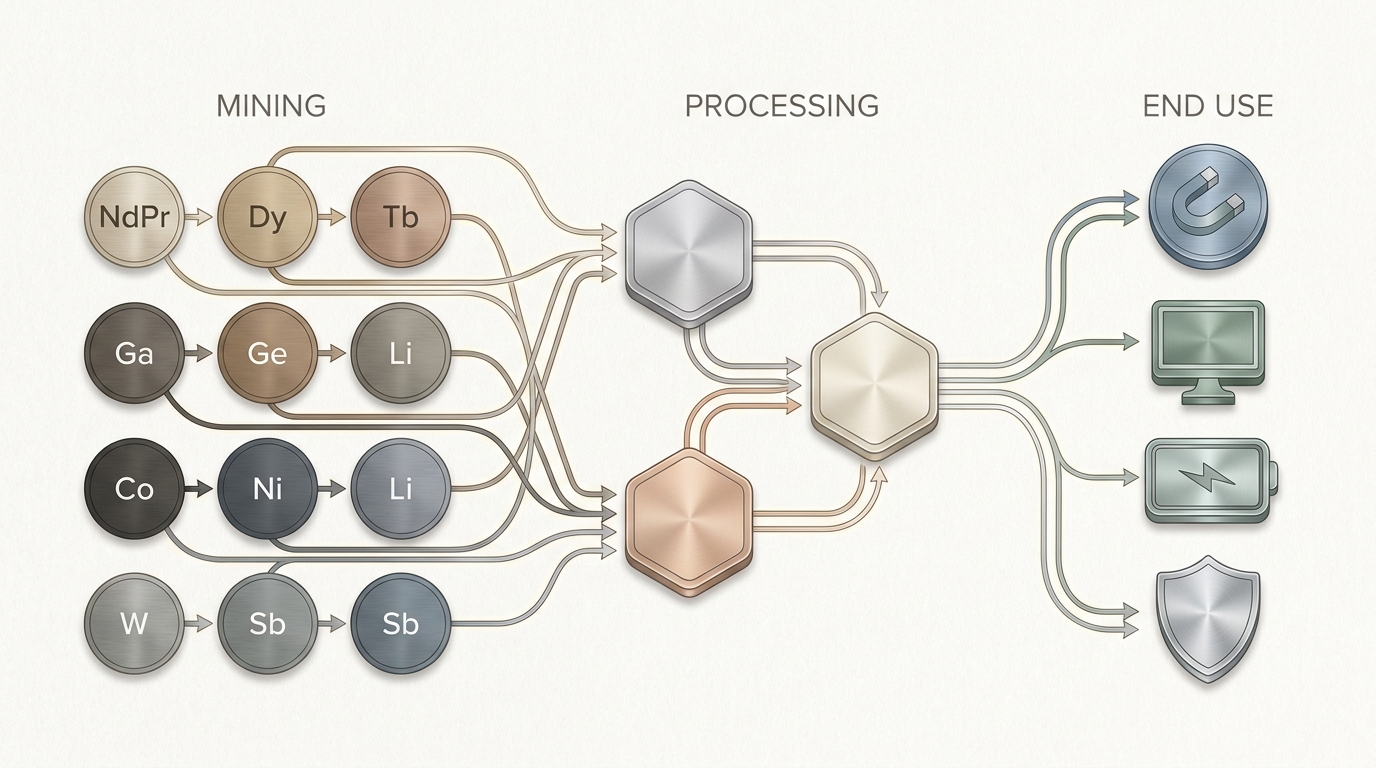
    Supply-chain bottlenecks across critical minerals.
    Supply-chain bottlenecks across critical minerals.

    3. Tb (Terbium)

    Terbium is one of the smallest markets on this list and one of the easiest to underestimate. Like dysprosium, Tb is valued for what a very small addition can do to magnet performance, especially where high coercivity is non-negotiable. It also appears in phosphors and specialized electronics, but the strategic case is really about high-spec magnets used in transport, industrial automation, and defense-adjacent systems. Supply is structurally tight because terbium occurs in low concentrations, is rarely the economic driver of a mine on its own, and depends on the same highly concentrated heavy rare earth processing chain that dominates dysprosium. In practice, that means more than 95% of refined heavy rare earth output still traces back to Chinese separation capacity. That concentration matters because even modest shifts in EV motor demand, turbine specifications, or export policy can produce outsized strain in a market this small. It is a classic chokepoint commodity: little tonnage, high leverage, and very limited room for error once an OEM has validated a magnet recipe. For retail readers building a broader view of critical metals, Tb is useful because it challenges the assumption that only large commodity markets matter. Sometimes the small additive is what stalls the system. The verdict is that terbium deserves attention precisely because it can move from obscurity to urgency very quickly, especially if magnet producers start optimizing for performance over material thrift. The companion terbium explainer goes deeper into those trade-offs.

    4. Ga (Gallium)

    Gallium is a textbook example of why a critical minerals list should not be built around tonnage alone. It is a low-volume material, but it sits inside high-value semiconductors such as gallium arsenide and gallium nitride that are used in RF chips, power electronics, LEDs, fast chargers, telecom equipment, radar, satellites, and military systems. The strategic role is obvious once the end uses are lined up: Ga helps modern electronics run faster, hotter, and more efficiently than silicon alone can manage in certain applications. The bottleneck is that gallium is usually recovered as a byproduct from bauxite and zinc processing, so supply does not respond cleanly to gallium demand. Even more important, China has accounted for roughly 95% to 98% of primary gallium production in recent years, giving it an extraordinary degree of leverage over a market that many downstream buyers only notice when trade restrictions arrive. That combination of byproduct dependence and geographic concentration is exactly the kind of hidden fragility procurement teams dislike. It means new supply cannot simply be willed into existence with higher prices if refining routes, feedstock access, and purification know-how are missing. The verdict: gallium is one of the most acute semiconductor-linked strategic metals, and the key indicators are export licensing, non-Chinese refining investments, and the pace of GaN adoption in power electronics. Readers wanting the fuller semiconductor angle can continue with this gallium deep dive.

    5. Ge (Germanium)

    Germanium rarely gets the public attention of lithium or rare earths, yet it remains one of the quietest pressure points in advanced manufacturing. Its end-use profile is unusually strategic: fiber-optic systems, infrared optics, thermal imaging, night-vision equipment, certain semiconductor applications, and some solar technologies all rely on germanium in ways that are hard to replace quickly. That makes Ge far more relevant to communications resilience and defense capability than its modest market size would suggest. Supply is constrained for a different reason than the magnet metals: germanium is typically recovered as a byproduct of zinc processing and, in some regions, from coal-related streams, so the metal’s availability is tied to other industrial decisions rather than a standalone germanium mine pipeline. China has often represented around 60% of global germanium output and an even more influential share of downstream processing, which creates the same uneasy pattern seen elsewhere in this list: specialized demand facing a concentrated midstream. In operational terms, the real risk is not just physical scarcity but specification risk. Optical and semiconductor customers do not want simply “more germanium”; they need consistent purity, reliable refining, and qualified product forms. That slows substitution and raises the cost of disruption. The verdict is that Ge belongs firmly in the upper tier of non-battery critical metals, especially for readers comparing defense-adjacent inputs with cleaner-energy names. A fuller technical overview appears in this germanium guide.

    How these minerals show up in key technologies.
    How these minerals show up in key technologies.

    6. Li (Lithium)

    Lithium is the most recognizable name on this list, but the familiar headline often hides the more useful insight: lithium is not one market, it is a chain of mine supply, brine operations, chemical conversion, and battery-grade qualification that can tighten in different places at different times. End-use demand is anchored by lithium-ion batteries for EVs, grid storage, consumer electronics, and power tools, so it is still the signature metal for electrification. Yet the bottleneck is increasingly chemical and logistical rather than purely geological. Australia, Chile, China, and Argentina account for more than 90% of global lithium mine supply, while China still handles roughly 60% of lithium chemical conversion capacity, especially in the battery-grade products the cathode industry needs. That split matters because large resources do not automatically produce reliable carbonate or hydroxide volumes at specification. Water constraints in brines, ramp-up trouble in hard-rock projects, permitting delays, and converter bottlenecks all show up before a battery maker feels truly secure. Compared with the rare earths, lithium has a broader project pipeline, but the scale of battery demand keeps it on every critical minerals list. The verdict is that lithium remains essential but increasingly nuanced: it is less of a pure scarcity story than a quality, processing, and execution story. For anyone sorting through the difference between resource abundance and usable supply, the next stop is this lithium explainer.

    7. Co (Cobalt)

    Cobalt’s reputation is complicated, and that is exactly why it stays on this list. It remains important in nickel-rich battery cathodes, superalloys for aerospace, catalysts, and a range of industrial applications, so the demand base is broader than the battery narrative alone. At the same time, cobalt is a supply-chain case study in concentration and governance risk. The Democratic Republic of the Congo typically provides about 70% of mined cobalt, while China controls roughly three-quarters of refining and chemical conversion, giving the market both a geographic choke point upstream and a processing choke point downstream. That structure is why cobalt can unsettle procurement teams even when battery chemistries are trying to use less of it. Lower-intensity chemistries, including LFP, have reduced cobalt demand growth in some segments, but they have not erased the metal’s role in high-performance cathodes or its continuing importance in turbine and superalloy applications. The operational lesson is that demand evolution does not automatically equal supply security. Cobalt also carries ESG baggage that can reshape contracts, audits, and sourcing strategies in a way few other battery metals do. The verdict is that cobalt is no longer the simple “must-have battery winner” story it once appeared to be, but it is still one of the most consequential strategic metals because the chain remains highly clustered and politically exposed. Readers wanting the fuller battery-versus-aerospace picture can continue to this cobalt deep dive.

    8. Ni (Nickel)

    Nickel is the metal on this list that most clearly forces a distinction between scale and suitability. Yes, nickel is a massive market thanks to stainless steel, but not all nickel units are equally useful for batteries. The battery story focuses on class 1 nickel and battery-grade intermediates that feed high-energy cathode chemistries, while the broader market still leans heavily on stainless demand. That split is the first reason nickel belongs in a modern critical minerals list: enormous end-use demand does not guarantee the right form of supply. The second reason is Indonesia, which has grown to roughly half of global mined nickel output and an even larger share of incremental supply growth, especially through processing routes tied to EV materials. That scale has redrawn the market. It has also introduced difficult questions around carbon intensity, permitting, waste management, and whether laterite-to-battery conversion can expand smoothly enough to meet demand without repeated operational setbacks. HPAL projects, matte conversion, and precursor qualification are not trivial steps. In procurement terms, nickel is less of a single chokepoint than gallium or terbium, but it is a major industrial dependency where processing route, specification, and ESG profile matter almost as much as headline tonnage. The verdict is that nickel is essential, but investors should treat it as a differentiated chain rather than a monolithic metal market. The finer-grained picture is laid out in this nickel explainer.

    Chokepoint visualization for global critical mineral supply risk.
    Chokepoint visualization for global critical mineral supply risk.

    9. W (Tungsten)

    Tungsten is an older industrial metal, but dismissing it as yesterday’s story would be a mistake. It remains indispensable in cemented carbides, cutting tools, drilling equipment, wear-resistant parts, aerospace components, and several defense applications where extreme hardness, density, and heat resistance are the point. That is what keeps W on any grown-up list of critical metals: the market is mature, but substitution is often poor once performance requirements get serious. China still accounts for roughly 80% or more of global tungsten mine supply and a substantial majority of downstream processing, including ammonium paratungstate and related intermediates. Outside China, supply options exist, but they tend to come with longer development timelines, smaller scale, and more exposed cost structures. This is the kind of market where a buyer may think diversification is available until they trace the chain past concentrate into chemical conversion and finished hard-metal products. Tungsten’s strategic context is therefore less about hype and more about industrial continuity. Machine shops, mining equipment, aerospace manufacturing, and defense procurement all feel the effect if tungsten units tighten or specifications narrow. The verdict is that W is a classic resilience metal: not flashy, absolutely relevant, and difficult to replace in high-performance applications. For readers comparing “energy transition metals” with defense-linked materials, tungsten is a useful reminder that the critical story is broader than batteries. More detail is available in this tungsten guide.

    10. Sb (Antimony)

    Antimony is probably the most under-followed material on this list, which is exactly why it deserves the final slot. It shows up in flame retardants, lead-acid battery alloys, primers and munitions, specialty glass, PET catalysts, and various chemical applications that do not always make headlines but remain deeply embedded in industrial systems. The supply chain is narrower than many expect. China has often accounted for about half of global mined antimony and a larger share of refined and chemical products such as antimony trioxide, while a meaningful portion of the remaining supply comes from a small group of jurisdictions rather than a broad, liquid global base. That creates the sort of opaque market structure where trade frictions, environmental controls, or mine disruptions can have an outsized effect. Antimony is also awkward because substitution depends heavily on the end use: in some flame-retardant systems there is room to adjust formulations, but in other applications the qualification cycle can be slow and costly. This is not a metal that benefits from abundant transparent pricing, broad producer diversity, or easy downstream flexibility. The verdict is that Sb belongs on a contemporary critical minerals list as a classic strategic holdover: smaller market, less media attention, but very real leverage in defense and industrial chemicals. Readers who want the full picture on this quietly important chokepoint can continue to the antimony deep dive.

    If there is one takeaway from this critical minerals list, it is that “critical” does not simply mean geologically rare. It means a material sits inside an important technology stack and is hard to replace, slow to scale, or dangerously concentrated in a few processing hubs. For broad retail readers, the most supply-constrained names here are usually the magnet rare earths and semiconductor inputs; the largest system-level exposures are lithium, nickel, and cobalt; and the materials that often surprise newcomers are tungsten and antimony. That is also the cleanest way to separate a rare earth elements list from the broader universe of strategic metals: rare earths are one powerful subset, while the wider critical-minerals picture spans batteries, chips, optics, hard metals, and defense supply chains.
  • Top 10 Structural Differences in Critical Minerals ETFs: REMX, LIT, COPX, BATT Compared

    Top 10 Structural Differences in Critical Minerals ETFs: REMX, LIT, COPX, BATT Compared

    For retail investors and RIAs using a critical minerals ETF as a thematic sleeve, the real decision is rarely about last quarter’s return chart. It is about structure: what the fund actually owns, where those companies operate, and whether the portfolio is tied to ore bodies, chemical conversion, or the wider battery-industrial stack. That sounds technical, but it is the difference between buying exposure to mine permitting in Chile, rare earth separation in China, or battery manufacturing demand in Korea and Japan.

    That is why REMX, LIT, COPX, and BATT should not be treated as interchangeable. One rare earth ETF can carry more processing risk than mining risk. One lithium ETF can end up looking partly like an industrial technology basket. A copper miners fund may be cleaner than the others, but it also comes with brutal single-commodity and jurisdiction concentration. And a battery materials ETF can be broad enough to dilute the minerals thesis investors thought they were getting.

    The ranking below focuses on ten structural differences that matter most in practice: methodology, country exposure, mine-versus-processor weighting, concentration, and holdings overlap. It avoids performance contests and tax advice. Instead, it answers the more useful question for allocation work: what kind of supply-chain risk each product is really underwriting.

    1. Critical Minerals ETF Is a Label, Not a Uniform Asset Class

    The first surprise in this category is how little standardization actually exists. “Critical minerals ETF” sounds like a coherent bucket, but in portfolio construction it can mean at least four very different things: upstream mining equities, processors and refiners, integrated battery-material supply chains, or broad industrial technology portfolios with some mineral sensitivity embedded inside. That is the starting point for understanding why REMX, LIT, COPX, and BATT can all fit the theme while behaving like different tools.

    From a supply-chain perspective, the distinction is not cosmetic. Upstream miners are tied to reserve quality, capex overruns, royalty changes, water access, community relations, and permitting timelines. Processors are more exposed to chemical conversion bottlenecks, environmental compliance, power pricing, and export policy. Downstream battery names lean on manufacturing utilization, battery chemistry trends, OEM procurement cycles, and industrial-policy support. When an ETF blends those layers, the investor is no longer taking a simple commodity view; they are underwriting several parts of the chain at once.

    That is also why the frequently asked question, “What is the best critical minerals ETF?” has no universal answer. The cleaner answer is that the “best” structure depends on what exposure is actually needed. A rare earth ETF like REMX is closer to a strategic-metals bottleneck trade. LIT is better described as a lithium-and-battery ecosystem vehicle. COPX is the most miner-centric of the group. BATT is often the broadest expression of battery materials and adjacent manufacturing. For advisors and self-directed investors alike, classification comes before conviction. Skip that step and the portfolio thesis drifts almost immediately.

    2. REMX Leans Closest to the Strategic Metals Bottleneck

    Among the four, REMX is the fund most likely to be mistaken for a simple mining product when it is actually broader and, in some ways, more sensitive to industrial chokepoints. The VanEck rare earth strategy tracks a rare earth and strategic metals universe rather than a narrow list of ore producers. In practice, that means the portfolio can include miners, refiners, processors, and companies with meaningful exposure to metals such as rare earth elements, lithium, cobalt, titanium, and other strategic inputs depending on index eligibility and periodic rebalances.

    That methodology matters because rare earth economics are not controlled only at the mine gate. Separation and refining are where a huge amount of practical power sits. A deposit can be geologically attractive and still fail to translate into secure supply if the processing route is costly, environmentally constrained, or politically exposed. So when investors ask whether the remx etf includes processors or only miners, the better answer is that processors are part of the point. It is designed to capture the rare earth and strategic metals value chain, not just pit-to-port extraction.

    The verdict is clear: REMX is one of the purer expressions of critical materials scarcity, but it is not a clean “mine leverage only” instrument. It carries concentration risk because the eligible universe is narrow, country risk because strategic metals supply chains remain unevenly distributed, and processing risk because downstream conversion often matters more than volume headlines suggest. For investors specifically seeking a rare earth ETF or vaneck rare earth exposure, that impurity is not a flaw. It is the core structural feature. The catch is that the same feature makes REMX especially sensitive to policy shocks, export controls, and processing concentration rather than just raw mining sentiment.

    3. LIT Is a Lithium ETF, but Only Partly a Miner Fund

    LIT is often the first ticker people reach for when they want lithium exposure, and that instinct is understandable. But structurally, LIT is not a pure upstream bet on brine assets, spodumene supply, or conversion shortages. Its methodology is built around the lithium and battery technology ecosystem, which broadens the portfolio beyond miners into chemical converters, battery material firms, and downstream companies that benefit from battery adoption. That broader footprint is exactly why investors sometimes feel they bought lithium and got something closer to a battery supply-chain blend.

    There is a practical reason for this design. Lithium rarely reaches end markets in the form investors picture when they hear “mining.” Conversion into lithium carbonate, hydroxide, or other battery-grade chemicals is where quality, pricing, and strategic control begin to diverge. A lithium ETF that excludes processors would miss a meaningful part of the bottleneck. LIT so tends to carry exposure to companies whose economics depend on chemical conversion margins, contract structures, and downstream battery demand as much as on raw extraction. In other words, it is closer to a lithium platform than a lithium pit.

    That makes LIT a useful vehicle, but not the simple one-line commodity proxy it is often marketed as in casual conversations. Its country mix can include China, Australia, the United States, Japan, and South Korea, reflecting the reality that lithium is mined in one set of places and turned into battery materials somewhere else. The fund’s structural advantage is that it captures more of the commercial chain. The trade-off is dilution: when battery technology or manufacturing names dominate sentiment, the lithium etf thesis can start behaving less like raw materials exposure and more like an industrial growth basket. That is not necessarily a problem. It just needs to be acknowledged upfront.

    4. COPX Is the Cleanest Commodity-Equity Link, and That Cuts Both Ways

    If the question is which of these funds most directly maps onto a single mined commodity through listed equities, COPX is the cleanest answer. Its methodology centers on copper miners and diversified mining companies with meaningful copper exposure. Unlike LIT or BATT, it does not need an ecosystem story to justify itself. Unlike REMX, it is less dependent on a strategically complex processing chain. Its identity is much simpler: a basket of companies whose earnings power is closely tied to copper mine economics.

    That simplicity is a strength, especially for advisors who want clearer factor attribution. The portfolio is generally driven by mine life, grade quality, reserve replacement, brownfield and greenfield project execution, labor relations, and local permitting. It also means the operational reality is harsher than many thematic summaries suggest. Copper supply growth is slow, project lead times are long, water stress is material in several producing regions, and fiscal regimes can change right when capital intensity rises. A copper miners ETF is never just a demand story; it is also a timeline story, and timelines in mining almost always slip.

    The verdict on COPX is straightforward. It is not a broad critical minerals ETF so much as a specialist sleeve inside the theme. That makes it powerful but less diversified. Country exposure tends to lean toward jurisdictions such as Chile, Peru, Canada, the United States, and Australia, with all the permitting, social license, and labor friction that implies. For investors seeking the purest mine-heavy structure of the four, COPX is the least ambiguous. The cost of that purity is concentration in one commodity and a handful of large producers. When copper works, the linkage is clearer than in the other funds. When the mining cycle turns or a major jurisdiction stumbles, the same clarity becomes unforgiving.

    5. BATT Is the Broadest Battery Materials ETF, and the Least Pure Minerals Bet

    BATT tends to attract investors who want the battery theme without committing to a single metal. On paper, that sounds like prudent diversification. In structure, though, BATT often sits furthest from a classic materials-only portfolio. Depending on the index methodology and rebalance mix, it can hold raw material suppliers, processors, cathode and anode participants, battery manufacturers, and adjacent technology or industrial names. That gives it breadth, but breadth is not the same thing as minerals purity.

    This is where many portfolio assumptions quietly break. A battery materials ETF can include enough downstream manufacturing and technology exposure that mineral pricing stops being the dominant driver. Utilization rates, EV production schedules, policy incentives, cell chemistry transitions, and industrial competition start to matter just as much. From a procurement-style lens, BATT is closer to a supply-chain architecture fund than to a mining basket. That makes it useful in periods when the whole battery complex is expanding, but it can also mute the upside that investors expected from direct commodity leverage.

    The strategic verdict is that BATT works best for those who want a diversified way to express the battery buildout rather than a concentrated view on a particular mineral shortage. Country exposure often leans heavily toward Asia because processing, component manufacturing, and cell production remain concentrated there. That introduces a different risk profile than COPX or even REMX: less reserve and permitting drama, more manufacturing concentration and industrial-policy sensitivity. As a battery materials etf, BATT is credible, but it is broad enough that the thesis can drift away from raw materials faster than many retail investors realize. In category terms, it may be the most forgiving operationally and the least precise thematically.

    6. The Real Divide Is Mine Weighting Versus Processor Weighting

    A more useful way to compare these ETFs is not by marketing label but by where they sit on the mine-to-processor spectrum. COPX is predominantly mine-weighted. REMX is mixed, but often more processor-sensitive than first impressions suggest. LIT sits in the middle, carrying both upstream resource and midstream conversion exposure while also pulling in battery-linked industrial names. BATT typically pushes furthest downstream, often making processors and manufacturers more important than extraction economics alone.

    That distinction is operationally decisive. Mine-heavy portfolios live and die by geology, stripping ratios, reserve replacement, freight, royalties, water permits, and community negotiations. Processor-heavy portfolios care more about feedstock security, reagent costs, environmental compliance, energy pricing, qualification standards, and conversion yields. When a government introduces export restrictions or local-content rules, processor-heavy funds can react very differently from mine-heavy funds even if both are technically exposed to the same material. Rare earths are the clearest example: controlling separation capacity can matter more than controlling ore tonnage.

    For allocation work, this is one of the few structural filters that immediately improves decision quality. Investors who believe the bottleneck is new mine supply usually end up closer to COPX, or to the miner components within REMX and LIT. Those who believe the real choke point sits in conversion, qualification, and downstream industrial policy are often talking about REMX, parts of LIT, or the broader battery-processing exposure embedded in BATT. The category looks crowded, but the underlying exposures are not redundant. The mine-versus-processor split explains far more than the product names do.

    7. Country Exposure Drives More Risk Than Most Fact Sheets Admit

    In practice, country concentration is where the supply-chain story becomes real. Two ETFs can both claim diversification because they hold dozens of stocks, yet still be structurally concentrated if those holdings cluster in the same operating geographies or depend on the same policy regimes. REMX and BATT frequently lean into Asian processing and manufacturing exposure. LIT often spans mining jurisdictions and processing hubs at the same time. COPX looks globally diversified on paper but can remain heavily dependent on a short list of copper-producing regions and the political realities attached to them.

    That matters because the risks are not interchangeable. China exposure may bring concerns around export controls, industrial policy, and state-linked competitive dynamics, but it can also reflect real dominance in processing and component manufacturing. Latin American exposure in a copper portfolio introduces royalty debates, water access, labor bargaining, and infrastructure constraints. Australian and North American exposure usually signals stronger rule of law, but it often comes with higher costs, slower permitting, and less tolerance for environmental shortcuts. There is no “safe” country mix here; there are only different trade-offs between cost, speed, and predictability.

    The practical conclusion is that country concentration should be read as a strategic feature, not a side note. A critical minerals ETF is often a disguised geopolitical allocation as much as an industrial one. That is especially true in REMX, where processing geography can dominate the investment case, and in LIT or BATT, where Asian battery supply chains remain central. Investors comparing these funds on ticker familiarity alone miss the more important question: which jurisdictions, and which policy environments, are being outsourced into the portfolio. In this theme, geography is not background noise. It is the thesis.

    8. Holdings Overlap Exists, but the Revenue Drivers Still Diverge

    One reason these funds are often grouped together is that some top holdings can overlap across themes. Large diversified miners, well-known lithium producers, or dominant battery-chain companies may appear in more than one portfolio. That overlap can create the illusion that REMX, LIT, and BATT are variations of the same trade. They are not. A shared holding does not mean shared exposure if that company represents different parts of the supply chain, carries different weight in each fund, or derives revenue from more than one commodity and geography.

    Consider the mechanics. A company with lithium operations may appear in LIT because it is central to battery materials, while a strategic metals or diversified materials name might enter REMX through broader eligibility screens tied to rare earths and adjacent strategic commodities. In BATT, the same issuer could serve as one node inside a larger manufacturing ecosystem. Weighting also matters. A stock that is a top-five holding in one ETF can be a minor supporting position in another. The risk contribution, therefore, is not comparable just because the name appears on both factsheets.

    This is a useful corrective for investors looking for hidden concentration. Top holdings overlap can raise correlation, especially during periods when the market treats all battery or resource names as one macro trade. But overlap is only half the story. The more revealing question is what share of each fund’s thesis rests on that company. In COPX, overlap is usually less about battery ecosystems and more about copper-heavy miners. In LIT and BATT, it may reflect broad battery-chain exposure rather than direct commodity leverage. So yes, there is overlap. No, it does not erase the structural differences.

    9. Concentration Risk Is Not Just About Position Size

    Investors often define concentration too narrowly, reducing it to the weight of the top ten holdings. That is part of the story, but not enough in thematic materials funds. True concentration shows up in three layers at once: issuer concentration, commodity concentration, and supply-chain-node concentration. COPX may be diversified by number of stocks and still be highly concentrated in copper economics. REMX may hold multiple names that ultimately depend on a narrow set of strategic-metals bottlenecks. BATT can look broad while remaining concentrated in one industrial theme and a handful of Asian manufacturing centers.

    This is why concentration can feel hidden in ETFs that appear more diversified than individual stocks. If several holdings respond to the same policy shock, the same refining bottleneck, or the same battery-demand cycle, the practical diversification is lower than the name count suggests. We have seen versions of this problem repeatedly across resource and industrial baskets: different tickers, same operational choke point. In critical minerals, processing concentration is the classic example. In copper, it is the slow cadence of mine development and dependence on a few major producers. In battery funds, it is the concentration of manufacturing capacity and demand sensitivity in a limited set of markets.

    The verdict is that concentration should be analyzed through the lens of failure modes, not just weights. What breaks the thesis? A permitting delay, a refinery bottleneck, a policy intervention, a chemistry shift, a labor dispute, a demand air pocket? Once framed that way, the structural differences between these ETFs become sharper. REMX concentrates strategic chokepoints. COPX concentrates mining execution and copper dependency. LIT spreads risk across the lithium chain but introduces ecosystem dilution. BATT diversifies the battery story while potentially reducing the purity that many investors thought they were buying.

    10. Which Structure Fits Which Mandate Depends on the Bottleneck Being Underwritten

    By this point, the hierarchy is less about which ticker sounds more “critical minerals” and more about what kind of bottleneck an investor wants exposure to. REMX is the strongest fit for those who want a rare earth ETF or broader vaneck rare earth style exposure centered on strategic materials scarcity, especially where processing and geopolitical concentration matter. LIT is the more balanced lithium etf for investors who accept that lithium today is inseparable from chemical conversion and battery demand. COPX is the cleanest expression of copper mining leverage. BATT is the broad battery materials ETF for investors who want the whole industrial chain, even if that means less direct minerals sensitivity.

    That also answers the commercial-intent FAQ in a more honest way. What is the best critical minerals ETF? There is no single winner because these funds are solving different exposure problems. How are critical minerals ETFs constructed? Usually as equity baskets built around extraction, processing, refining, and downstream industrial participation rather than direct ownership of physical minerals. Does REMX include processors or only miners? It includes both, and that is central to how the fund behaves. Those are not side questions. They are the core due-diligence questions for anyone comparing the category seriously.

    The final judgment is blunt. Investors who want cleaner commodity-equity linkage will usually find COPX easiest to explain and REMX most strategically distinctive. Investors who want a middle ground between raw material exposure and industrial adoption typically land in LIT. Those who want the broadest battery-chain participation, and can tolerate a less pure minerals thesis, will understand why BATT remains in the conversation. In other words, structure is the product. Once that is clear, the comparison stops being a branding exercise and becomes what it should have been from the start: a decision about which part of the critical minerals supply chain deserves capital, and which failure modes are acceptable along the way.

  • Physical Strategic Metals: Storage, Purity, Liquidity and Resale Checklist

    Physical Strategic Metals: Storage, Purity, Liquidity and Resale Checklist

    Why this guide? Physical strategic metals can play a role in portfolio diversification, treasury protection, or supply assurance, but the business risk sits in the details of custody, documentation, and exit planning. This guide is written for investors, family offices, procurement teams, and physical commodity buyers who need to evaluate physical strategic metals storage at an oversight level. Estimated review time: about 8 minutes.

    Executive Overview

    • Price is only part of the decision. In physical metals, value is shaped by purity, provenance, storage quality, insurance, and how easily a buyer will accept the metal later.
    • Buy from recognized sources. For bullion, favor LBMA-accredited or equivalent refiners and well-established dealers with transparent pricing, published buyback terms, and a credible operating history.
    • Choose units that support liquidity. For gold and silver, 1 oz to 100g bars often provide a practical balance between value density and resale flexibility. Larger bars can suit larger mandates but may narrow the buyer pool.
    • Documentation is part of the asset. Hallmarks, serial numbers, invoices, assay certificates, and chain-of-custody records directly affect resale confidence and compliance readiness.
    • Segregated, insured, audited storage is usually the institutional default. It improves title clarity and reduces counterparty uncertainty compared with unallocated or informal arrangements.
    • Not all strategic metals are equally liquid. Gold and silver generally have broad resale markets, while platinum, palladium, nickel, cobalt, lithium-related materials, and specialty alloys may require specialized channels and tighter specifications.

    What This Means for You: If your organization cannot quickly answer what it owns, where it is stored, how purity was verified, who insures it, and how fast it can be sold or transferred, the program is not yet institutional-grade.

    1. Business Objective

    Success in a physical metals program is not simply “owning metal.” Success means holding material that is verifiable, properly titled, securely stored, and realistically resellable under normal market conditions. The right objective depends on whether the buyer is acting as an investor, a family office, or a procurement function securing future supply.

    • For investors and family offices: the goal is capital preservation discipline, clean provenance, and orderly access to liquidity.
    • For procurement teams: the goal is dependable specification, inventory integrity, and reduced supply-chain disruption.
    • For all buyers: the goal is to avoid hidden carrying costs, custody disputes, or resale discounts caused by incomplete documentation or unsuitable storage.

    A strong business objective can be stated simply: hold physical metal in a form and jurisdiction that preserves authenticity, protects ownership rights, and supports an efficient exit when needed.

    What This Means for You: Treat physical metal as an operating asset with governance requirements, not just as a purchase. Oversight should cover title, control, auditability, and exit readiness from day one.

    2. Investment Overview

    The total cost of ownership for physical metal includes more than the purchase price. Leaders should approve a full lifecycle budget that covers acquisition, verification, storage, insurance, transport, legal review, and periodic audit or resale testing.

    • Time commitment: a new program typically takes several weeks to structure, approve counterparties, open custody arrangements, and finalize documentation standards.
    • Capital outlay: budget for spot price plus dealer premium, logistics, assay or verification costs where needed, storage fees, and insurance.
    • Internal resources: treasury or investment leadership, procurement, legal, compliance, tax, and finance should all have a defined role.
    • Policy decisions: decide early on acceptable metal types, approved refiners, target jurisdictions, storage model, insurance rules, and exit channels.

    For bullion, well-known refiners and mints such as those operating to internationally recognized standards can simplify future resale. For industrial or battery-linked strategic metals, the cost structure may also include sampling, laboratory testing, packaging controls, and specialist logistics.

    What This Means for You: The most expensive mistake is often not overpaying on day one; it is discovering during a sale, audit, or dispute that the asset was never configured for smooth ownership and transfer.

    Segregated depository vault setup and custody controls (illustrative).
    Segregated depository vault setup and custody controls (illustrative).

    3. Implementation Roadmap

    The practical sequence is straightforward: define what you will buy, verify what arrives, place it in the right custody model, protect it with insurance and controls, and confirm that liquidity works before you need it.

    Phase 1: Source Only What You Can Defend Later

    • Approve dealer and refiner criteria. For bullion, favor LBMA-accredited or equivalent refiners where relevant. Review dealer reputation, operating history, complaint patterns, and buyback terms.
    • Demand transparent pricing. The quote should clearly separate spot price, premium, shipping, storage setup, and any handling fee.
    • Select practical unit sizes. For gold and silver, 1 oz to 100g bars often support both value density and resale ease. Larger bars can work for family offices or institutional mandates, but exit flexibility may be narrower.
    • Match form to purpose. Coins and smaller bars may improve flexibility; kilobars and larger bars can suit larger allocations; industrial lots must match end-use or market-accepted specifications.

    Leadership decision: Approve a purchase universe before buying. That usually includes approved metals, refiners, sizes, and jurisdictions. It prevents ad hoc buying that later creates storage or resale friction.

    Phase 2: Verify Purity, Provenance, and Packaging

    • Confirm fineness standards. Bullion buyers commonly expect gold and silver at bullion-grade purity levels, ideally very high fineness; platinum and palladium are typically held to similarly strict standards. For nickel, cobalt, or specialty alloys, the relevant question is whether the material meets the resale or manufacturing specification.
    • Require hallmarks and serial numbers. The product should show a clear refiner mark, weight, stated purity, and a unique serial number where applicable.
    • Inspect packaging integrity. Original tamper-evident packaging can strengthen resale confidence, especially for retail-format bullion.
    • Use independent testing when appropriate. XRF analysis, assay, or accredited lab testing may be appropriate for non-standard material, secondary market inventory, or industrial grades.
    • Retain a full evidence file. Keep invoices, assay certificates, product photos, packing slips, bar lists, and transport records. A retention period of at least seven years is a practical minimum in many organizations.

    Leadership decision: Set a rule that no asset enters the long-term inventory without a complete provenance file. In physical markets, documentation is not paperwork overhead; it is part of the resale value.

    What This Means for You: A metal position with weak records may still be genuine, but it can become slower and more expensive to finance, transfer, or liquidate.

    Phase 3: Design the Right Storage and Custody Model

    Physical strategic metals storage should be selected based on asset value, access needs, jurisdictional considerations, and the importance of direct title. For most executive programs, the real choice is not “where can we put it,” but “what storage model best preserves ownership certainty and saleability.”

    • On-site or home storage: suitable only for modest holdings or emergency-access requirements. It raises concentration, security, and insurance concerns.
    • Bank safe deposit boxes: can provide familiar custody, but access windows, insurance arrangements, and audit practicality may be limited.
    • Professional segregated vaulting: usually the strongest institutional choice for high-value holdings because specific bars or lots are identified as yours.
    • Unallocated or commingled storage: may lower fees and simplify trading, but it introduces more counterparty dependence because title is less direct.
    • Confirm ownership structure. Ask whether the arrangement is allocated, segregated, or unallocated, and verify how title is documented.
    • Check audit rights. Independent third-party audits, reconciled bar lists, and exception reporting should be standard.
    • Review withdrawal terms. Understand notice periods, minimum withdrawal sizes, transport procedures, and associated fees.
    • Assess environmental controls. Silver and industrial materials may be more sensitive to moisture, packaging damage, or contamination than investors initially expect.
    • Choose politically and legally stable jurisdictions. Jurisdiction selection affects enforceability, transport, taxation, and recovery options in disputes.

    Leadership decision: For material holdings, segregated and insured vaulting in a stable jurisdiction is often worth the additional cost because it improves auditability, counterparty protection, and resale confidence.

    End-to-end strategic metals due diligence checklist flow.
    End-to-end strategic metals due diligence checklist flow.

    Illustrative 90-Day Timeline

    1. Days 1-15: define mandate, metal types, approved sizes, budget, and governance owners.
    2. Days 16-30: shortlist dealers, refiners, vaults, insurers, and any assay partners; review legal and tax implications.
    3. Days 31-60: complete onboarding, open custody accounts, document verification standards, and finalize reporting templates.
    4. Days 61-75: execute first purchase, verify delivery records, and reconcile bar lists or lot details.
    5. Days 76-90: test reporting, audit reconciliation, and if feasible, a small withdrawal or buyback process.

    What This Means for You: A short implementation timeline is possible, but only if governance, documentation standards, and partner selection are established before the first purchase order is issued.

    Phase 4: Protect the Asset with Insurance and Counterparty Controls

    • Verify all-risk coverage. Confirm what is covered during storage, transit, and handling, and review exclusions carefully.
    • Assess provider strength. The vault operator, insurer, and logistics provider should all be financially credible and operationally mature.
    • Diversify where appropriate. A single provider or single jurisdiction may be efficient, but it also concentrates operational and political risk.
    • Reconcile statements regularly. Monthly or quarterly inventory reconciliation should be part of the operating cadence.
    • Screen for compliance issues. Cross-border movement may trigger sanctions checks, customs rules, tax treatment, or origin-related compliance review.

    Leadership decision: Insurance should be reviewed as a board-level or investment-committee control for material holdings, not as a routine back-office detail.

    Phase 5: Build the Resale Path Before You Need It

    Liquidity is often misunderstood. A metal may be valuable, but that does not mean it can be sold quickly, locally, or at a tight spread. The likely exit path should shape the original purchase decision.

    • Map likely buyers in advance. Gold and silver generally have broad markets; platinum and palladium can be narrower; industrial strategic metals may require specialized counterparties or end-users.
    • Review buyback terms before purchase. A good partner can explain spread methodology, settlement timing, and any conditions tied to packaging or storage chain-of-custody.
    • Preserve resale-friendly condition. Intact packaging, serial verification, and continuous custody can reduce questions at sale.
    • Test the process. A small partial sale or transfer can reveal practical delays before a larger exit is necessary.
    • Understand local constraints. Tax, VAT or GST treatment, import rules, and dealer documentation requirements vary by jurisdiction.

    Leadership decision: If liquidity is a priority, avoid buying forms that only a small number of counterparties will accept. The narrower the market, the more important documentation and specification become.

    What This Means for You: In strategic metals due diligence, the best time to plan the sale is before the purchase. Exit friction is much easier to prevent than to fix.

    4. Risk Mitigation

    • Opaque dealer pricing: mitigate by requiring line-item quotes showing spot, premium, and every fee.
    • Counterfeit or misdescribed material: mitigate by buying from recognized sources, checking hallmarks and serials, and using independent assay where warranted.
    • Wrong bar or lot size: mitigate by aligning unit size with intended resale channel and position size.
    • Weak title or custody language: mitigate by documenting whether holdings are segregated, allocated, or unallocated and by confirming beneficial ownership.
    • Inadequate insurance: mitigate through documented all-risk coverage, periodic policy review, and alignment with current inventory value.
    • Single-point failure: mitigate through provider, location, or jurisdiction diversification when exposure becomes material.
    • Documentation gaps: mitigate with a mandatory file standard and a retention policy of seven years or longer where appropriate.
    • Resale surprises: mitigate through pre-arranged buyback discussions and at least one test transfer or liquidation.

    What This Means for You: Most losses in physical metal programs come from operational weaknesses, not from the metal itself. Governance is the real hedge.

    Purity and authenticity verification workflow (illustrative).
    Purity and authenticity verification workflow (illustrative).

    5. Success Indicators

    Executives should track a short set of measurable indicators that show whether the program remains controlled, liquid, and policy-compliant.

    • Provenance completeness: percentage of holdings with invoices, certificates, serial records, and storage confirmation.
    • Policy compliance: percentage of holdings sourced from approved refiners, dealers, and jurisdictions.
    • Storage quality: percentage stored in segregated or otherwise policy-approved custody.
    • Insurance adequacy: insured value compared with current replacement value and transport exposure.
    • Audit performance: number of exceptions found in independent reconciliations.
    • Liquidity performance: time required to transfer or liquidate a test lot under normal conditions.
    • Total carrying cost: annualized cost of storage, insurance, verification, and administration as a share of asset value.
    • Concentration risk: share of holdings exposed to one provider or one jurisdiction.

    What This Means for You: If management reporting only shows the metal price and not the custody, audit, insurance, and liquidity metrics above, leaders are not seeing the full risk picture.

    6. Partner Selection

    The right implementation support can reduce both operational risk and decision fatigue. The goal is not to outsource accountability, but to choose partners whose processes make oversight easier.

    • Dealers and refiners: look for recognized accreditation where relevant, transparent pricing, published buyback practices, and a clear escalation path for disputes.
    • Vault and custody providers: prioritize clear title structures, independent audits, robust physical security, detailed reporting, and credible insurance arrangements.
    • Assay and testing partners: use accredited laboratories or accepted testing providers when non-standard or industrial materials require verification.
    • Logistics partners: require secure transport, documented chain-of-custody, and experience with cross-border compliance.
    • Advisory support: legal, tax, and compliance partners should be comfortable with global metal ownership, storage jurisdiction issues, and resale documentation.

    Red flags to avoid: pressure selling, unclear ownership language, vague insurance answers, resistance to third-party audit, no transparent buyback method, and poor documentation discipline.

    What This Means for You: Good partners reduce friction at every stage, but the strongest signal of quality is not marketing language. It is the consistency of their records, contracts, controls, and willingness to support verification.

    Final Takeaway

    A disciplined approach to physical strategic metals storage turns a simple purchase into a resilient ownership program. For executive teams, the checklist is clear: buy recognized material, verify purity and provenance, store it under a custody model that preserves title, insure it properly, measure liquidity before it is needed, and select partners that make auditability easy. That is the foundation of effective metal storage and sound strategic metals due diligence in a global market.