Category: Critical Metals Guides

English guides explaining strategic and critical metals for an international audience.

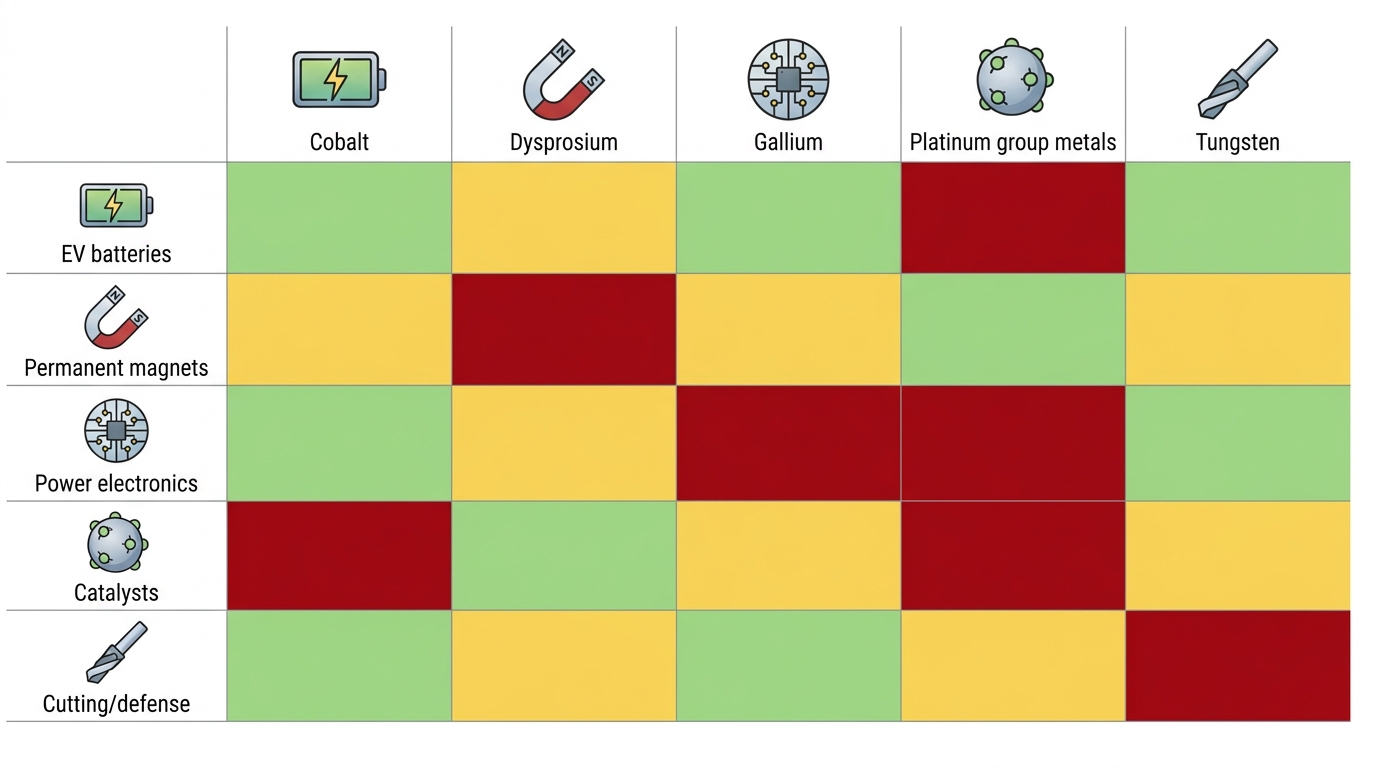
  • Mine-to-Magnet Risk Mapping: Where Western Rare Earth Supply Chains Hold and Fail

    Mine-to-Magnet Risk Mapping: Where Western Rare Earth Supply Chains Hold and Fail

    In operational reviews of rare earth suppliers, a recurring discovery moment appears early: many projects described as “rare earth production” stop at ore, concentrate, or mixed chemical product. The difficult part of the chain starts after mining. In mine to magnet terms, resilience depends on five linked stages-ore extraction, solvent extraction separation, metal reduction, alloying, and magnet manufacturing-and the main Western gaps sit in the middle and downstream steps rather than in geology alone. That distinction explains why Mountain Pass in California and Mount Weld in Western Australia matter, yet still do not by themselves create a complete non-Chinese rare earth supply chain.

    • The ore extraction stage secures feedstock, but mineralogy, impurity profile, and radionuclide handling determine whether downstream rare earth processing is practical.
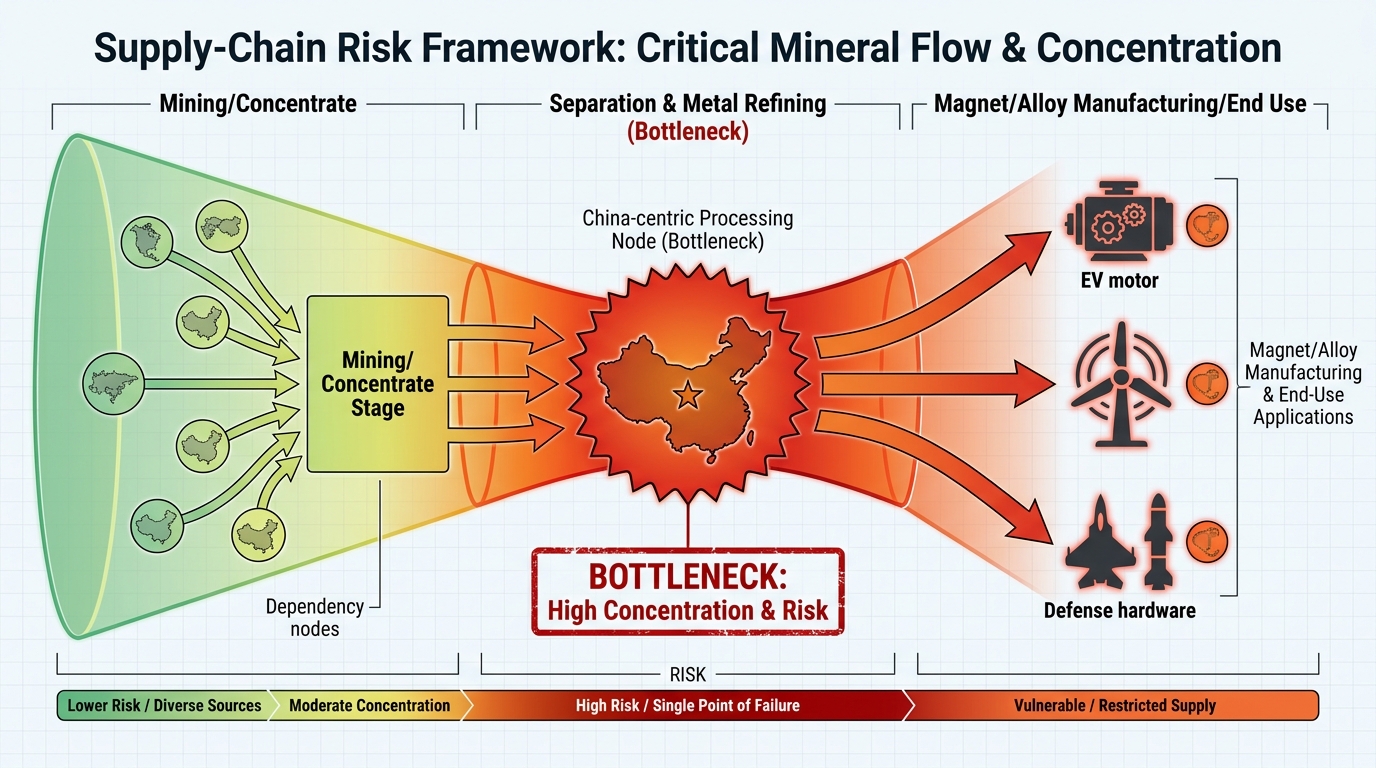
    • Solvent extraction separation remains the central bottleneck because chemically similar rare earths require long, tightly controlled processing cascades and demanding waste-management systems.
    • The metal reduction stage, NdFeB alloy strip casting, and sintered magnet production introduce yield, contamination, and qualification risks that many front-end mining narratives understate.
    • China dominates each stage not only through capacity, but through integration, operating experience, equipment ecosystems, and qualification history with end users.
    • Observed non-Chinese resilience patterns include partial vertical integration, alternate processing routes, staged qualification of intermediates, and selective redesign to reduce heavy rare earth dependence.

    What mine to magnet actually covers

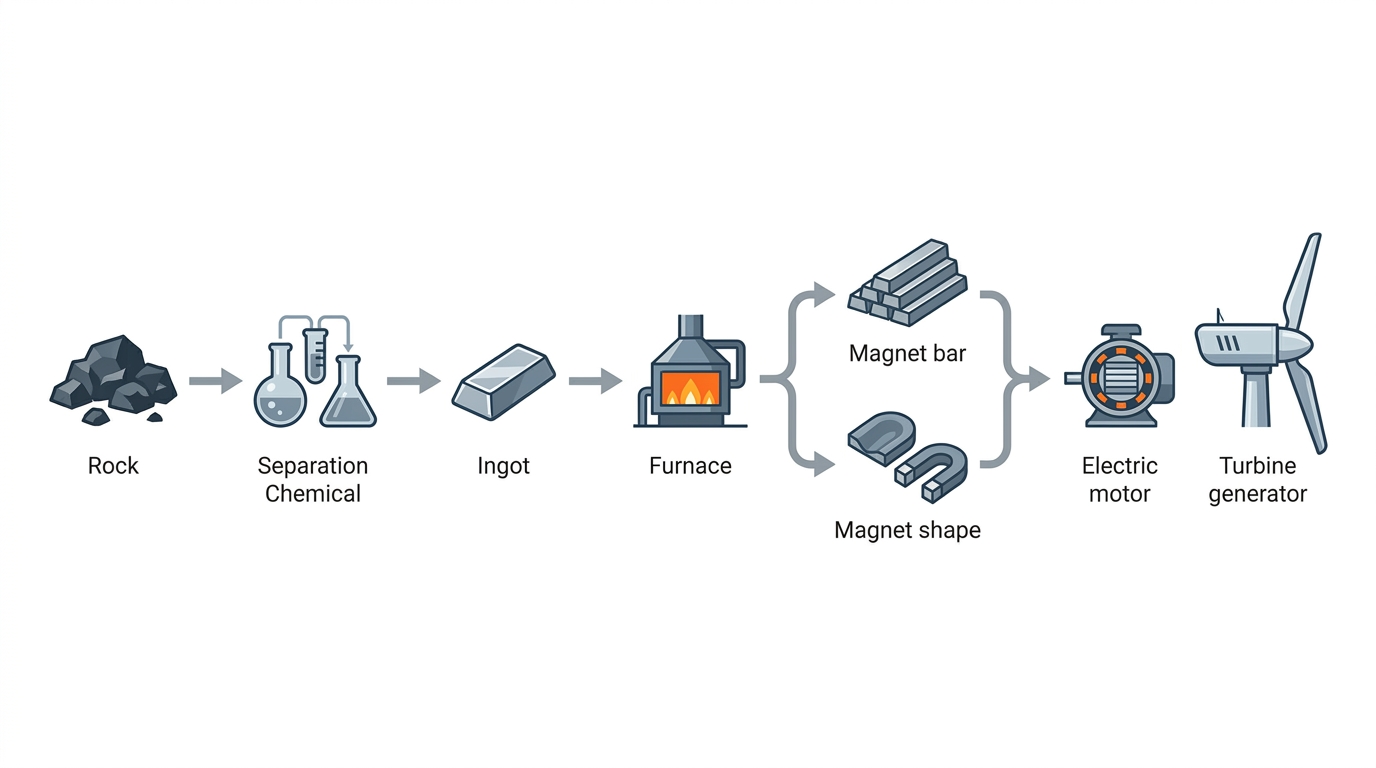
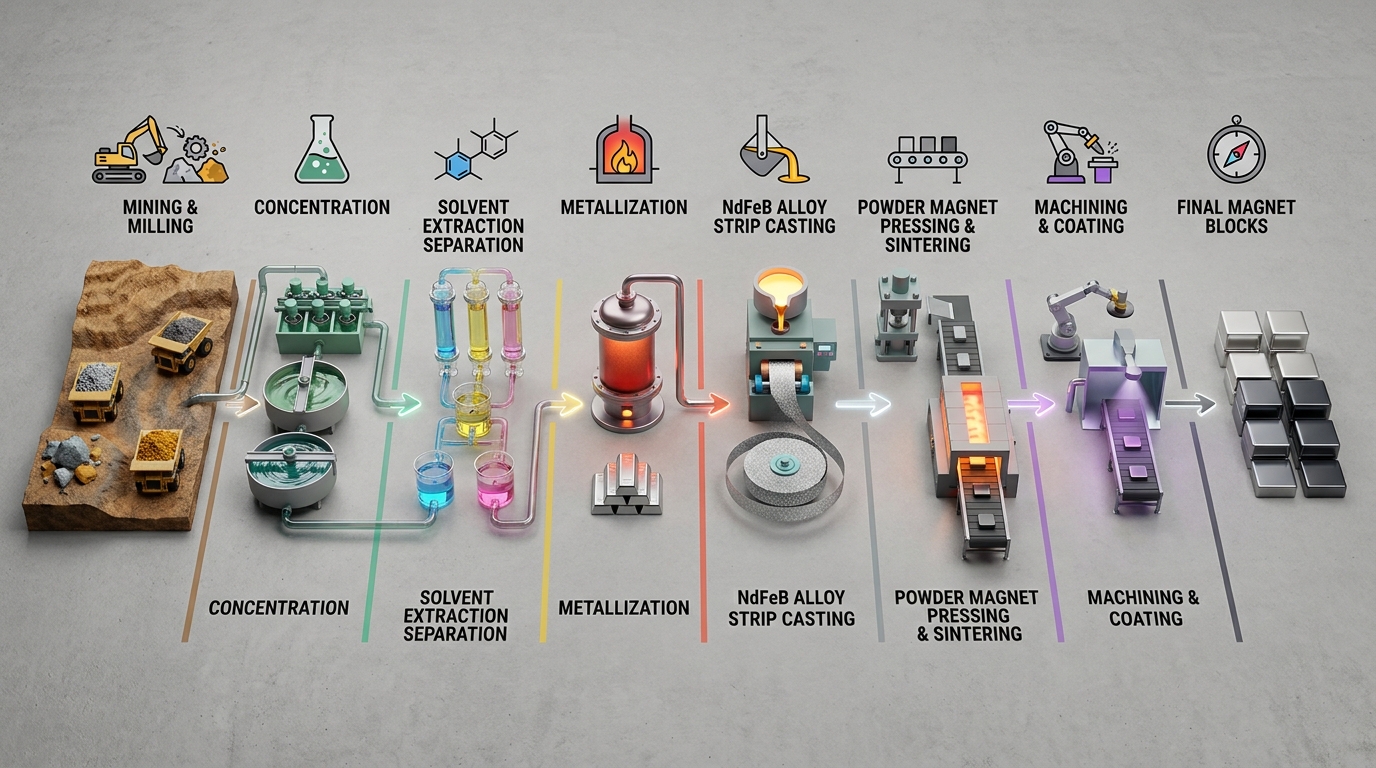
    Mine to magnet is shorthand for a full rare earth value chain that turns mined material into finished permanent magnets, usually NdFeB products for motors, actuators, sensors, and high-performance industrial systems. In analytical terms, the chain is only complete when material moves through five distinct industrial transformations. Ore is extracted and beneficiated; mixed rare earths are separated into individual oxides or refined streams; oxides are reduced into metal; metal is alloyed into magnet feedstock; and that feedstock is turned into finished magnets through powder processing, pressing, sintering, machining, coating, and magnetization.

    A second discovery moment often follows from that definition: a country can host an active rare earth mine and still remain dependent on foreign processing at several points. That is the central structural issue in western rare earth discussions. Front-end capacity exists in several jurisdictions, but broad commercial depth across all five stages remains limited outside China.

    Stage 1: Ore extraction and concentrate production

    The ore extraction stage is the most visible part of the rare earth supply chain, but it is not the hardest to localize. Mountain Pass, California, remains the best-known active U.S. rare earth mine and a key Western source of ore and concentrate. Mount Weld, Western Australia, remains one of the highest-profile non-Chinese rare earth feedstock sources and is linked to Lynas’s downstream processing chain. Smaller or emerging projects exist in Canada, Sweden, Greenland, Brazil, and parts of Africa, although most are not yet integrated into a full mine-to-magnet route.

    Analytically, the useful question at this stage is not simply whether ore exists, but whether the ore can move cleanly into downstream chemistry. TREO, or total rare earth oxides, is only one part of that picture. Mineralogy determines liberation behavior, concentrate quality, and how readily the mixed rare earth stream can be processed later. Bastnaesite, monazite, xenotime, and ionic clay systems create different operational profiles. Waste streams also matter: thorium, uranium, and other regulated impurities can move a project from straightforward mining into complex compliance management under U.S., Australian, or European permitting regimes.

    Observed failure modes at the mining stage include unstable concentrate specification, overreliance on headline TREO without downstream recoverability evidence, and underestimation of residue handling where radioactive impurities are present. In practice, two projects with similar grade language can create very different downstream outcomes once impurity suite and mineralogy are examined closely.

    Stage 2: Solvent extraction separation

    Solvent extraction separation is often the least understood step in rare earth processing and the most important bottleneck in the chain. Rare earths are not exceptionally rare in geological terms; the difficulty lies in separating chemically similar elements through repeated extraction, scrubbing, and stripping stages. This is a plant-scale chemical operation with tight process control, sensitive reagent balance, and a heavy documentation burden around waste, emissions, and water treatment.

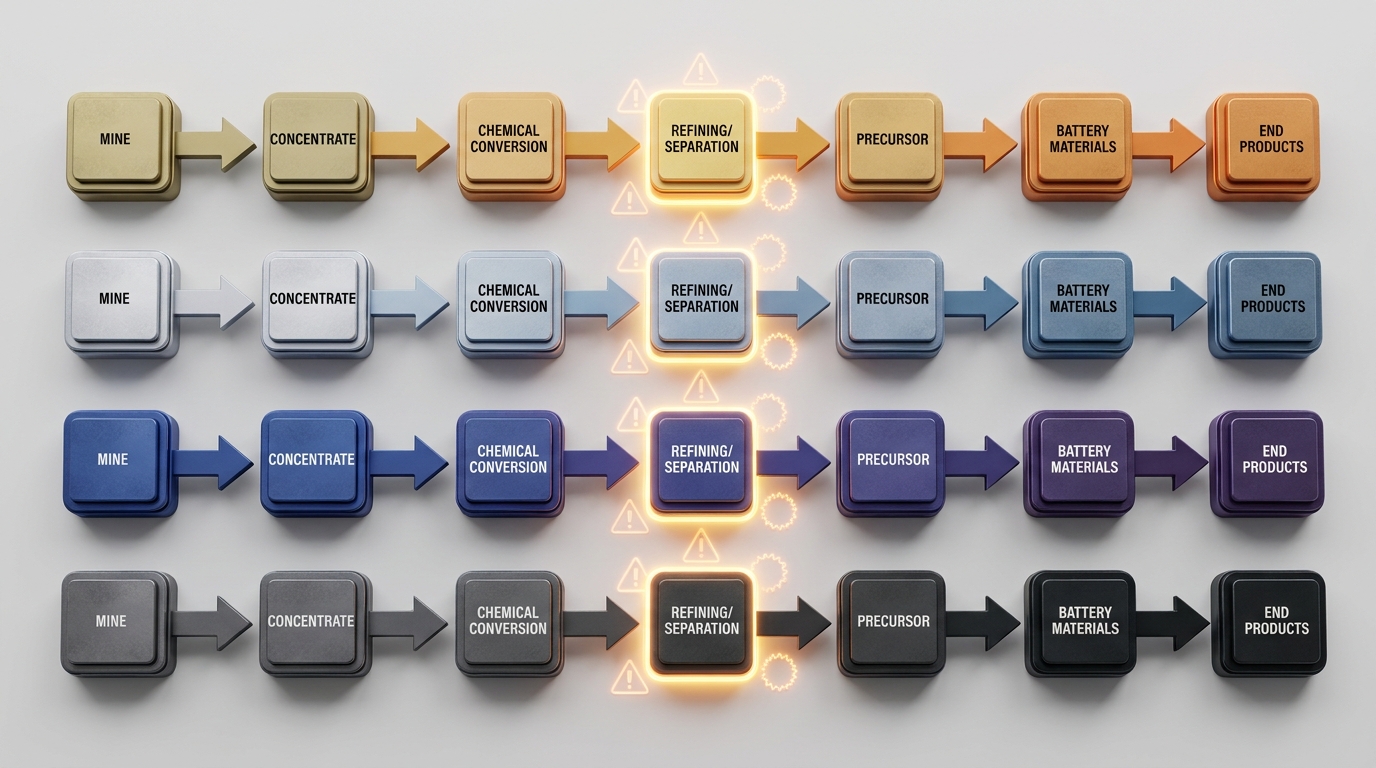
    Stage-by-stage mine-to-magnet pipeline overview
    Stage-by-stage mine-to-magnet pipeline overview

    China dominates this stage because it spent decades building integrated separation systems, operator know-how, reagent supply, and waste-treatment infrastructure. The Western position is narrower. Australia-linked production associated with Mount Weld and Lynas is one of the most visible non-Chinese channels. The United States has mining capability and has treated separation as a strategic build-out area, but the overall commercial base remains much smaller than China’s. In practical terms, a mine without reliable separation access remains exposed, even if ore production itself is strong.

    Common failure modes here include feed variability that destabilizes the extraction circuit, impurity carryover that affects downstream oxide specification, and delays linked to environmental controls rather than core chemistry alone. Commissioning risk is also unusually high: nameplate concepts often look linear on paper, while real plant tuning depends on many campaigns of operating data.

    Stage 3: Metal reduction and metallization

    The metal reduction stage is where separated oxides become usable rare earth metal. This step receives less public attention than mining or magnets, yet it is one of the sharpest industrial cliffs in the mine to magnet pathway. Rare earth metals are reactive, oxygen-sensitive, and demanding to handle. Purity is not a cosmetic issue: ppm-scale contamination can echo into alloy performance and magnet qualification later in the chain.

    Western rare earth capacity is comparatively thin at this point. The challenge is structural. Metallization depends on reliable separated oxide supply, specialized equipment, and a downstream customer base that can absorb metal or alloy at consistent specification. China benefits from proximity between oxide producers, metal makers, alloy plants, and magnet manufacturers. That integration reduces logistics friction and creates faster feedback when purity or yield drifts.

    Solvent extraction separation bottleneck visualization
    Solvent extraction separation bottleneck visualization

    Observed failure modes include oxidation during handling, inconsistent metal purity, and process economics that weaken when metallization sits far from both oxide production and alloy consumption. A recurrent discovery moment in supplier diligence is that a technically credible oxide producer may still have no practical bridge into stable metal production.

    Stage 4: Alloying and NdFeB alloy strip casting

    After metallization, rare earth metal is combined with iron, boron, and selected additives to make magnet alloy feedstock. For NdFeB systems, NdFeB alloy strip casting is a critical step because it shapes microstructure, oxidation behavior, and later powder characteristics. In operational terms, this is where chemistry starts to merge with materials engineering: a cast alloy that looks acceptable in bulk form can still create powder behavior that destabilizes pressing, sintering, or final magnetic performance.

    China’s dominance at this stage reflects cluster effects as much as capacity. Alloying sits next to metal supply on one side and magnet manufacturing on the other. That allows rapid correction when composition drifts, heavy rare earth loading changes, or customer specification tightens. Western capacity exists in narrower form, but it is less deeply networked, and that matters because alloying is highly sensitive to upstream purity and downstream qualification.

    Typical failure modes include microstructural inconsistency, oxygen pickup, and dependence on a single upstream metal route. Where dysprosium or terbium enters the design, exposure to heavy rare earth availability adds another layer of risk inside the rare earth supply chain.

    Stage 5: Sintered magnet production

    Sintered magnet production is the last industrial transformation and often the hardest to stand up at scale. Powder is milled, aligned, compacted, sintered, machined, coated, and magnetized into finished product. Performance depends on more than chemistry alone. Press behavior, grain boundary control, thermal profile, corrosion resistance, machining yield, and coating adhesion all influence whether a magnet can enter automotive, aerospace, defense, robotics, or industrial motor service.

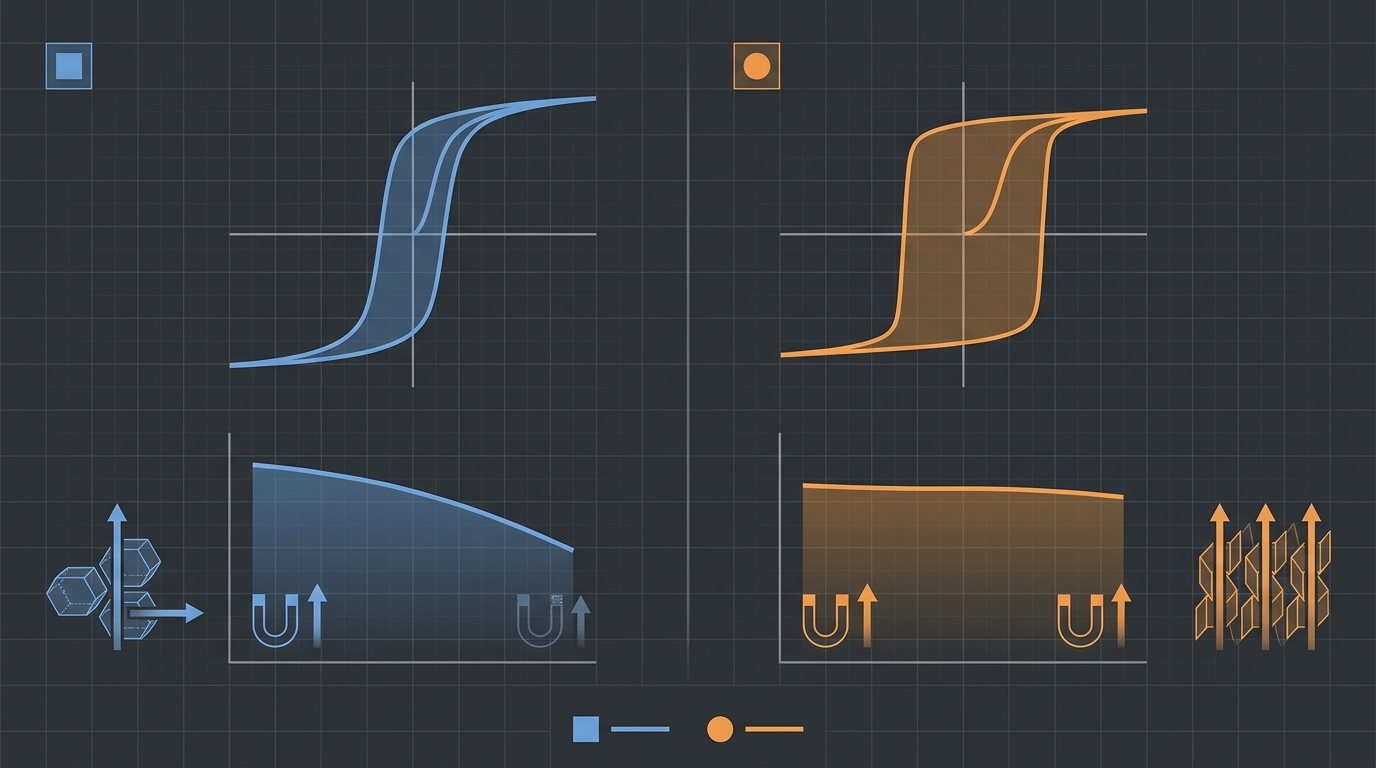
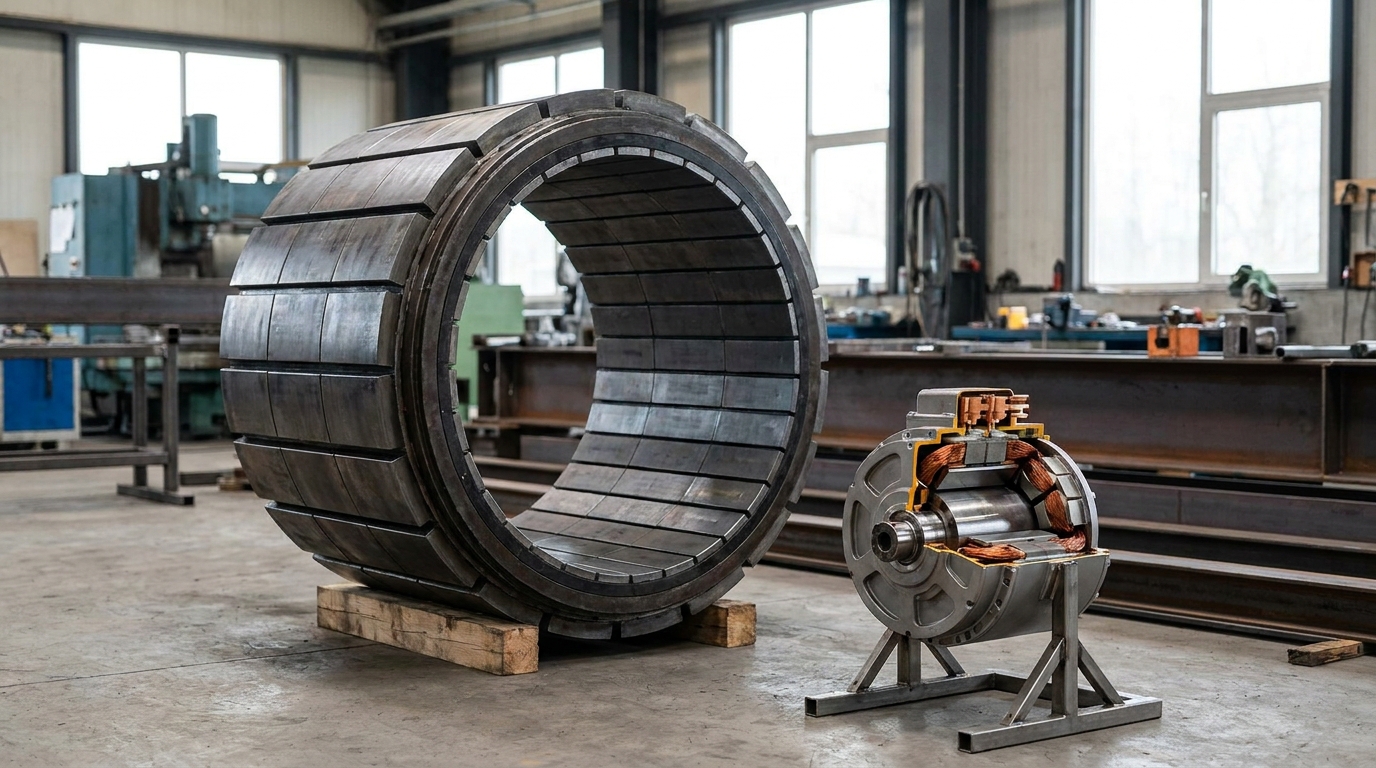
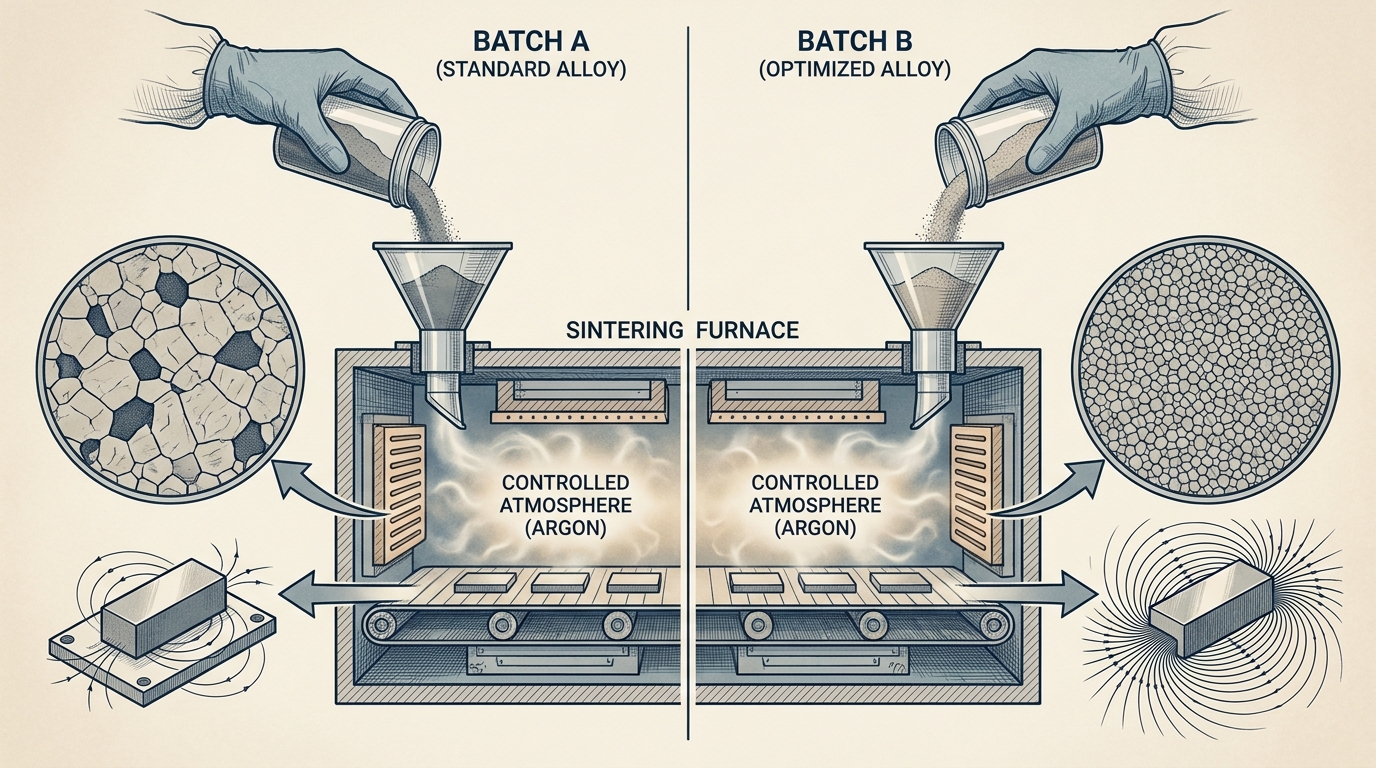
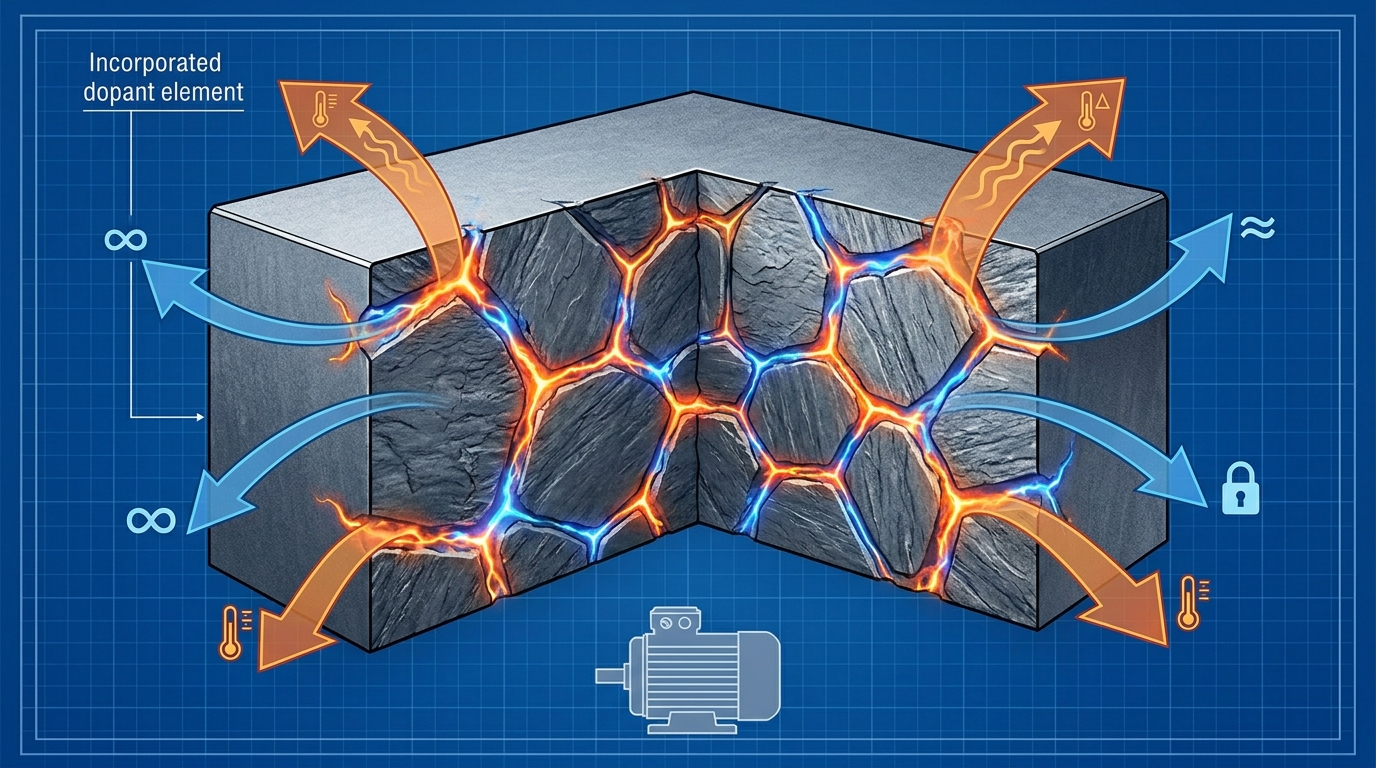
    Why alloying and sintering are the hardest quality-critical steps
    Why alloying and sintering are the hardest quality-critical steps

    China dominates this stage through installed manufacturing base, specialized tooling, coating ecosystems, and qualification history with end users. Western rare earth efforts have increasingly focused on restoring magnet-making capability, but qualification remains a major barrier. Magnet customers often assess not only elemental composition, but route history: oxide source, metal purity, powder characteristics, sintering behavior, and consistency across production lots. That means a factory can exist before a dependable commercial magnet stream fully exists.

    Observed failure modes include insufficient lot-to-lot consistency, coating failures in end-use environments, and weak integration between alloy specification and finished magnet requirements. At this final stage, the value chain stops behaving like commodity processing and starts behaving like a qualified advanced-manufacturing system.

    Cross-stage evidence used in risk mapping

    • Orebody mineralogy, TREO distribution, and the split between light and heavy rare earth content.
    • Impurity profile, including thorium or uranium-bearing residues and the jurisdiction-specific compliance pathway for handling them.
    • Flowsheet maturity for solvent extraction separation, including sensitivity to feed variability and waste-treatment integration.
    • Metal purity evidence, oxygen-control practices, and traceability from oxide to reduced metal.
    • Alloy reproducibility, especially around NdFeB strip casting, powder behavior, and heavy rare earth additions.
    • Qualification status for sintered magnet production, including documentation, product consistency, and end-use acceptance history.

    Observed resilience patterns outside China

    Several non-Chinese approaches appear repeatedly across the western rare earth landscape. One pattern is partial vertical integration around a mine and one or two downstream stages rather than the whole chain at once. Another is geographic splitting of stages, where ore originates in one jurisdiction and later processing takes place elsewhere under tighter compliance control. A third pattern is qualification of intermediate products-mixed carbonate, separated oxide, alloy, or magnet—rather than immediate pursuit of end-to-end internalization. Redesign to reduce heavy rare earth intensity also appears in some applications, although substitution at system level remains constrained by performance requirements.

    These patterns clarify the larger point. The difficulty in standing up western rare earth production is not the absence of rock. It is the absence of a broad, connected industrial chain with chemical separation depth, metallization capability, alloying experience, and magnet qualification history comparable to China’s. In mine to magnet analysis, the middle stages usually determine whether front-end mining becomes strategic capacity or remains only a feedstock source.

  • What Is Gallium? Supply Concentration and Export Control Risk Framework

    What Is Gallium? Supply Concentration and Export Control Risk Framework

    In electronics and industrial component reviews, gallium often appears late in the map. The spend line can look small, yet the functional dependency can be large because gallium sits inside RF amplifiers, power devices, LEDs, and radar modules where redesign is slow and qualification is demanding. That mismatch between apparent material importance and actual system criticality is one of the recurring discovery points in gallium risk analysis.

    • Gallium is mainly a byproduct of aluminum refining, so supply is shaped by upstream alumina and aluminum process decisions as much as by gallium demand.
    • Strategic end uses are concentrated in gallium nitride (GaN) and gallium arsenide (GaAs) devices used in 5G base stations, radar AESA systems, EV chargers, power electronics, LEDs, and optoelectronics.
    • China’s export control regime, effective August 1, 2023, turned gallium trade into a licensed flow rather than a routine industrial shipment.
    • Common failure modes include purity mismatch, incomplete export documentation, single-jurisdiction dependence, and limited substitution once a device platform is qualified.
    • Observed responses in the market include dual qualification, reclaimed material streams, regional processing steps, and inventory buffers, each carrying distinct trade-offs in traceability, timing, and specification control.

    What gallium is in supply-chain terms

    For anyone asking what is gallium, the most operational answer is that gallium is a strategic byproduct metal used mainly in compound semiconductors rather than a bulk industrial metal consumed in large visible volumes. Chemically, it is a soft metal with unusual physical properties, but the supply-chain significance comes from its role in compounds such as gallium nitride and gallium arsenide. Those materials support high-frequency, high-power, and thermally demanding electronics where conventional silicon can face performance limits.

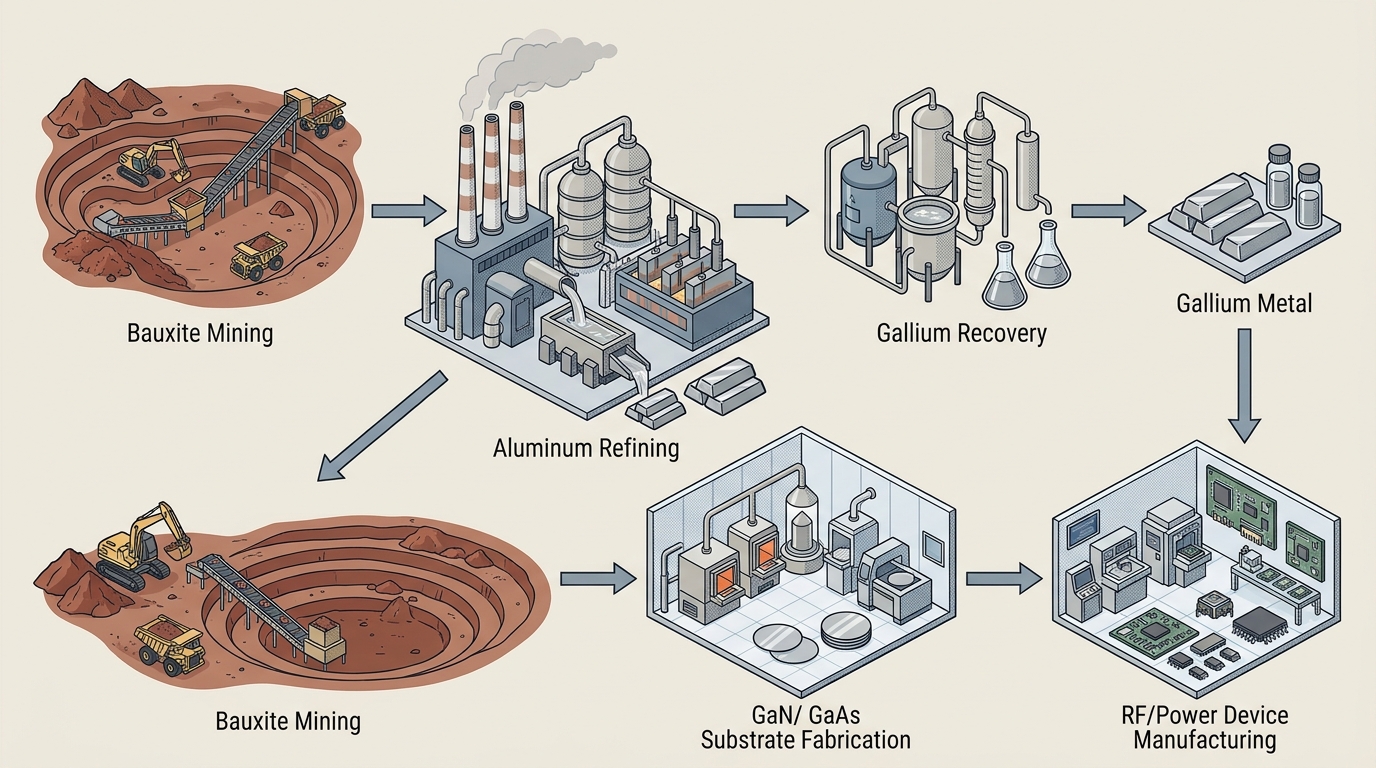
    The upstream detail that matters most is origin. Gallium is commonly recovered as a byproduct of aluminum refining, especially from bauxite processing streams, with some linkage to other metallurgical circuits. That means gallium availability is not governed only by gallium demand. It also depends on how much relevant upstream material is processed, whether recovery circuits are active, and whether refiners maintain the extraction steps needed to isolate gallium from larger industrial streams. In practice, this creates a structurally less elastic supply profile than a primary mined metal.

    A second recurring discovery point appears during supplier mapping: gallium risk is often hidden inside several conversion stages. Material may move from byproduct recovery into refining, then into high-purity metal, then into wafers, epitaxy, RF devices, or power semiconductors. A downstream manufacturer can therefore appear diversified at the device level while remaining exposed to a concentrated upstream source.

    Where gallium matters: end-use criticality and performance dependence

    Gallium uses are best understood through the devices it enables rather than through the metal alone. The strongest demand linkage today runs through GaN power electronics and GaAs or GaN RF applications. In 5G base stations, GaN supports power amplifiers and radio-frequency functions where high-frequency performance, thermal robustness, and power density matter. That is why the phrase gallium 5g usually refers to gallium-based RF hardware in telecom infrastructure rather than to the metal in isolation.

    In radar AESA systems, gallium compounds are valued because active electronically scanned arrays contain many transmit and receive elements, and performance can improve when each module handles power efficiently under tight thermal constraints. The strategic sensitivity of gallium becomes more visible here because radar electronics combine strict qualification, defense-adjacent compliance, and limited tolerance for redesign.

    Molten gallium (demonstrating the low melting point)
    Molten gallium (demonstrating the low melting point)

    In EV chargers and other power electronics, GaN is associated with faster switching, smaller passive components, compact form factors, and improved efficiency relative to legacy silicon in some use cases. The point is not that gallium is a battery metal. The point is that gallium nitride can sit inside the charger, converter, or power supply where energy conversion performance matters. LEDs, laser diodes, and other optoelectronic applications remain important as well, reinforcing the fact that gallium demand spans telecom, industrial power, consumer electronics, and defense-related systems.

    A practical scope for gallium risk mapping

    Operational reviews often become clearer when the chain is divided into distinct nodes rather than treated as a single “metal supply” problem. The first node is byproduct generation inside aluminum-related processing. The second is extraction and purification into gallium metal or higher-purity forms. The third is conversion into semiconductor materials such as GaN and GaAs. The fourth is device manufacturing, including RF components, power semiconductors, LEDs, and specialized modules. The fifth is end-market integration into systems such as telecom base stations, chargers, industrial equipment, and radar.

    Each node carries a different risk type. Upstream nodes are exposed to metallurgy, byproduct economics, and jurisdictional concentration. Midstream nodes are exposed to purity control, documentation, and export licensing. Downstream nodes are exposed to qualification cycles, reliability testing, and design lock-in. A useful feature of this mapping is that it separates physical availability from usable availability. Material can exist in the chain while still being unavailable for a given product because purity, form, certification, or licensing do not line up.

    Supply concentration and the 2023 China export control regime

    The structural issue behind gallium china export exposure is concentration. China has held a dominant position in important parts of the gallium supply chain, including primary production and refining capacity. When a byproduct metal is also concentrated in one jurisdiction, policy risk becomes part of ordinary supply-chain analysis rather than an external headline.

    Gallium as a byproduct of aluminum refining and its path into semiconductors
    Gallium as a byproduct of aluminum refining and its path into semiconductors

    That reality became more formal in 2023 when China introduced an export control regime for gallium and germanium, effective August 1, 2023. The mechanism was licensing, not a universal prohibition. Even so, the operating environment changed in a lasting way. Shipments that once moved as routine industrial trade became subject to a controlled process involving export approvals and end-use related documentation. The practical effect was additional friction around scheduling, compliance review, and shipment certainty.

    One consistent lesson from disruption reviews is that licensing regimes affect more than the first exporter. A downstream device maker in North America, Europe, Japan, or Korea can still be exposed if Chinese-origin gallium sits upstream in a non-Chinese conversion chain. The immediate supplier may look geographically diversified, while the actual dependency remains concentrated at the material stage.

    Observed failure modes in gallium supply chains

    • Byproduct rigidity: gallium output does not always rise in step with gallium demand because production is tied to larger aluminum-related process flows.
    • Licensing and document friction: export approvals, end-use declarations, and shipment paperwork can create delays or uncertainty even when material exists.
    • Purity and specification mismatch: semiconductor applications are sensitive to trace contamination, and impurity control at the ppm level can affect yield or qualification.
    • Single-jurisdiction exposure: multiple suppliers at the device level can still rely on the same upstream country or refining hub.
    • Qualification lock-in: once GaN or GaAs devices are designed into 5G base stations, radar modules, or chargers, substitution often becomes a redesign problem rather than a purchasing switch.
    • Visibility gaps: procurement systems may classify gallium as an indirect input, leaving hidden exposure inside modules, wafers, or packaged components.

    Criteria commonly used to assess resilience

    In practice, gallium resilience is usually assessed through a mix of material, process, and compliance criteria. Material criteria include purity grade, form, conversion route, and consistency across batches. Process criteria include whether supply comes from primary byproduct recovery, reclaimed streams, or third-party tolling stages, and whether each stage is traceable. Compliance criteria include export-license exposure, end-user screening, documentation completeness, and the jurisdictions involved at each conversion step.

    Another useful criterion is technical criticality. A gallium input used in an LED product line does not carry the same redesign burden as one embedded in a qualified radar AESA transmit module. The same metal can therefore present very different risk profiles depending on the application, even before any geopolitical factor is added.

    Substitution and design flexibility

    The question “Can gallium be substituted in semiconductors?” rarely has a single answer. In some lower-performance or less space-constrained applications, silicon-based alternatives can be workable if the system tolerates efficiency loss, thermal compromise, or larger footprints. In more demanding RF and power applications, especially those built around gallium nitride, substitution narrows quickly because the material choice is linked to the architecture of the device and the surrounding system.

    GaN-enabled telecom and defense hardware concept (generic, non-branded)
    GaN-enabled telecom and defense hardware concept (generic, non-branded)

    A recurring discovery in engineering-commercial reviews is that substitution language can be misleading. At the spreadsheet level, it may look as though one semiconductor material can replace another. At the system level, the change can trigger new thermal validation, EMC work, reliability testing, and customer requalification. In that sense, substitution is often a downstream project rather than a near-term supply release valve.

    Observed management options and their trade-offs

    Several patterns have appeared across companies exposed to gallium risk. One is dual qualification of suppliers or processing steps, especially where upstream origin and downstream device assembly can be separated. Another is the use of reclaimed or recycled gallium streams for applications where purity and traceability align with product requirements. A third pattern is regionalization of selected midstream or downstream steps, intended to reduce the number of cross-border compliance handoffs even when raw material concentration remains. Inventory buffers also appear in some chains, though they mainly address timing friction and do not remove origin concentration or licensing dependency.

    Each of these options shifts a different part of the risk rather than eliminating it. Dual qualification can improve continuity but may still leave shared upstream exposure. Reclaimed material can broaden the feed base but introduces its own traceability and specification questions. Regional processing can shorten some trade routes while leaving the core gallium source unchanged. That is why gallium risk analysis often works best as a layered assessment of origin, conversion, compliance, and application lock-in.

    Seen through that lens, gallium is not merely a niche metal. It is a small-volume, high-consequence input whose importance comes from the systems it enables and the concentration embedded in its supply chain. The 2023 Chinese export control regime did not create gallium’s strategic relevance, but it made the underlying structure easier to see: byproduct dependence upstream, concentration in key refining stages, and limited flexibility once advanced devices are qualified into critical end markets.

  • What Is Terbium? A Supply Risk Framework for the Heavy Rare Earth Behind EV Magnets

    What Is Terbium? A Supply Risk Framework for the Heavy Rare Earth Behind EV Magnets

    Procurement and technical teams rarely assess the terbium element as a standalone input. In operational practice, terbium appears as a heavy rare earth issue that starts in geology, becomes visible in separation chemistry, and finally matters in magnet or phosphor qualification. That sequence is the main reason supply analysis around terbium often looks different from analysis around copper, nickel, or other bulk materials. The relevant constraint is usually not mining volume alone. It is the combination of ore type, heavy rare earth distribution, solvent extraction capability, regulatory exposure, impurity control, and downstream qualification into a usable form.

    • Terbium is a heavy rare earth typically assessed as part of a broader heavy rare earth stream rather than as an isolated mine output.
    • Terbium and dysprosium usually travel together in supply analysis because they occur in similar deposits, pass through related separation circuits, and serve overlapping magnet functions.
    • Two demand anchors matter most in practice: green phosphors and NdFeB magnet additives used to improve high-temperature performance.
    • Southern China remains central because ion-adsorption clay resources and a large share of the separation ecosystem sit in the same supply architecture.
    • Substitution and recycling are real but partial; both moderate exposure in some applications without removing the dependence on primary heavy rare earth supply.

    What terbium is in supply-chain terms

    Terbium, symbol Tb, is a lanthanide and is generally classified as a heavy rare earth. In commercial discussions, the relevant product is rarely pure metallic terbium in a simple commodity sense. The market usually revolves around terbium oxide, chemical intermediates, metal, alloy additions, or magnet-related feedstock. That distinction matters because the tradable and usable form is created through technically demanding midstream steps, not simply by extracting ore.

    From an application perspective, the two uses that repeatedly shape risk discussions are green phosphors and magnet additives. In phosphor chemistry, terbium is valued for its luminescent properties, especially where precise green emission is required. In magnets, terbium is used in small quantities to improve coercivity and thermal stability in NdFeB systems. The magnet role is especially visible in electric vehicles, wind turbines, industrial motors, robotics, and some defense-adjacent applications where performance under heat becomes a design constraint.

    Why terbium and dysprosium are usually analyzed together

    A recurring discovery moment in heavy rare earth work is that a “terbium issue” often turns out to be a dysprosium-and-terbium issue. The pairing starts in geology. Tb and Dy are commonly associated with heavy rare earth-bearing deposits, especially ion-adsorption clays in southern China and some clay or carbonatite systems elsewhere. The pairing continues in processing because both elements move through related separation circuits and refining flows. It then reappears at the demand end because both can be used to improve high-temperature magnet performance.

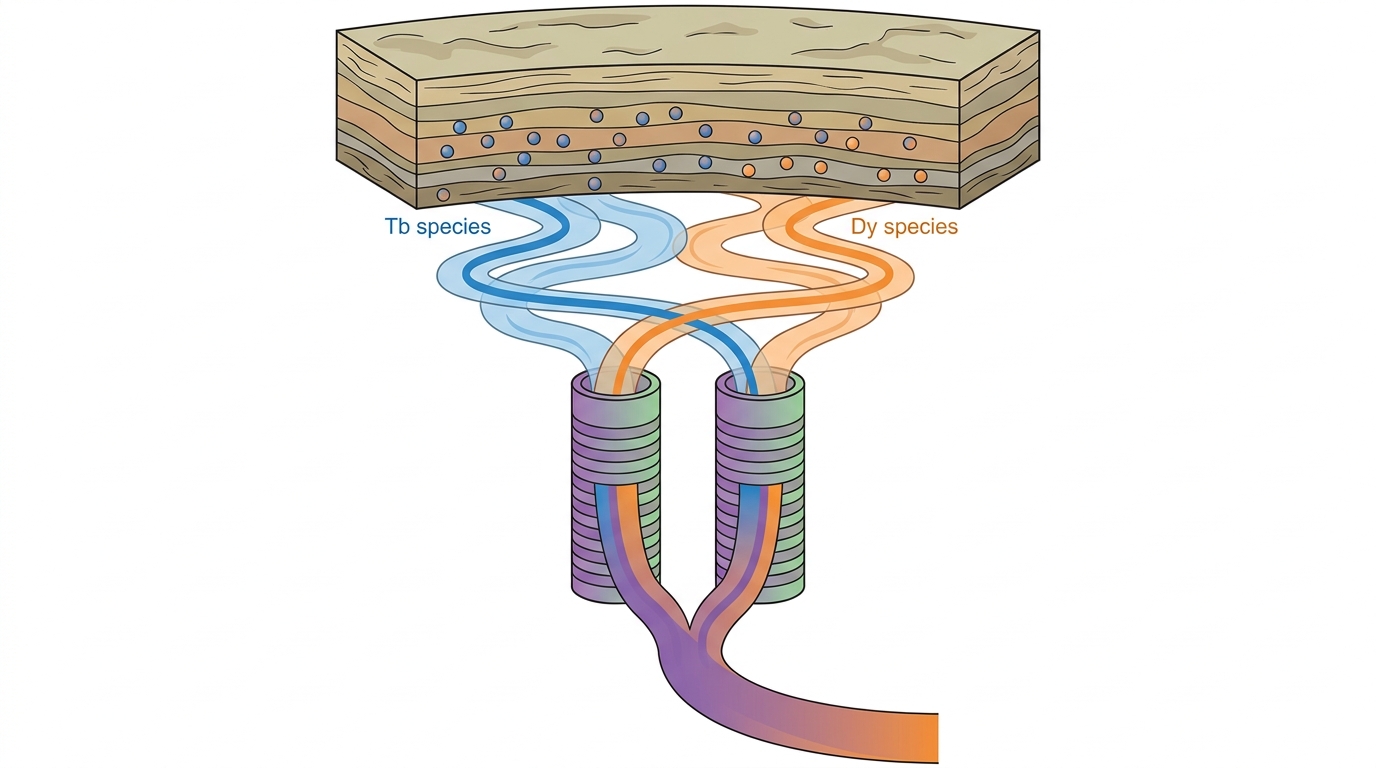
    This co-movement changes how concentration risk is measured. A project can look diversified at the mine level while remaining concentrated in practice if the heavy rare earth stream still depends on the same midstream separation network. In several observed cases across rare earth markets, upstream headlines created an impression of new supply while the real bottleneck remained individual oxide separation, product purity, or oxide-to-metal conversion. That gap is one of the most important reasons Tb and Dy are often discussed as a pair rather than as independent markets.

    Supply chain bottleneck visual for terbium (Tb) and dysprosium (Dy) connection.
    Supply chain bottleneck visual for terbium (Tb) and dysprosium (Dy) connection.

    Analytical perimeter: where terbium risk actually sits

    A practical supply review usually maps terbium across the full chain rather than stopping at mine ownership or resource statements. The relevant perimeter typically includes six layers.

    1. Deposit and mineralogy: whether the source is an ion-adsorption clay, hard-rock system, or another rare earth host, and how Tb and Dy sit inside the broader rare earth basket.
    2. Intermediate product: whether the output is mixed rare earth carbonate, mixed oxide, or a more advanced separated product.
    3. Separation: the ability to isolate terbium from chemically similar neighboring rare earths through solvent extraction or related flowsheets.
    4. Refining and conversion: the path from oxide to metal, alloy, or application-specific feedstock.
    5. Qualification: whether the material is accepted for magnet, phosphor, optical, or other end uses with the required impurity profile.
    6. Regulatory and traceability layer: origin documentation, environmental compliance, customs classification, and chain-of-custody records that travel with the product.

    This perimeter matters because many apparent supply additions do not cross all six layers. In rare earths, the presence of ore or concentrate does not automatically translate into usable terbium for high-specification applications.

    Core criteria used to assess terbium exposure

    Several criteria tend to separate superficial analysis from operationally useful analysis.

    • Heavy rare earth distribution inside TREO: TREO means total rare earth oxides. A deposit can show meaningful TREO while containing limited heavy rare earth content, or the reverse. For terbium analysis, the internal distribution of Dy, Tb, and adjacent elements often matters more than the headline rare earth total.
    • Separation difficulty: terbium sits among chemically similar lanthanides, so the complexity of separation is part of the supply risk. The number of effective separation stages, reagent handling, and control of neighboring elements can determine whether material is truly marketable.
    • Product specification and impurity control: end users often qualify oxides, metals, or alloys against narrow impurity windows. In practice, impurity limits may be discussed in ppm, or parts per million. A material that is nominally “terbium oxide” can still face qualification friction if the impurity profile drifts.
    • Jurisdictional concentration: southern China remains the central reference point because ion-adsorption clay resources and the associated separation chain are deeply established there. Supply concentration is so geological and institutional at the same time.
    • End-use coupling: the supply picture changes when magnet demand strengthens relative to phosphor demand, or when downstream applications shift toward higher-temperature operating conditions that favor Tb or Dy additions.
    • Substitution and recycling elasticity: the relevant question is not whether a substitute exists in theory, but whether substitution works in a given performance envelope and whether recycled feed arrives in a usable form at the right stage of the chain.

    Failure modes observed in terbium supply analysis

    Several failure modes recur when terbium is mapped too narrowly.

    • Mine-level diversification that leaves midstream concentration unchanged: new ore sources can still depend on the same separation geography, leaving the core bottleneck intact.
    • Confusion between mixed rare earth output and separated terbium availability: a project may produce a rare earth intermediate without having a qualified route to individual Tb oxide.
    • Overstated substitution: engineering measures can reduce terbium intensity in some magnets, but high-temperature applications often retain a requirement for heavy rare earth performance support.
    • Assuming phosphor demand has disappeared: green phosphors are no longer the only narrative, yet they remain part of the demand base and can tighten an already narrow market.
    • Ignoring regulatory friction in southern China: environmental controls, licensing changes, and administrative enforcement can affect availability even when geology has not changed.
    • Treating oxide availability as the final answer: oxide, metal, alloy, and finished magnet qualification are different steps, and disruption at any one of them can delay usable supply.

    One of the clearest discovery moments in practice appears when a supply source looks robust on paper but only offers mixed rare earth material. That material can be strategically interesting, yet it does not immediately solve Tb availability for a motor or phosphor chain. Another common discovery moment appears downstream: a separated oxide exists, but the path into alloy or magnet production remains unqualified, leaving the market tighter than headline supply figures suggest.

    Observed options for managing terbium-related risk

    Across industry, several management approaches appear repeatedly. Their relevance varies by product form and end use, but the pattern is consistent enough to be part of a standard analytical frame.

    High-temperature NdFeB magnet concept with terbium as a performance additive (generic).
    High-temperature NdFeB magnet concept with terbium as a performance additive (generic).
    • Geographic diversification across more than one layer: some supply chains seek diversification not only in upstream ore but also in separation, metal conversion, and magnet fabrication.
    • Parallel qualification of product forms: companies sometimes qualify oxide, alloy, and finished magnet routes in parallel because substitution between forms is limited once a specification is fixed.
    • Lower heavy rare earth intensity in magnets: grain boundary diffusion, microstructural engineering, thermal management, and motor design changes can reduce the amount of terbium required in some applications.
    • Application-specific channel separation: phosphor-grade and magnet-grade flows are often treated differently because purity profiles, conversion steps, and qualification standards are not identical.
    • Recycling loops focused on concentrated streams: magnet manufacturing scrap and selected end-of-life equipment are the most commonly discussed sources because the terbium content is more recoverable than in highly dispersed consumer products.

    These options do not erase concentration. They change where the constraint appears. In one configuration the bottleneck may sit in clay-derived feedstock; in another it may shift to solvent extraction, oxide-to-metal conversion, or magnet qualification.

    Substitution status and recycling limits

    Substitution is best described as partial and application dependent. In magnets, the main technical theme is reduction of heavy rare earth loading rather than total removal across all performance classes. Where operating temperatures, compact motor architecture, or long service life create narrow performance windows, terbium can remain difficult to replace completely. In phosphors, alternative systems exist, but terbium still retains value in precise green-emission chemistry and specialty formulations.

    Recycling is important but not yet equivalent to a full secondary supply base. The most credible recycling streams tend to come from concentrated sources such as magnet production scrap, selected industrial equipment, or larger end-of-life motors. Recovery from highly dispersed products is more challenging because collection, dismantling, and chemical separation all add complexity. As a result, recycled terbium often complements rather than replaces primary heavy rare earth production.

    Signals commonly tracked in the terbium chain

    • Policy or environmental actions affecting ion-adsorption clay production and processing in southern China.
    • Announcements related to non-Chinese separation capacity, especially capacity capable of producing separated heavy rare earth oxides rather than mixed intermediates.
    • Changes in magnet manufacturing technology that alter Dy/Tb loading for high-temperature applications.
    • Evidence of tighter impurity control or more stringent qualification requirements in downstream magnets, phosphors, or specialty materials.
    • Shifts in recycling activity from laboratory scale or scrap recovery toward repeatable industrial recovery from end-of-life equipment.

    FAQ

    What is terbium used for?

    Terbium is mainly used in green phosphors and as a performance-enhancing additive in NdFeB magnets. It also appears in optical materials, sensors, and other specialized applications where rare earth chemistry is valued for specific functional properties.

    Ion-adsorption clay to separation pathway concept for heavy rare earths.
    Ion-adsorption clay to separation pathway concept for heavy rare earths.

    Why is terbium critical for green energy?

    Its main green-energy relevance comes from high-performance permanent magnets. Small additions of terbium can improve thermal stability and resistance to demagnetization in demanding motor environments, which is why the element remains relevant in electric mobility, wind systems, and industrial electrification.

    Is there a substitute for terbium?

    There are partial substitutes and intensity-reduction techniques, especially in magnets, but complete substitution is limited in the most demanding performance settings. The practical result is usually a reduction in terbium use rather than a universal replacement.

    The cleanest way to answer what is terbium from a supply perspective is to treat it as a high-specification heavy rare earth embedded in a Dy-linked chain. The most important facts are not only that terbium is used in green phosphors and magnets, but also that it is concentrated in a narrow geological and processing system centered on southern China. That is why terbium analysis routinely focuses on pairing with dysprosium, midstream separation capability, qualification discipline, and the practical limits of substitution and recycling.

  • What Dysprosium Is and Why It Matters: A Supply-Chain Risk Framework

    What Dysprosium Is and Why It Matters: A Supply-Chain Risk Framework

    In rare-earth supply chains, disruption rarely begins with a simple shortage at the mine. The recurring operational pattern appears further downstream: mixed feed moves into a narrow set of separation circuits, thermal-performance requirements tighten at the magnet stage, and an apparently minor additive becomes a gating factor for finished equipment. Dysprosium sits squarely in that pattern. It is a small-volume material by mass, but a high-criticality material by function, particularly where high-performance permanent magnets operate under heat, vibration, and compact design constraints.

    • Key takeaway: Most commercial dysprosium uses are tied to NdFeB magnets, where dysprosium improves coercivity and thermal stability rather than serving as a bulk material.
    • Key takeaway: Supply concentration is strongest in heavy rare earth separation and downstream conversion, not only at the mining stage, and China remains the central jurisdiction in that part of the chain.
    • Key takeaway: End-market demand from EV traction motors, wind turbine generators, defense systems, and specialized industrial motors gives dysprosium strategic importance out of proportion to tonnage.
    • Key takeaway: Substitution and recycling are real but partial; both are constrained by technical trade-offs, feed availability, and processing complexity.

    Operational context: dysprosium is a performance input before it is a volume story

    The answer to “what is dysprosium” begins with chemistry, but risk analysis starts with function. Dysprosium, symbol Dy and atomic number 66, is a lanthanide and is generally classified as a heavy rare earth element. That classification matters because heavy rare earths are usually harder to source, harder to separate, and more concentrated in processing than light rare earths. The dysprosium element is a silvery metal in pure form, yet in commerce it is rarely the stand-alone metal that drives concern. The market focus is the role dysprosium plays inside high-specification magnet systems.

    A practical discovery in supplier reviews is that many organizations initially treat rare earths as one interchangeable category. That view often collapses once product engineers define operating temperatures and demagnetization tolerance. At that point, dysprosium stops looking like a marginal constituent and starts looking like a functional requirement embedded in a magnet grade, a motor architecture, or a defense-related assembly.

    1. Material role: the heavy rare earth function behind magnet reliability

    Among dysprosium uses, the most commercially significant application is as an additive in neodymium-iron-boron, or NdFeB, permanent magnets. The reason is not cosmetic alloying. Dysprosium contributes to coercivity, meaning resistance to demagnetization, especially at elevated temperatures. In plain operational terms, it helps a magnet keep performing when thermal loads increase. That is why the phrase “dysprosium magnet” appears so frequently in EV, wind, and defense coverage.

    This thermal-performance role is central to the uses of dysprosium. NdFeB magnets are valued because they provide high magnetic strength in compact form factors. The weakness of the system is that heat can degrade magnetic performance if the formulation is not designed for that environment. Dysprosium is one of the established ways to strengthen the magnet against that failure mode. A recurring pattern in technical diligence is that dysprosium demand is driven less by total equipment count than by the share of applications that combine miniaturization, high power density, and sustained operating heat.

    Outside magnets, dysprosium also appears in more specialized applications such as certain lasers, control components, and nuclear-related uses. Those niches matter for criticality mapping, but they do not alter the main conclusion: commercially relevant dysprosium uses are overwhelmingly anchored in magnet performance.

    2. End-market pull: EV motors, wind turbines, defense, and industrial assemblies

    Demand analysis becomes clearer when end markets are separated by performance requirement rather than by headline category. In electric vehicles, dysprosium matters most in traction motors that use high-performance permanent magnets and operate in compact thermal envelopes. The metal is not present because of fashion in battery-electric design; it is present because elevated temperatures can weaken magnet performance, and dysprosium can help preserve coercivity.

    Photorealistic visual of dysprosium metal in a lab context (no text).
    Photorealistic visual of dysprosium metal in a lab context (no text).

    Wind turbine demand follows a similar logic. Permanent-magnet generator designs can create pull-through demand for rare earth magnets, and dysprosium becomes relevant where thermal resilience and reliability are important. Defense demand is structurally different. Absolute tonnage may be modest, but qualification standards, reliability thresholds, and strategic sensitivity raise the material’s importance. Industrial motors, sensors, actuators, and high-temperature magnetic assemblies add a further layer of demand that is easy to miss because it is dispersed across many applications rather than concentrated in one visible sector.

    One practical discovery from market mapping is that dysprosium demand is rarely linear with unit growth in any single sector. Motor design changes, magnet grain-boundary engineering, and different thermal management strategies can all shift dysprosium intensity per unit. For that reason, demand analysis works better as a specification exercise than as a headline-reading exercise.

    3. Supply concentration by stage: mining is only the opening layer

    The most important supply-chain fact about dysprosium is that concentration sits deep in the heavy rare earth processing chain. China dominates the separation stage for HREEs and remains highly influential in downstream conversion into oxide, metal, alloy, and finished magnet products. Even where feedstock originates outside China, the chain often narrows when mixed rare-earth material reaches chemical cracking and solvent-extraction separation.

    A recurring discovery in rare-earth due diligence is that mine diversification does not always translate into processing diversification. A supply map can look geographically diverse at the concentrate level and then reconcentrate at separation. For dysprosium, that middle-stage bottleneck is frequently more consequential than the location of the original ore body. The result is a multi-step concentration profile: upstream feed may be dispersed, but dysprosium oxide production, metal-making, alloy conversion, and magnet manufacturing can still depend on a small number of linked processing ecosystems.

    Conceptual cross-section showing dysprosium’s role in NdFeB magnet thermal stability (symbol-only).
    Conceptual cross-section showing dysprosium’s role in NdFeB magnet thermal stability (symbol-only).

    This is why a dysprosium risk review usually tracks the chain in sequence: ore or ionic-clay-derived feed, cracking, solvent extraction, separated oxide, metal or master alloy conversion, and magnet fabrication. At each stage, the number of viable operators tends to narrow, especially for heavy rare earths. China’s position in HREE separation is so not simply a mining story; it is a process-control story, a technical-know-how story, and a compliance-documentation story.

    • Supply concentration criteria commonly examined: origin of feedstock, location of separation, oxide purity route, metal or alloy conversion site, and final magnet manufacturing location.
    • Traceability criteria commonly examined: country-of-origin statements, certificates of analysis, safety and product documentation, chain-of-custody records, and export or customs classifications where relevant.
    • Operational resilience criteria commonly examined: number of qualified processors per stage, dependence on one jurisdiction, and evidence that a non-China route is genuine rather than nominal.

    4. Failure modes observed in dysprosium supply chains

    Dysprosium-related disruption tends to appear in a small set of recurring failure modes. The first is apparent diversification that disappears under process tracing. A supplier may cite non-China mining, while actual separation or metal conversion still relies on Chinese facilities. The second is specification mismatch. A project can secure rare-earth material in principle, yet fail at the application level because the magnet grade, coercivity target, or thermal profile does not line up with the end-use requirement.

    A third failure mode is documentation weakness. Rare-earth supply chains increasingly face scrutiny around origin, environmental handling, and industrial security. Missing or inconsistent product documentation can delay acceptance even when physical material exists. A fourth failure mode is substitution overstatement. Public discussions sometimes imply that dysprosium can be designed out quickly. In practice, substitution depends on operating temperature, motor architecture, weight constraints, and the performance penalties a system can tolerate.

    A fifth failure mode concerns recycling narratives. Secondary supply is often discussed as if it were an immediate offset to primary concentration. Experience on the ground tends to show a slower reality: magnet scrap streams are fragmented, end-of-life collection is uneven, dismantling is laborious, and reprocessing into high-purity feed is technically demanding. Recycling exists, but the path from scrap to magnet-ready material remains narrower than many market summaries suggest.

    5. Substitution status: real pathways, incomplete relief

    Substitution analysis in dysprosium almost always resolves into three categories. The first is reduced dysprosium loading within NdFeB magnets through microstructural optimization or grain-boundary diffusion approaches. These techniques can lower the amount of heavy rare earth required in some designs while preserving performance. The second is replacement with another heavy rare earth, most notably terbium, in certain formulations. The third is system-level substitution, such as alternative motor architectures that reduce or avoid permanent-magnet dependence.

    Supply-chain choke-point diagram for heavy rare earth processing and end-use dependencies (no text).
    Supply-chain choke-point diagram for heavy rare earth processing and end-use dependencies (no text).

    Each pathway carries trade-offs. Lower loading can preserve supply without eliminating exposure. Terbium substitution changes the dependence rather than removing heavy rare earth dependence. Alternative motor designs can alter efficiency, size, weight, thermal behavior, or acoustic performance. In practical assessment, substitution status is therefore less a binary answer than a constraint map. A useful phrasing in technical reviews is that dysprosium is partly avoidable in some products, but not frictionlessly replaceable across all high-performance magnet applications.

    6. Recycling reality: useful secondary supply, limited near-term release valve

    Recycling matters because dysprosium is embedded in finished magnets rather than consumed like a fuel. In theory, that creates recoverable inventory. In practice, the path to recovery is difficult. Post-industrial scrap is easier to identify than end-of-life consumer material, but volumes are still linked to manufacturing geography and magnet fabrication patterns. End-of-life products often contain magnets in assemblies that are not easy to disassemble, and the recovered material still requires sophisticated processing before it becomes a reliable source of separated heavy rare earth content.

    The practical market picture is that recycling supports resilience, especially where magnet scrap is concentrated and well characterized, yet it does not currently dissolve primary supply concentration. In other words, recycling reality is best understood as supplementary rather than transformative in the present supply environment.

    7. Evidence framework: how dysprosium risk is usually evaluated in practice

    A working framework for dysprosium analysis usually combines five evidence layers. The first is functional criticality: whether dysprosium is essential to the target performance window or simply beneficial. The second is stage concentration: where separation, metal-making, and magnet fabrication actually occur. The third is substitution elasticity: how much performance flexibility exists if dysprosium intensity changes. The fourth is traceability and compliance integrity: whether origin and processing claims are consistently documented. The fifth is secondary supply realism: whether recycling claims are tied to identifiable scrap streams and credible reprocessing routes.

    When those five layers are assembled, dysprosium usually emerges as a classic small-input, high-consequence material. The metal matters because its main role sits inside a narrow technical requirement, its most sensitive processing steps are concentrated, and the available relief valves-substitution, redesign, and recycling-each carry real constraints. That combination explains why dysprosium appears so often in EV, wind, defense, and industrial resilience discussions even though it is rarely a headline material by tonnage alone.

  • Overlooked Rare Earth Elements: A Supply Risk Framework for Yttrium, Europium and Gadolinium

    Overlooked Rare Earth Elements: A Supply Risk Framework for Yttrium, Europium and Gadolinium

    In rare earth supply reviews, the first operational surprise is often how little the headline NdPr story explains about real downstream exposure. Magnet metals dominate public coverage, yet production teams, specialty materials buyers, and strategic metals research functions regularly encounter a different constraint set in yttrium, europium, and gadolinium. These elements sit in phosphors, ceramics, medical imaging inputs, nuclear materials, microwave electronics, and defense-adjacent systems. They are usually not mined for their own sake. They are recovered, separated, purified, and qualified as part of a much more complicated basket logic.

    • NdPr explains magnet demand, but it does not explain the full rare earth risk picture; yttrium, europium, and gadolinium follow different end-use and refining pathways.
    • Supply risk is shaped less by ore abundance alone than by by-product economics, separation capacity, product purity, and jurisdictional concentration.
    • Yttrium matters in phosphor host materials and advanced ceramics; europium remains tightly linked to red phosphors and optical systems; gadolinium crosses into MRI contrast agents, neutron absorption, and specialty electronics.
    • Export-control sensitivity often appears at the downstream material or end-use level, not only at the mixed rare earth concentrate or oxide level.
    • Observed monitoring signals include basket chemistry, non-Chinese separation progress, qualification status, document completeness, and exposure to China-linked refining routes.

    Why NdPr is not the whole rare earth story

    The magnet narrative is real, but it is incomplete. Neodymium and praseodymium support electric motors, wind turbines, and many industrial drives, so they naturally attract the most attention. The analytical blind spot appears when that volume story is treated as a proxy for all rare earth risk. Yttrium, europium, and gadolinium belong to smaller, thinner, more application-specific markets where substitution can be limited and separation capability matters as much as mine output.

    A recurring discovery in supplier assessments is that nominal mine capacity says very little about separated oxide availability. The relevant question is not simply whether ore exists, but whether the operator can recover a given element from the basket, refine it to the needed purity, and move it through a compliant route into a specialized end use. This is where overlooked rare earth elements become operationally important. A production line may not fail because rare earth ore is absent; it may fail because a niche oxide, dopant, or compound is unavailable in qualified form.

    Analytical perimeter for a watchlist review

    A practical review of yttrium supply chain exposure, europium rare earth availability, and gadolinium applications usually covers a small set of recurring criteria. The framework is descriptive rather than predictive, but it tends to separate robust supply chains from fragile ones.

    • Basket chemistry: whether the host ore or concentrate actually carries meaningful yttrium, europium, or gadolinium content.
    • Recovery route: whether the element is realistically recovered or simply present in trace amounts that are not separated commercially.
    • Refining position: where solvent extraction, separation, oxide production, or downstream compound preparation takes place.
    • Product form: mixed concentrate, carbonate, oxide, metal, doped phosphor, contrast-agent precursor, or engineered ceramic input.
    • Qualification burden: whether the end market requires pharmaceutical, nuclear, defense, or electronics-grade validation.
    • Jurisdictional exposure: reliance on China-based mining, separation, export licensing, or transshipment routes.
    • Failure modes: by-product cutbacks, purity drift, customs holds, end-use screening, or loss of downstream qualification.

    Yttrium: phosphor host, ceramic stabilizer, and a concentrated refining story

    Yttrium rarely attracts the attention given to magnet materials, yet it remains central to two important product families. The first is phosphor chemistry, where yttrium oxide often acts as a host lattice for rare earth dopants in display and lighting materials. The second is advanced ceramics, especially yttria-stabilized zirconia and related high-temperature applications. In practice, this means yttrium touches both electronics and industrial materials, with very different qualification pathways.

    The supply side is highly concentrated. Bayan Obo in Inner Mongolia, operated by China Northern Rare Earth Group, remains the most important reference point in any global map. It is the world’s largest rare earth deposit and produces yttrium as a by-product of iron ore and rare earth extraction. Reported rare earth concentrate capacity is in the range of 120,000 to 150,000 tonnes annually, with yttrium accounting for roughly 3 to 5 percent of the rare earth basket. Outside China, Mountain Pass in California produces about 40,000 tonnes of rare earth concentrate annually, with estimated yttrium recovery of roughly 1,200 to 1,500 tonnes per year, contingent on processing capacity and the broader basket economics. Lynas, with mining in Western Australia and processing in Kuantan, Malaysia, is another relevant non-Chinese node, with annual rare earth production around 11,000 tonnes and estimated yttrium recovery in the range of 300 to 400 tonnes.

    The main failure mode in yttrium is not geological scarcity in isolation; it is dependence on the wider rare earth basket. When operators optimize around higher-profile outputs, yttrium recovery can become secondary. Another observed issue is that end users may speak about “yttrium” as if oxide, ceramic powder, and phosphor precursor are interchangeable forms. They are not. Purity, particle behavior, and downstream processing history can matter as much as origin. In periods of tighter trade scrutiny, document packages such as certificates of analysis, origin statements, safety documentation, customs classification, and end-use paperwork move from back-office detail to central risk factor.

    Visual overview of the distinct application ecosystems for Y, Eu, and Gd.
    Visual overview of the distinct application ecosystems for Y, Eu, and Gd.

    Europium: a niche element with low substitution tolerance

    Europium is one of the most easily overlooked rare earth elements because its market is small, specialized, and tied to functions that disappear inside a finished product. Its best-known role is as a red phosphor activator, particularly in europium-doped yttrium systems used in display technologies and optical materials. In plain terms, it is one of the reasons the red channel in phosphor-based systems works as intended.

    Operationally, europium is difficult because the market is thin and the element is present in very low concentrations in many deposits. A second discovery from fieldwork and supplier mapping is that “available in the ore” often overstates what can be produced at separated, saleable quality. Europium tends to depend on a narrow band of processors with the technical willingness to recover and refine it. That makes the europium rare earth chain vulnerable to outages, maintenance events, and policy moves that would look minor in a larger commodity but become material in a niche material.

    China remains the dominant center of gravity here as well, with Bayan Obo and related Inner Mongolian operations feeding state-owned and licensed private refining systems. Mountain Pass and Lynas matter as alternative nodes, but non-Chinese scale remains limited relative to China’s separation infrastructure. The practical implication is that europium availability often reflects processing commitment rather than mining headlines. A mine can be operating, a concentrate can be flowing, and yet downstream users can still experience tightness in a specific europium-bearing product.

    For export-control analysis, europium also deserves special attention because the control question may arise through the end use. Optical systems, detection equipment, specialty phosphors, and defense-adjacent electronics can trigger scrutiny even when the underlying oxide does not appear to be the only regulated item. That downstream sensitivity is one reason europium belongs on a rare earth watchlist even if it never becomes a volume story comparable to NdPr.

    Clarifies the by-product trap and why NdPr focus masks distinct bottlenecks.
    Clarifies the by-product trap and why NdPr focus masks distinct bottlenecks.

    Gadolinium: medical imaging, neutron absorption, and dual-use complexity

    Gadolinium sits in a broader application set than europium, but the supply chain is not necessarily simpler. The most visible use is in gadolinium-based contrast agents for MRI imaging, where the element’s magnetic behavior makes it valuable in diagnostic workflows. It also appears in nuclear contexts because of its strong neutron absorption properties, and in specialty electronics such as garnets and microwave materials. Defense relevance enters through sensors, electronics, and systems where these properties are not easily replicated without performance trade-offs.

    The key analytical feature of gadolinium is that end-market diversity creates multiple qualification environments. Medical applications bring pharmaceutical and regulatory expectations. Nuclear applications add strict material control and documentation requirements. Electronics and defense pathways can add dual-use review, product testing, and provenance scrutiny. A supplier may be acceptable for one industrial oxide application and unusable for a medical or nuclear pathway because the documentation trail, impurity profile, or validation history is not aligned.

    In practice, gadolinium failure modes often include purity drift, inability to maintain application-specific specifications, and delays related to compliance rather than simple tonnage shortages. This is one reason gadolinium applications deserve separate treatment in strategic materials analysis. A seemingly modest disruption at the separation stage can propagate into hospitals, reactor supply chains, or specialist electronics manufacturing in ways that are disproportionate to the element’s public profile.

    Export-control relevance and the role of China-linked processing

    Export-control discussions around rare earths are often simplified into a binary question: restricted or unrestricted. The operational reality is more layered. China’s position in mining and especially in separation gives it leverage even when formal bans are absent. The practical chokepoint often sits in licensed exports, quota-like administrative behavior, or prioritization of domestic downstream users during periods of tighter supply. For yttrium, europium, and gadolinium, this matters because the value often resides in a high-purity or application-specific compound rather than a generic mixed product.

    A third discovery from trade and supplier mapping is that compliance risk can attach to the route as much as to the origin. Material mined in one jurisdiction may still travel through China-linked separation, Malaysia-based processing, or downstream finishing elsewhere before reaching the final customer. Mountain Pass in the United States and Lynas in Australia and Malaysia have become important reference points in discussions about diversification, but the degree of independence depends on exactly which step is under review: concentrate production, separation, metallization, compound preparation, or final component manufacture.

    Connects material processing to downstream critical applications.
    Connects material processing to downstream critical applications.

    Observed management patterns in the market

    Across specialty materials markets, several risk-management patterns appear repeatedly. Some groups qualify more than one geographic source for the same oxide or downstream compound. Others reduce exposure by tracking not only miners but also separators and compound makers, since the bottleneck often emerges after the mine gate. Recycling and reclamation occasionally appear in phosphors and specialty ceramics, though they rarely eliminate dependence on primary supply. In high-consequence applications, stockholding, approved-vendor structures, and tighter document control are common features of the operating model.

    These patterns also show why overlooked rare earth elements are not equally “investable” or equally scalable. Some belong on a watchlist because disruption would matter, not because the addressable market is broad. That distinction is especially relevant for family offices, strategic metals mandates, and private wealth research teams trying to separate narrative value from actual supply-chain significance.

    What belongs on the watchlist

    The case for tracking yttrium, europium, and gadolinium is straightforward: they reveal the parts of the rare earth system that the NdPr narrative leaves out. Yttrium highlights by-product dependence and the importance of phosphor and ceramic supply chains. Europium highlights low substitution tolerance in a very thin market. Gadolinium highlights how a single element can bridge medicine, nuclear systems, electronics, and defense screening. Together, they show that rare earth resilience is shaped by refining capability, qualification status, compliance burden, and route dependency at least as much as by mine tonnage.

    That is why these materials remain relevant entries on a rare earth watchlist even when they are not the largest-volume names in the sector. Procyon’s strategic metals watchlist discussion commonly examines these dependencies alongside magnet materials, separation bottlenecks, and export-control developments when mapping global supply risk.

  • Critical Minerals Price Volatility: A Supply Risk Interpretation Framework

    Critical Minerals Price Volatility: A Supply Risk Interpretation Framework

    Soft or falling spot prices in lithium, cobalt, nickel, manganese, and selected rare earth products have often been read as evidence that scarcity has eased. Operational reviews across recent disruptions showed a more complicated pattern. Material could be abundant at the ore or concentrate stage while availability at the refined, qualified, or exportable stage remained tight. In the market background behind this brief, lithium was described as down roughly 75% during 2023, while other battery materials also weakened sharply from recent highs. At the same time, export-control risk, refining concentration, project delays, and strategic dependence on a small number of jurisdictions became more visible rather than less.

    Key takeaways

    • Spot weakness and supply security measure different things; price can soften while deliverability deteriorates.
    • Refining concentration is often the governing bottleneck, especially where conversion capacity is concentrated in one country or a small number of processors.
    • By-product metals behave differently from primary commodities because output depends on another metal’s production economics.
    • Export controls, licensing, and customs enforcement can restrict supply even when global mine production appears ample.
    • Project pipelines often slow during price weakness, creating future tightness that is not visible in the prompt market.

    Analytical scope: where supply risk actually sits

    Critical minerals supply risk rarely sits in one place. A useful assessment separates the chain into four layers: resource extraction, intermediate processing, final refining, and market access. The distinction matters because the apparent surplus can sit upstream while the actual bottleneck sits downstream. Lithium quoted in LCE, or lithium carbonate equivalent, can look plentiful on paper even when battery-grade hydroxide conversion is constrained. Rare earth projects reported in TREO, or total rare earth oxide, can appear large while the magnet-relevant fractions such as NdPr, dysprosium, or terbium remain limited. In practice, the chain fails at the narrowest qualified stage, not at the most visible headline stage.

    • Physical form: ore, concentrate, mixed carbonate, oxide, metal, alloy, magnet, or chemical precursor.
    • Refining route: the number of steps between mine output and usable material, including solvent extraction, separation, calcination, or precursor synthesis.
    • Jurisdictional concentration: where mining, refining, and export clearance are concentrated.
    • Qualification status: whether the material is merely produced or actually approved for industrial use at required impurity levels, often measured in ppm.
    • Documentary friction: certificate of origin, assay, safety data, chain-of-custody records, export licensing scope, and HS code alignment.

    Can supply risk rise while prices fall?

    Yes, and recent market behavior made that contrast unusually clear. Spot prices respond quickly to visible inventory, temporary oversupply, destocking, and financial positioning. Supply risk responds to a different set of variables: concentration of refining, fragility of trade routes, permitting delays, qualification cycles, and policy intervention. The result is a recurring disconnect. A large wave of spodumene, laterite, or mixed concentrate can depress the headline market while the useful product form remains exposed. One discovery repeated across battery materials and rare earths was that “available” often meant available in the wrong location, wrong chemical form, or wrong specification.

    That distinction becomes sharper in concentrated markets. A seaborne cargo moving from Australia to China, a rare earth intermediate moving from Myanmar into Chinese separation plants, or cobalt-bearing feed moving from the Democratic Republic of Congo into Chinese or European refineries can all exist physically while still being vulnerable to licensing, customs inspection, plant outages, reagent shortages, or political decisions. None of those frictions is visible in a spot chart alone.

    • Observed failure mode: surplus upstream, bottleneck downstream.
    • Observed failure mode: material produced, but not qualified for the end-use application.
    • Observed failure mode: exportable volume restricted by licensing rather than geology.
    • Observed failure mode: single-country refining exposure creating high correlation across suppliers.

    Refining concentration: the bottleneck that survives price weakness

    Refining concentration is one of the most important reasons why low prices do not automatically solve critical minerals supply risk. In lithium, additional ore from Australia, Argentina, or Chile does not by itself create secure access to battery-grade chemicals. The conversion stage remains specialized, capital intensive, and geographically concentrated. Similar logic applies to cobalt sulfate, nickel Class 1 products, spherical graphite, and separated rare earth oxides. A market can be long raw material and short refined product at the same time.

    Spot prices fall while structural supply risk rises (refining, export controls, project delays).
    Spot prices fall while structural supply risk rises (refining, export controls, project delays).

    Rare earths show the issue in its clearest form. Mining and concentration are only the opening steps. Separation into individual oxides, then conversion into metals, alloys, and magnets, creates several additional choke points. Even when non-Chinese rare earth projects report meaningful TREO, the relevant question is often whether separated NdPr oxide, dysprosium oxide, or terbium oxide can move through a qualified downstream chain. In practice, concentration in separation and magnet making has mattered as much as concentration in mining. A notable discovery in market reviews was that many “alternative” supply stories still depended on the same small cluster of downstream processors.

    By-product dependency: why adjacent metals can tighten unexpectedly

    By-product metals behave differently because their supply is tied to the economics of another commodity. Cobalt is largely associated with copper and nickel production. Indium depends heavily on zinc refining. Tellurium and selenium depend on copper anode slimes. Gallium can be linked to alumina processing, and germanium to zinc and coal-related streams. In these cases, a weak spot market for the by-product does not necessarily determine output. The controlling variable is often whether the host metal continues to be mined and processed at sufficient intensity.

    This creates a recurring analytical trap. A low cobalt price can coincide with tight future cobalt availability if copper or nickel expansion slows. A soft dysprosium market can still be strategically tight if the light rare earth circuit that carries it is curtailed. The same logic applies when geology fixes the output ratio. Rare earth deposits do not respond neatly to demand for a single element; the basket composition comes from the ore body. As a result, markets for NdPr, Dy, and Tb can diverge from the headline tone of TREO or mixed rare earth concentrate. Strategic scarcity often hides inside the basket.

    Refining concentration creates bottlenecks independent of ore availability.
    Refining concentration creates bottlenecks independent of ore availability.

    Export controls and regulatory scarcity

    Export controls create another channel through which supply risk can rise independently of price. In rare earths and adjacent materials, policy actions can target ore, intermediates, processing equipment, chemical inputs, or finished products such as magnets. The practical effect is to shift the relevant question from “How much exists globally?” to “What can legally leave the jurisdiction, in what form, and under which documentation?” This distinction has become more important as governments increasingly treat critical minerals as strategic industrial inputs rather than ordinary commodities.

    China remains central to this discussion because of its role in rare earth separation, magnet production, and several battery-material processing chains. Indonesia illustrates a parallel dynamic through nickel policy, where domestic-processing requirements have shaped global flows regardless of ore abundance. Myanmar matters in heavy rare earth feed, the Democratic Republic of Congo in cobalt-bearing material, and graphite markets remain sensitive to processing concentration and trade restrictions. A recurring discovery in customs and compliance reviews is that the constraint sometimes sits in classification, licensing scope, or proof of origin rather than physical shortage. Cargo can exist, and still not move.

    Project delays and the gap between strategic need and actual capacity

    Price weakness also affects the future supply picture through project execution. New refining plants, separations circuits, and chemical conversion lines are not switched on in response to short-term demand alone. They rely on financing confidence, permitting, engineering execution, reagent supply, power reliability, and qualification with downstream users. When prices soften, marginal projects often slow, even if long-run strategic demand remains intact. The visible market may look calm while the next layer of capacity quietly moves further out on the calendar.

    That lag is particularly relevant in non-Chinese rare earth separation, graphite processing, and specialty by-product recovery. Pilot success does not always translate into commercial yield, impurity control, or steady throughput. In several markets, the discovery moment came after announcements: nameplate ambition was not the same as sustained, specification-compliant output. Supply risk interpretation so benefits from separating “announced,” “commissioned,” “qualified,” and “consistently delivered.” Only the last category resolves practical scarcity.

    Export controls and policy instruments can tighten supply even as spot markets weaken.
    Export controls and policy instruments can tighten supply even as spot markets weaken.

    Observed response patterns and the trade-offs they reveal

    Across industrial supply chains, several response patterns have appeared repeatedly. None removes risk entirely; each shifts it from one node to another. Diversification across jurisdictions reduces single-country exposure but can add qualification complexity. Holding more intermediate inventory can soften short-term disruption but does not solve structural refining dependence. Recycling and secondary feed can improve resilience in some products, yet quality consistency and traceability can become more important. Material substitution can help, but performance trade-offs are common, especially in magnets, high-spec chemicals, and impurity-sensitive applications.

    • Geographic diversification: lower concentration risk, higher coordination and qualification burden.
    • Multiple process routes: better flexibility, but more complex impurity and consistency management.
    • Secondary and recycled feed: resilience benefits where recoverability and specification control are mature.
    • Substitution or redesign: possible in selected applications, often constrained by performance and certification requirements.
    • Structured monitoring: useful where trade policy, plant performance, and customs practice move faster than annual supply-demand studies.

    Why critical mineral prices are so volatile

    Critical mineral price volatility tends to be amplified by thin markets, uneven transparency, concentration of processing, policy intervention, and long project lead times. Many of these markets are small relative to bulk commodities, so inventory shifts or a single plant outage can move sentiment quickly. The chain is also chemically specific: small differences in purity, particle size, or precursor route can separate interchangeable material from non-interchangeable material. Volatility therefore reflects both commodity-market behavior and industrial qualification constraints. In rare earths and by-product metals, the signal is even noisier because supply can be dictated by another metal’s economics or by a state policy choice rather than by the standalone price series.

    Procyon Metals maintains strategic metals monitoring across refining concentration, export-control exposure, project execution, and by-product dependency. Discussion requests regarding strategic metals monitoring, watchlists, and market-interpretation frameworks can be directed to Procyon Metals.

  • Critical Metals Explained: A Supply Chain Risk Framework for Family Offices and Physical Commodity

    Critical Metals Explained: A Supply Chain Risk Framework for Family Offices and Physical Commodity

    When a shipment clears customs yet still cannot enter production, the root cause is often not the mine. In critical metals, disruption commonly appears one or two steps later: at separation, refining, alloying, or in the document trail that proves lawful origin and compliant movement. That operational reality matters for family offices, private wealth advisers, and physical commodity buyers examining critical minerals supply risk. A metal becomes “critical” not because it sounds scarce, but because an industrial system depends on it, substitutes are limited, and supply is concentrated in places, companies, or process steps that can fail abruptly.

    • Criticality is usually a combination of economic importance, concentrated supply, and low substitutability rather than simple geological rarity.
    • Mine diversification can disappear at the refining stage; processing bottlenecks often create more practical risk than upstream ore availability.
    • Physical due diligence extends beyond assay results to origin evidence, export licensing, chain of custody, storage controls, and sanctions screening.
    • Observed resilience tools include stockpiles, alternate processors, recycled feed, route diversification, and specification flexibility, each carrying different trade-offs.
    • Current policy signals include the EU Critical Raw Materials Act, Chinese export licensing on selected materials, and U.S. sourcing rules tied to battery materials after 2026.

    What makes a metal critical or strategic in practice

    Public definitions vary by jurisdiction, but most frameworks converge on three tests: the material has a high role in industrial activity, supply is vulnerable to concentration or disruption, and substitution is difficult without loss of performance or requalification time. “Strategic” often adds a defense dimension. Uranium historically sat at the center of state strategy during the Manhattan Project era; today, lithium is central to battery manufacturing. Tungsten is frequently classed as strategic because of hard metal and defense applications. Rare earths illustrate the distinction well: some are critical because of magnet demand and processing concentration, while a rare element such as osmium has limited industrial scale and so a very different risk profile.

    Another recurring discovery in real reviews is that not all critical materials are rare, and not all rare materials are critical. Copper is geologically widespread, yet logistics disruptions tied to war, power constraints, permitting delays, and refinery outages can still make copper a critical bottleneck for grids, electrification, and wiring. The label therefore reflects system dependence more than crustal abundance. Public methodologies often use concentration metrics such as the Herfindahl-Hirschman Index, with high values indicating supply concentration, but the industrial question remains more practical: where does usable material actually come from, in what form, under which documentation, and through which processor?

    The risk perimeter: ore body, processor, form, and route

    A reliable review usually maps the material across its full chain rather than stopping at mine ownership. In rare earths, a deposit may report TREO, meaning total rare earth oxides, but downstream exposure often sits in the NdPr split or in access to dysprosium and terbium for high-temperature magnets. A high-TREO concentrate is not the same as a separated oxide usable in magnet chemistry. In lithium, project descriptions may use LCE, or lithium carbonate equivalent, yet the relevant issue for many downstream uses is conversion capability into the required salt or precursor. In specialty metals, impurity thresholds measured in ppm can decide whether a batch is acceptable or rejected.

    That difference between resource and usable form is one of the most common moments of discovery in diligence work. A diversified upstream map can appear reassuring until the flow narrows into one refiner, one separation facility, or one alloy producer. China’s role in rare earth separation, graphite processing, and gallium and germanium exports is the clearest current example. The Democratic Republic of Congo may dominate cobalt mining, while refining control sits elsewhere. Indonesia may shape nickel intermediate supply, but battery-grade qualification and environmental scrutiny create a separate risk layer. The practical perimeter therefore includes country, processor, form, route, and qualification status, not just tonnage.

    Visual overview of what makes metals critical and where supply risk concentrates.
    Visual overview of what makes metals critical and where supply risk concentrates.

    Core criteria used to assess critical metals exposure

    A structured assessment usually turns on six criteria. First is supplier concentration by mine, country, and processor. A market with several mines can still behave like a single-source market when one separator or refiner dominates output. Second is processing complexity. Materials that require difficult solvent extraction, high-purity conversion, or specialist alloying tend to carry longer disruption tails because new capacity cannot be qualified quickly. Third is substitutability. A metal used in a high-performance magnet, battery chemistry, turbine alloy, or semiconductor layer may have no near-term replacement without redesign and requalification.

    Fourth is compliance and documentation. In practice, document packs often determine whether a material is actually deliverable. Typical files include assay certificates, certificate of origin, export permits where applicable, sanctions screening records, conflict-minerals declarations, safety data sheets, and warehouse or vault receipts. A second moment of discovery commonly appears here: chemistry may be proven, while lawful origin or custody continuity remains incomplete. Fifth is logistics. Critical metals frequently move through a narrow set of ports, transshipment hubs, and ocean routes. Congestion in Singapore, Busan, or other major hubs can have different implications from a disruption in the South China Sea or the Red Sea. Sixth is policy exposure. The EU Critical Raw Materials Act, Chinese export licensing on gallium, germanium, and graphite, and U.S. battery sourcing rules all shape the usable map of supply.

    Failure modes observed across critical metals supply chains

    The most frequent failure mode is the hidden single point of failure. Rare earth concentrate may be available, but separation capacity remains concentrated. Nickel intermediate may be plentiful, but a single conversion route into battery-grade material can tighten the whole chain. A second failure mode is form mismatch. Market commentary may treat oxide, metal, alloy, and finished component as interchangeable, while downstream plants do not. A third failure mode is specification drift. Impurity levels, moisture content, particle size, or isotope profile can push a batch outside qualification even when the headline material name looks correct.

    Illustration of why refining and processing create the biggest chokepoints.
    Illustration of why refining and processing create the biggest chokepoints.

    A fourth failure mode is documentary interruption. Export controls do not always ban material outright; they can impose licensing, end-use checks, or additional scrutiny that slows movement materially. The gallium and germanium measures introduced by China in 2023, followed by broader graphite licensing in 2025, fit this pattern. A fifth failure mode is jurisdictional or social license disruption: environmental permitting, local opposition, labor action, power constraints, and scrutiny around artisanal or conflict-linked supply can all interrupt flow. Cobalt from the DRC, nickel from Indonesia, and rare earth processing in Malaysia each illustrate a different version of that risk. A final failure mode is custody ambiguity. Metal stored in bonded warehouses or third-party facilities can look secure on paper while audit rights, title clarity, or withdrawal procedures remain uncertain.

    Observed resilience configurations and their trade-offs

    Several risk-management patterns appear repeatedly in practice. One is inventory buffering through strategic stockpiles or larger working inventories. This can reduce exposure to short licensing delays or shipping disruption, but it increases storage, insurance, and audit complexity. Another is dual geography: upstream material from one jurisdiction and processing in another. Australia-to-Malaysia rare earth flows and South American lithium combined with non-Chinese conversion efforts reflect that approach. The trade-off is that political diversification can introduce more interfaces, more qualification work, and more documentation.

    Recycled feed is another observed option, especially in magnets, battery black mass, tungsten, and certain electronic metals. Recycling can soften primary supply shocks, though feed consistency and recovery yields vary. Specification flexibility also appears in resilient systems: a buyer or industrial operator with more than one qualified chemistry, alloy, or component design often has more room to respond when a narrow grade disappears. Finally, physical custody and traceability are frequently treated as resilience tools rather than mere back-office controls. Segregated storage, independent assay verification, and periodic inventory audit can reduce ambiguity when supply is tight and substitution is limited.

    Depicts physical due diligence, custody, and procurement resilience.
    Depicts physical due diligence, custody, and procurement resilience.

    A practical review sequence for family offices and institutions

    A typical review sequence contains five passes. The first pass defines the exact material and form under consideration: oxide, carbonate, metal, alloy, precursor, magnet, or component. The second maps concentration by country, company, and processing step, with attention to whether apparent upstream diversity collapses at conversion or separation. The third tests documentation: origin evidence, export permissions, sanctions status, conflict-minerals exposure, REACH or equivalent compliance where relevant, and storage records. The fourth identifies failure modes that are realistic for that chain, including policy shifts, processing outages, qualification delays, and route concentration. The fifth compares the resilience configurations already visible in the market, along with their operational compromises.

    For family offices with indirect exposure through owned businesses or industrial holdings, this sequence often reveals that criticality sits inside a supplier’s supplier rather than in the headline commodity itself. That is especially common in rare earth magnets, battery precursor chains, and semiconductor materials. Related reading within Procyon Metals includes the rare earth magnets guide and the physical strategic metals due diligence checklist, both of which extend the same framework into narrower categories and document-level review.

    Closing perspective

    Critical metals are best understood as supply-chain systems rather than scarcity stories. Concentration, processing difficulty, export controls, custody, and documentation often matter more than reserve headlines. For institutions requiring a structured review of supplier concentration, processing exposure, chain of custody, and policy-sensitive bottlenecks, a strategic metals due diligence conversation with Procyon Metals is available.

  • Heavy Rare Earths: A Risk Framework for Dysprosium, Terbium, and High-Temperature Magnet Dependence

    Heavy Rare Earths: A Risk Framework for Dysprosium, Terbium, and High-Temperature Magnet Dependence

    Publication setting: lang-en. This guide is written for family offices, strategic metals investors, and private wealth advisors reviewing heavy rare earth exposure through a supply-chain and resilience lens rather than a promotional one. The operational context is straightforward: many magnet supply chains appear diversified at the mine level, yet become highly concentrated once dysprosium and terbium are isolated, refined, and qualified for high-temperature use.

    • Heavy rare earths matter less for bulk tonnage than for performance at heat, speed, vibration, and long duty cycles.
    • Dysprosium and terbium are not interchangeable with neodymium and praseodymium in high-temperature magnet applications; they solve a different physics problem.
    • The strategic bottleneck usually sits in ionic clay feedstock, separation capability, and qualification data, not in headline rare earth resource size alone.
    • Recent disruption signals have centered on Myanmar feedstock routes into China, Chinese export control tightening, and slow non-China separation buildout.
    • Observed resilience configurations include recycling, alternative refining geographies, stockpiles, and engineering approaches that reduce HREE intensity where thermal limits allow.

    Why dysprosium and terbium matter more than their volume suggests

    In permanent magnets, the central concept is coercivity. In plain English, coercivity describes how well a magnet resists losing its magnetic strength when exposed to heat or opposing magnetic forces. A standard NdFeB magnet can be very strong at room temperature, yet far less stable once temperature rises and mechanical stress becomes continuous. Dysprosium and terbium are used in small amounts to improve that stability. Their role is disproportionate because the application often fails on thermal stability before it fails on basic magnet strength.

    This is why heavy rare earths appear repeatedly in high-temperature systems. Sector research cited in the brief points to EV traction motors from Tesla and BYD as examples of compact, high-rpm designs where heat generation makes Dy/Tb-doped magnets important. The same pattern appears in offshore wind generators exposed to sustained operating temperatures and corrosive conditions, and in defense systems where demagnetization is not a tolerable failure mode. Reporting referenced French groups such as Safran, Thales, and MBDA in that context. A recurring discovery in supplier review is that a product may be described as “rare earth magnet material,” while the decisive question is actually whether the heavy rare earth content has been engineered and validated for the real thermal envelope.

    Light versus heavy rare earths: the non-interchangeable point

    Light rare earths and heavy rare earths are often grouped together in public discussion, but they sit differently in supply-risk analysis. Neodymium and praseodymium drive the core magnetic field in many NdFeB magnets. Dysprosium and terbium are then added when the magnet must continue to perform under higher temperatures or stronger opposing fields. In practice, that means the lighter rare earths support volume production, while the heavy rare earths often determine whether the component remains usable in demanding duty cycles.

    Geology reinforces that distinction. Light rare earths are more commonly associated with hard-rock deposits such as bastnäsite and monazite. Heavy rare earths are more strongly associated with ionic adsorption clays, especially in southern China and in Myanmar feedstock routes linked to Chinese processing. That difference matters because it changes everything downstream: mining methods, environmental controls, impurity profiles, traceability quality, and the availability of commercial separation capacity.

    Illustrative magnet microstructure and heat-resistance concept for Dy/Tb-enabled coercivity.
    Illustrative magnet microstructure and heat-resistance concept for Dy/Tb-enabled coercivity.

    Where the bottleneck actually sits in the heavy rare earth supply chain

    In operational terms, the heavy rare earth bottleneck is not a single choke point but a stack of dependencies. The first layer is feedstock origin: ionic clay material from Kachin State in Myanmar and from southern Chinese provinces such as Jiangxi and Guangdong remains central to global Dy/Tb availability. The second layer is chemical separation. Many projects can produce mixed rare earth material; far fewer can separate dysprosium and terbium to the purity required for magnet applications. The third layer is metallization, alloying, and magnet manufacturing, where small chemistry changes can alter high-temperature performance. The fourth layer is end-use qualification, where automotive, wind, and defense programs may reject material that is technically available but not yet validated.

    An important discovery point in due diligence is the gap between “rare earth exposure” and “heavy rare earth capability.” A project can have a credible total rare earth resource and still offer limited near-term relevance to Dy/Tb-constrained magnets if the heavy fraction is small, difficult to separate, or routed to third-party processors. Another common discovery point is document asymmetry: mine presentations are often detailed, while separation flow sheets, impurity data, and magnet qualification records are much harder to obtain.

    Evaluation criteria that clarify real supply risk

    Four criteria tend to separate robust analysis from headline reading.

    • Feedstock quality and mineralogy: The review focus is not only total rare earth oxide content, but the distribution of dysprosium, terbium, and related heavies within the ore or clay. Ionic clays and hard-rock deposits behave differently in processing and waste management.
    • Separation capability: Mixed rare earth output is not equivalent to separated Dy and Tb oxides. The practical questions concern solvent extraction capability, impurity control, and whether the separation route is already operating at commercial scale or still sitting in pilot status.
    • Thermal performance evidence: Magnet buyers in EV, wind, and defense systems care about coercivity retention under heat. Material qualification data matters more than generic claims of “high performance.”
    • Traceability and compliance: Chain-of-custody records, assay certificates, environmental disclosures, and export-control exposure all influence whether the material is actually usable in regulated end markets.

    Jurisdiction sits across all four. China remains dominant in heavy rare earth refining, and the brief highlighted that more than 70% of global dysprosium and terbium feedstock can trace back to routes that ultimately serve Chinese separation. Myanmar therefore matters beyond its own production footprint. Disruption in Kachin State is not a local mining issue alone; it can affect the availability of high-temperature magnet inputs globally. Non-China projects in the United States, Australia, Brazil, and Chile are strategically relevant because they change route optionality, even when they remain at pilot, ramp-up, or partial-processing stages.

    Strategic bottleneck supply chain and end-use linkages for Dy/Tb.
    Strategic bottleneck supply chain and end-use linkages for Dy/Tb.

    Observed failure modes in heavy rare earth procurement and qualification

    The first failure mode is thermal underperformance. A magnet can meet room-temperature specifications and still fail once the operating environment moves into the upper thermal band seen in traction motors, offshore wind equipment, or aerospace systems. The second failure mode is concentration risk disguised as diversification. Separate mines may still converge into the same refining geography, leaving the downstream chain exposed to one policy regime. The third failure mode is documentation weakness: incomplete assay records, unclear origin statements, or limited auditability around artisanal or informal clay extraction.

    The latest developments reinforce those vulnerabilities. The brief referenced tighter Chinese controls on certain heavy rare earth and magnet exports in 2025, alongside rising trade friction with the United States. It also highlighted disruption in Myanmar, where conflict and border instability have affected feedstock flow. In practice, these developments tend to surface first as delays, qualification uncertainty, or changing allocation behavior rather than as a simple “no supply” event. Another observed failure mode appears in emerging non-China supply: mining progress can arrive earlier than separation readiness, producing a timeline mismatch between raw material availability and magnet-grade output.

    Observed risk-management configurations across the market

    Several patterns appear repeatedly in response to heavy rare earth concentration. One is geographic diversification of refining and magnet manufacturing, especially in the United States and Australia, even when feedstock remains globally mixed. Another is recycling: scrap magnets and end-of-life components are increasingly treated as secondary sources of dysprosium and terbium, although impurity management and collection quality remain important limits. A third pattern is engineering effort to reduce HREE intensity per unit of magnet performance, including more efficient use of Dy/Tb in magnet design where thermal margins permit.

    A fourth pattern is strategic stockpiling in defense-adjacent systems, where continuity and qualification history often matter more than simple material availability. None of these configurations eliminates the bottleneck. What they do change is the location of the constraint: from raw material access, to separation capability, to qualification timing, to compliance management. That shift is often the practical difference between apparent supply and usable supply.

    Visual comparison of how Dy/Tb magnets operate under high-temperature conditions in EV and wind systems.
    Visual comparison of how Dy/Tb magnets operate under high-temperature conditions in EV and wind systems.

    Two recurring questions in heavy rare earth analysis

    Why are dysprosium and terbium important? Because they allow permanent magnets to retain performance under higher heat and stress. In EV motors, wind generators, and some defense systems, that thermal resilience can be more decisive than baseline magnetic strength.

    What is the difference between light and heavy rare earths? Light rare earths such as neodymium and praseodymium are central to the main magnetic field and often dominate volume. Heavy rare earths such as dysprosium and terbium are scarcer and are used to preserve magnet performance when the operating environment becomes harsh. That is why heavy rare earths often form the strategic bottleneck despite far smaller tonnage.

    In heavy rare earth due diligence, the most revealing evidence usually appears in feedstock origin, separation flow sheets, coercivity data, and qualification history rather than in total rare earth headlines. Procyon’s rare earth due diligence question set for heavy rare earth review is available on request.

  • Critical Metals Supply Resilience: Exposure Mapping, Failure Modes, and Decision Signals

    Critical Metals Supply Resilience: Exposure Mapping, Failure Modes, and Decision Signals

    Production interruptions tied to neodymium magnet feed, gallium wafer inputs, lithium chemicals, or antimony compounds rarely begin with a single dramatic shortage. In many operating environments, the first signal is quieter: a supplier quotation window that suddenly narrows, a certificate of origin that no longer identifies the processing node, a component maker that can ship assemblies but not disclose the oxide, alloy, or precursor route behind them. In critical metals, the fragile point is often not the mine itself. It is the separation plant, the refining circuit, the tolling arrangement, the export licence, the logistics corridor, or the embedded dependency inside a subassembly. That operating reality is what makes “critical metals explained” a supply-chain discipline rather than a glossary exercise.

    Key takeaways

    • Critical metals risk often sits in processing, refining, and component fabrication rather than mining alone.
    • Apparent supplier diversification can be misleading when multiple vendors rely on the same refinery, separator, or magnet maker.
    • Observed resilience measures include route mapping, alternate qualification, inventory buffers, secondary feed, recycling, and tighter document control, each with visible limits.
    • Executive visibility usually improves when risk is measured through concentration, traceability, compliance status, specification stability, and timeline exposure rather than headline market noise alone.

    Critical metals explained in operational terms

    Strategic metals, critical minerals, and critical metals are often used interchangeably in board papers, but the operating meaning is more specific: materials with concentrated supply chains, limited substitution, and high importance to manufacturing continuity. The group spans rare earth elements such as neodymium and dysprosium, battery metals such as lithium, cobalt, and nickel, and speciality inputs including gallium, germanium, and antimony. For magnet users, semiconductor manufacturers, aerospace programmes, and battery supply chains, the relevant question is not only whether a metal is available in geological terms. The sharper question is where separation, refining, alloying, and component conversion are concentrated.

    Industry and policy materials cited in 2024-2025 describe China as controlling 91% of refined rare earth elements and 92% of rare earth magnets, alongside significant refining shares in nickel, lithium, and cobalt. Late-2024 Chinese export bans on gallium, germanium, and antimony for the U.S. context reinforced a point already familiar in practice: mine ownership does not remove processing dependence. In supplier files, common technical abbreviations include TREO for total rare earth oxides, LCE for lithium carbonate equivalent, MT for metric tonnes, and ppm for parts per million in impurity or contamination limits. Those terms matter because qualification failures often arise from chemistry and purity drift rather than from the metal family name alone.

    Exposure mapping: defining the real dependency

    Exposure mapping usually has three layers. The first is direct metal use in the bill of materials: oxides, carbonates, salts, alloys, powders, and sponge. The second is chemical or metallurgical intermediates embedded in purchased materials, such as cathode precursor, sputtering targets, or magnet alloys. The third is hidden dependence inside finished components bought from third parties. One recurring discovery in supplier reviews is that the legal seller and the decisive processing node are frequently different entities. A battery material sold by a regional distributor may still depend on a single Asian conversion line; a “non-Chinese” component may still contain Chinese-separated rare earths or Chinese-made magnets.

    Supply chain exposure mapping for critical minerals risk
    Supply chain exposure mapping for critical minerals risk
    • Material identity at the technical level: oxide, carbonate, metal, alloy, precursor, or finished component.
    • Process step that determines bottleneck risk: mining, separation, refining, alloying, sintering, wafering, cathode production, or magnet manufacturing.
    • Country sequence across the route: extraction, processing, conversion, assembly, and export.
    • Document trail: certificate of origin, safety and specification sheets, sanctions and export-control screening, and any proof of processing location.
    • Specification sensitivity: purity, contaminant limits in ppm, performance tolerance, and requalification burden if chemistry changes.

    The EU Critical Raw Materials Act is often referenced in internal risk discussions because it frames concern around excessive dependence on a single third country at the Union level, with a 65% benchmark frequently cited. In practice, however, company exposure is usually more granular than a single policy threshold. A manufacturer can have modest country concentration at a portfolio level and still face acute dependence in one critical node, such as heavy rare earth separation or antimony oxide conversion. Another recurring discovery is that supplier questionnaires often capture mine origin but not toll processing, subcontract separation, or intermediate storage. That gap matters because disruptions often emerge in those middle stages first.

    Supplier diversification: what actually changes risk

    In observed supply-chain reviews, diversification is strongest when it separates jurisdiction risk, processing risk, and specification risk rather than merely increasing the vendor count. Two qualified suppliers can still represent one real point of failure if both rely on the same separator, refiner, port, or logistics corridor. Rare earths illustrate this clearly: mine output in Australia or the United States can still leave a buyer exposed if the separation, metalmaking, or magnet conversion step remains concentrated elsewhere. Lithium presents a similar pattern when brine, spodumene, conversion, and cathode precursor production sit in different jurisdictions with different regulatory and logistics profiles.

    Observed options for diversification include multi-jurisdiction sourcing, alternate processing nodes, secondary feed from scrap or recycling, and design-level substitution where qualification barriers are manageable. Each option carries trade-offs. Multi-jurisdiction sourcing can reduce geopolitical concentration while increasing quality variation. Secondary feed can improve circularity and local availability while introducing chemistry variability and traceability questions. Substitution can reduce dependence on one metal family while creating fresh qualification work in performance-critical applications. In aerospace and semiconductor contexts, the qualification burden alone can be the dominant constraint, especially where ppm-level contamination affects yield or certification status.

    Jurisdiction screening in 2024-2025 has commonly focused on Australia, Canada, the United States, Chile, and selected African producers, while keeping close attention on the processing concentration that still sits in China for many metal families. A recurring operating lesson is that geographic variety at the mine stage does not automatically translate into route resilience. True diversification tends to appear only when refining, conversion, and component fabrication are also deconcentrated.

    Contract structures and document controls as observed risk tools

    Because the brief includes contracts and cost monitoring, it is useful to distinguish paper resilience from physical resilience. Longer-term supply agreements, nominated alternate origins, milestone-based volume ramps, and force-majeure language that names export controls or sanctions events are all observed in critical metals supply chains. Their practical value depends on whether the contracted source is technically qualified and whether the documentation matches the real process route. A contract that secures volume from a supplier still leaves exposure intact if the same upstream refiner serves every “alternate” source listed on paper.

    Document control often reveals more than headline commercial terms. Common review points include origin disclosure, proof of processing location, sanctions screening, product stewardship documentation, and change-notification language for chemistry, impurity profile, or subcontracted processing. One recurring discovery is that material can remain “available” contractually while becoming unusable operationally after a change in impurity profile, coating, particle size, or magnetic performance. In that setting, the contractual right exists, but the qualified material stream does not.

    Contracting, monitoring costs, and inventory planning for resilience
    Contracting, monitoring costs, and inventory planning for resilience

    Monitoring cost transmission, storage, and project-timeline risk

    Cost monitoring in critical minerals is rarely a simple index exercise. Margin pressure often reaches operations through indirect channels: scrap generation after a chemistry change, lower yield, expedited freight, duplicated qualification work, or delayed project milestones. A rare earth oxide benchmark may move one way while the magnet, alloy, or finished motor input moves differently; the same pattern appears in battery chains when lithium chemicals, precursor materials, and finished cells adjust on different timing. That is why many operating dashboards combine market signals with physical indicators.

    • Share of demand linked to a single country, refiner, or component maker.
    • Portion of supply with verified processing-route documentation.
    • Status of alternate-source qualification at the exact required specification.
    • Days of cover by material family and by stored form, such as oxide, carbonate, metal, alloy, or finished component.
    • Quality drift indicators, including impurity excursions in ppm, yield loss, or customer returns linked to material change.
    • Timeline exposure, including projects dependent on a single unqualified route or on export-licence continuity.

    Storage is another area where observed practice varies sharply by metal family. Some organisations hold buffer inventory in upstream form, such as oxide or carbonate, to preserve flexibility. Others hold alloy, powder, or finished components to reduce conversion uncertainty. The trade-off is straightforward: upstream inventory offers optionality but still relies on downstream processing access; finished-component inventory reduces processing risk but narrows flexibility and can create obsolescence or specification-change exposure. For hazardous, moisture-sensitive, or purity-sensitive materials, storage conditions become part of resilience analysis rather than a warehouse afterthought.

    Frequent failure modes in executive reviews

    • Supplier count is mistaken for route diversity, even though the same refinery or separator sits behind multiple vendors.
    • Mine geography is mapped, but conversion, tolling, and component fabrication are left untraced.
    • Commercial availability is treated as equivalent to qualified availability, despite unresolved ppm, purity, or performance issues.
    • Buffers exist in the wrong form, protecting one step of the chain while leaving the real bottleneck untouched.
    • Compliance and trade-control risk is reviewed after sourcing decisions, not as part of the original route definition.

    When critical metals supply resilience is analysed at operating level, the central question is usually simple: where is the single point of failure that the current reporting line does not show? For rare earth magnets, the answer often lies in separation or magnet making. For gallium, germanium, and antimony, it may sit in export controls and speciality processing. For lithium, cobalt, and nickel, it may sit in the conversion and precursor stages rather than at the mine. That framing turns critical metals explained from a market topic into a practical method for protecting continuity, margin stability, compliance status, and project timing.

  • Rare Earth Supply Resilience: A Public Risk Framework for NdPr, Dysprosium and Terbium

    Rare Earth Supply Resilience: A Public Risk Framework for NdPr, Dysprosium and Terbium

    Rare earth disruption rarely starts at the mine face. In operating reviews, the first fracture often appears further downstream: separated oxide allocation, metal-making, alloy conversion, sintered magnet production, or export paperwork tied to a jurisdiction that was not obvious in the original supplier map. That pattern matters for neodymium, praseodymium, dysprosium, and terbium because exposure is usually created by magnets and high-temperature performance requirements, not by the broad “rare earths” label alone. In practice, a mine outside China does not automatically remove China-linked risk if separation, metal conversion, or magnet finishing still runs through Chinese capacity or through trading routes with incomplete origin documentation.

    Key takeaways

    • Rare earth supply risk sits in the full chain: ore, separation, metal, alloy, magnet, component, and export documentation.
    • NdPr exposure usually tracks electric motors and high-performance magnets, while dysprosium and terbium exposure is concentrated in heat-resistant magnet applications such as aerospace, defence-adjacent systems, and some industrial drive environments.
    • A sourcing mix with more than 70% China-linked material is commonly treated as high concentration risk, especially when heavy rare earths depend on Chinese separation or licensing channels.
    • Observed failure modes include purity drift, hidden midstream dependency, incomplete traceability, customs delays, and inventory signals that arrive too late to prevent line disruption.
    • Common management structures include supplier diversification, indexed supply formulas, tolling or midstream partnerships, recycling flows, and documented origin controls; each reduces one part of the problem rather than the whole problem.

    Rare earth elements explained through end uses and processing steps

    The rare earth supply chain is often described as a mining story, but commercial exposure is usually a magnet story. Neodymium and praseodymium are commonly grouped as NdPr because they are central to NdFeB permanent magnets used in traction motors, wind turbine generators, robotics, and compact industrial drives. Research notes used in procurement screening often cite roughly 5-10 kg of NdPr per metric ton of EV motor-related output, although actual loading varies by motor design, power density, and the extent of ferrite or induction alternatives. Dysprosium and terbium matter for a narrower but more fragile slice of demand: magnets that need thermal stability and coercivity in higher-temperature operating environments.

    That distinction changes the way risk is measured. A business may appear diversified on total rare earth inputs while remaining highly exposed on magnet metals. Another discovery from field reviews is that oxide availability and magnet availability are not interchangeable. A supplier may have concentrate or mixed carbonate, yet no assured separation slot, no metal conversion route, or no qualified alloy partner. In other words, “rare earth metals explained” in operating terms means tracking the conversion path from TREO in concentrate to separated oxide, then to metal, alloy, magnet, and finished component.

    Where concentration risk actually sits

    China-linked concentration remains the central structural feature of the global rare earth supply chain, especially in separation, metal-making, and magnet manufacturing. In internal risk dashboards, one frequently used marker is simple: more than 70% China-linked sourcing is flagged as high concentration risk. The reason is not only market share. It is the combination of processing dominance, licensing discretion, and the ability of administrative controls to create multi-month timing gaps even when physical material exists.

    Heavy rare earths show this most clearly. Public reporting around 2025 highlighted tighter export licensing for dysprosium and terbium-related flows. Exact delays vary by shipment, counterparty, and end use, but the operating consequence is familiar: lead times stop behaving like logistics and start behaving like regulatory queues. A second recurring discovery is route concentration. Material mined in Australia, the United States, or Canada may still pass through Malaysia for processing, or through Chinese metal and magnet converters, before reaching an OEM or tier supplier. The map looks diversified until the midstream is drawn in full.

    Rare earth supply chain and magnet-metal exposure flow
    Rare earth supply chain and magnet-metal exposure flow

    Risk criteria used in supplier qualification

    Supplier qualification in this category is less about a single vendor questionnaire and more about evidence across five layers.

    • Material quality: ore grade and TREO composition at the mine, then magnet-grade purity at oxide and metal stages. A recurring failure point is assuming that available oxide automatically meets metal or alloy purity needs. In magnet applications, purity above 99.5% is often referenced for critical conversion stages.
    • Capacity realism: nameplate capacity, actual operating output, maintenance downtime, reagent dependency, and commissioning maturity. Development-stage assets and ramping separation plants sit in a different risk class from stable commercial operations.
    • Traceability and origin: documented chain of custody, beneficial ownership, and processing location. UFLPA screening, sanctions exposure, REACH documentation, and defence-related controls such as ITAR can become decisive.
    • Midstream dependency: separation partner, metal-making route, alloy producer, and magnet finisher. This is where many non-China narratives break down under scrutiny.
    • Logistics and customs resilience: port dependence, transshipment nodes, residue handling constraints, customs classification, and completeness of export licensing files.

    Publicly visible non-China nodes often examined in this framework include Lynas in Australia and Malaysia, MP Materials in the United States, and selected Canadian or Australian heavy rare earth projects such as Nechalacho and Browns Range. The important analytical point is not supplier branding; it is the exact stage reached commercially. Some assets provide concentrate. Others provide separated oxide. Fewer provide metal, alloy, or magnet output at scale.

    Failure modes observed in practice

    • Purity mismatch: the purchased form meets assay expectations at one stage but fails in alloying or magnet sintering. This is common where qualification focused on TREO rather than final-use chemistry.
    • Hidden China exposure: the primary supplier sits in a non-Chinese jurisdiction, but solvent extraction, metal conversion, or magnet finishing remains China-linked.
    • Documentation failure: origin records, environmental permits, or export classifications are incomplete, causing customs holds or compliance escalations.
    • Single-route logistics: one port, one processor, or one transshipment hub carries the entire flow. Malaysia-related residue scrutiny and permitting debates have shown how non-mine issues can become supply issues.
    • Inventory blind spots: supply-days-on-hand falls below 90 before management visibility catches up. By that stage, the problem is no longer procurement timing alone; it becomes production scheduling.

    A notable discovery from disruption reviews is that heavy rare earth shortages often surface first as allocation behaviour rather than outright force majeure. Suppliers preserve strategic accounts, product grades narrow, and informal lead-time guidance stops matching actual shipment release. That pattern is easy to miss when dashboards track only price or only warehouse stock.

    Decision framework for cost volatility and resilience
    Decision framework for cost volatility and resilience

    Observed management structures across procurement and midstream

    Market practice shows several recurring approaches, each attached to different failure modes. Supplier diversification is the most visible, but it is only meaningful when diversification exists at the same processing stage as the exposure. For NdPr, that may mean one source of separated oxide in Australia-linked flows, another in the United States, and a separate metal or alloy path if magnet conversion remains concentrated. For dysprosium and terbium, the analysis is stricter because heavy rare earth alternatives are fewer and project maturity outside China is more limited.

    Contract structures also vary by stage. Observed forms include index-linked oxide or metal formulas, floor-and-collar arrangements, force majeure language tied specifically to export licensing, and take-or-pay structures where a processor needs volume certainty to reserve separation capacity. These structures can smooth volatility or improve allocation visibility, but they do not eliminate physical concentration. A contract tied to a supplier without secured midstream capacity simply converts market risk into performance risk.

    Midstream partnerships are so a separate analytical category. Tolling arrangements, dedicated separation campaigns, alloy conversion partnerships, and magnet recycling loops all appear in current rare earth resilience planning. Public examples include Lynas-linked separation development in Texas and MP Materials’ effort to extend beyond concentrate into separated NdPr and downstream magnet material. The broader point is operational: midstream control changes the risk profile more than mine ownership alone. Recycling and scrap recovery add another layer, particularly for NdPr from end-of-life magnets, although scrap chemistry, contamination, and qualification cycles often limit immediate substitution.

    Magnet-metal bottleneck and material handling
    Magnet-metal bottleneck and material handling

    Risk metrics and signals worth tracking

    • China-linked share of total sourcing: above 70% is widely treated as a high-risk concentration marker.
    • Quarterly volatility: coefficient of variation above 30% indicates unstable pricing conditions even before physical shortages become visible.
    • Supply-days-on-hand: below 90 days is a common alert threshold in magnet-metal planning.
    • Separated-outside-China share: a more revealing metric than mine-origin share alone.
    • Compliance completeness: percentage of volume with auditable origin, sanctions screening, UFLPA review, and end-use documentation.
    • Lead-time drift: rising variance matters as much as rising average lead time when export licensing is the bottleneck.

    External benchmarks such as USGS criticality discussion, public company operating reports, customs notices, and specialist market services help frame the market, but internal BOM data often provides the decisive signal. A small share of total spend can still represent a single point of failure if that share carries all magnet performance or temperature resilience.

    How resilience appears in real rare earth operations

    Operationally resilient rare earth programs tend to show a few common characteristics: exposure mapped by metal rather than by broad commodity family; at least one verified non-China route at the same processing stage as the risk; quality evidence that reaches final-use requirements rather than mine assay only; and documented awareness of where dysprosium and terbium enter the design. Some sectors also explore engineering pathways that reduce heavy rare earth intensity, but those pathways are often constrained by qualification cycles, thermal performance needs, and customer approvals.

    For business leaders reviewing rare earth supply security, the core analytical shift is straightforward. The relevant question is rarely “Is there a supplier?” The more accurate sequence is “At which stage is concentration highest, which documents unlock movement, where does purity actually matter, and which disruption arrives first in practice?” In rare earths, resilience is usually built or lost in those details.