Category: Critical Metals Guides

English guides explaining strategic and critical metals for an international audience.

  • Physical Strategic Metals Liquidity Risk: Exit Channels, Failure Modes, and Evidence Framework

    Physical Strategic Metals Liquidity Risk: Exit Channels, Failure Modes, and Evidence Framework

    In physical strategic metals, the real stress point often appears only when inventory needs to move out of storage and into a consuming or trading channel. Entry can look straightforward: a quoted reference, a stated purity, a warehouse location, and a dealer willing to deliver material. Exit is where the market reveals its actual structure. A metal described as “high purity” may still be difficult to place if the form is wrong, the paperwork is incomplete, or the buyer universe is narrower than expected. In practice, physical metals liquidity is less about the headline commodity name and more about whether a downstream counterparty can use the exact material, in the exact form, from the exact jurisdiction, on the required timeline.

    Key takeaways

    • Liquidity in strategic metals is channel-specific: dealer buyback, refiner consumption, industrial offtake, and OTC markets behave differently and rarely clear on the same terms.
    • Bid-ask reality is driven by form, assay confidence, packaging, origin, and documentation, not only by a quoted reference price.
    • Rare earth exit conditions are usually narrower than gold because buyer universes are smaller and qualification standards are more exacting.
    • Observed failure modes are often operational rather than financial: misaligned specifications, incomplete chain-of-custody, sanctions screening, or storage and logistics frictions.

    Perimeter of the analysis: what “liquidity” actually covers

    A useful analytical perimeter separates four questions that are often blended together. First, can the material be sold at all. Second, through which channel. Third, how much discount appears between a reference value and an executable bid. Fourth, how long the process takes once assay, transport, and compliance checks begin. That perimeter matters because strategic metals resale is rarely a single event. It is a sequence of validations involving product identity, industrial usability, logistics feasibility, and counterparty acceptance.

    A recurring discovery moment in this market is that naming the metal is not enough. Powder, shot, sponge, ingot, foil, cathode, oxide, concentrate, and specialty compounds can sit in entirely different buyer universes. An oxide may interest a processor but not a dealer focused on standardized warehouse stock. A powder may carry contamination concerns that disappear only after requalification. A concentrate may have value in theory but little practical liquidity if the receiving plant is not configured for that chemistry.

    Criteria used to assess exit-channel resilience

    Across channels, the same core criteria recur. Product form is usually first, because many buyers are process-driven rather than market-driven. Purity and specification follow, including impurities that can affect refining yield or downstream performance. Assay quality is central, especially when older certificates conflict with current samples. Packaging condition matters more than newcomers often expect; damaged drums, broken seals, or degraded labeling can trigger a discount even when the underlying material remains usable.

    Documentation is another decisive layer. Certificates of analysis, safety data sheets, technical data sheets, export and import records, warehouse receipts, and chain-of-custody records often determine whether a quote remains indicative or becomes executable. Origin can narrow the buyer pool further. In rare earths and other sensitive strategic inputs, China-linked processing routes, sanctions-screened jurisdictions, and internal compliance rules in the United States or European Union can reshape the number of willing counterparties without changing the chemistry of the metal itself.

    From an operational perspective, the most informative checklist usually covers: reference pricing basis, accepted form factors, assay tolerance, documentation completeness, logistics constraints, jurisdictional screens, and likely buyer type. That checklist does not produce a single “liquidity score,” but it does reveal where a channel is robust and where it is only nominally open.

    Observed exit pathways and how they differ

    Dealer buyback and the spread structure behind it

    The physical metals dealer is often the fastest visible route, but usually not the cleanest from a spread perspective. Dealer buyback works as a best-efforts placement channel: the dealer underwrites not only ownership transfer but also the risk of finding the next buyer. That resale burden is why the dealer buyback spread structure in strategic metals is commonly wider than in gold.

    Conceptual diagram of common exit pathways for physical strategic metals
    Conceptual diagram of common exit pathways for physical strategic metals

    In observed practice, a buyback indication often embeds several layers: a spot reference or internal assessment price, dealer margin, assay or purity adjustment, form factor adjustment, packaging and logistics discount, jurisdictional and documentation discount, and a final liquidity premium for the risk of holding slow-moving stock. A material that looks interchangeable on paper can therefore clear at very different levels depending on whether it arrives as sealed cathode, open powder, off-spec sponge, or a non-standard oxide lot. The metals buyback channel is usually strongest when lots are standardized, provenance is clear, and the dealer already knows likely downstream placement.

    Refiner consumption as an industrial exit

    The refiner consumption channel is different because the buyer is evaluating feedstock utility rather than resale convenience. For certain oxides, intermediates, scrap streams, cathodes, or sponge material, this can be the most credible path if the chemistry aligns with an existing process line. In those cases, pricing is tied less to generic marketability and more to process compatibility, recoverable content, contamination risk, and handling effort.

    The distinction between interest and acceptance becomes important here. Refiners commonly express conditional interest first, followed by sampling, laboratory confirmation, environmental and safety review, and only then commercial acceptance. Time-to-cash can therefore move from days into weeks or months, even where the material is ultimately accepted. A frequent failure mode is assuming that a refinery’s willingness to discuss a metal category is equivalent to firm intake for a specific lot.

    Industrial offtake contracts and utility-driven demand

    Industrial offtake contracts sit further upstream in the supply chain and are most relevant where the material has a defined end use in magnets, catalysts, aerospace alloys, optics, battery inputs, or specialty chemicals. This channel is not a convenience exit. It is a utility-driven arrangement where the buyer values continuity of feed, specification stability, and compliance transparency. That tends to favor larger, repeatable, and technically consistent lots.

    Illustrating assay verification as a condition for acceptability
    Illustrating assay verification as a condition for acceptability

    Where offtake exists, liquidity is shaped by qualification status, delivery cadence, accepted impurities, and the buyer’s ability to substitute other feedstock. The channel is usually weak for fragmented inventory, mixed lots, or material whose process history cannot be reconstructed. In other words, industrial demand can be deep for the right specification and almost absent for a nearby but non-conforming one.

    OTC placement and specialty market channels

    OTC channels are where much of the real price discovery happens in strategic metals, even though transparency is low. These markets are relationship-heavy and product-specific. A physical metals dealer may participate in them, but so do brokers, specialist merchants, processors, and end users looking for very particular forms. OTC can improve execution when a lot matches a niche need that broad dealer buyback cannot capture.

    At the same time, OTC liquidity is fragile. It relies on counterparties who understand the material, trust the assay, and can absorb the lot operationally. Where reference pricing is thin, every uncertainty widens the bid-ask. That is why an indicative quote in a specialty metal can differ materially from a firm executable bid once samples, packaging inspection, origin review, and logistics planning begin.

    Failure modes that regularly erode exitability

    The most common failure modes are rarely visible at the initial purchase stage. One is form mismatch: material held in a format that no immediate buyer can process without extra conversion. Another is documentation decay, where original certificates, export papers, or warehouse records are incomplete, outdated, or inconsistent across custodians. A third is assay uncertainty, especially when historical paperwork reports headline purity but says little about impurities that matter to downstream processors.

    Packaging problems are another recurring source of discount. Moisture exposure, damaged drums, broken tamper seals, and relabeling gaps can trigger handling concerns even before chemistry is tested. Jurisdictional friction also appears frequently. A lot that is technically saleable may still face a reduced counterparty set because origin screening, sanctions checks, or internal compliance rules make onward placement cumbersome. In rare earths, an additional failure mode is the assumption that all separated oxides share the same marketability. In practice, rare earth exit conditions can differ sharply by element, separation history, and end-use qualification.

    Benchmarking bid-ask liquidity reality versus gold
    Benchmarking bid-ask liquidity reality versus gold

    Bid-ask reality versus gold

    Gold remains a useful comparison because it highlights what strategic metals usually lack. Gold benefits from standardized bullion formats, deep dealer networks, globally recognized pricing, and a broad set of immediately substitutable buyers. Strategic metals often have none of those advantages at the same depth. The bid-ask spread is therefore not simply a dealer choice; it is a reflection of narrower industrial demand, lower standardization, and the higher probability that a buyer inherits assay, compliance, and resale risk.

    That contrast is especially relevant when discussing physical metals liquidity with holders accustomed to bullion market conventions. A strategic metal can have a published reference level and still be functionally illiquid in one location or form. Conversely, a niche material may clear efficiently through a refiner or specialist OTC channel even when dealer screens look unappealing. The analytical point is that liquidity is conditional, not universal.

    What a robust evidence file tends to contain

    In observed practice, the strongest evidence file contains current assay data, historical certificates of analysis, chain-of-custody records, storage evidence, packaging photos, safety and technical sheets, and a clear description of metallurgical form. That file does not guarantee a tight spread, but it narrows uncertainty and makes channel comparison more meaningful. It also clarifies whether a holder is dealing with dealer marketability, refinery usability, or end-user qualification as the real bottleneck.

    For strategic metals resale, that distinction is often the entire case. A lot is not liquid because a reference price exists. It is liquid when a credible buyer can accept the material, verify the paperwork, move the package, and integrate the contents into a real process. That is the operating definition that tends to hold up across dealer buyback, refiner consumption, industrial offtake, and OTC placement.

  • Allocated Rare Earth Custody: Oxide vs Metal, Purity Bands, and Exit Risk (Framework)

    Allocated Rare Earth Custody: Oxide vs Metal, Purity Bands, and Exit Risk (Framework)

    In operational terms, the market label “physical rare earth investment” usually describes a custody and title exercise around identified material rather than a simple commodity holding. The practical object is often a separated rare earth oxide lot held under an allocated structure, supported by assay documentation and warehouse evidence. In day-to-day supply chain reviews, the central questions are rarely abstract. The file tends to turn on product identity, purity, contamination profile, storage status, release mechanics, compliance screening, and the realism of an eventual sale back into an industrial channel.

    • Oxide and metal are different risk objects: storage, handling, documentation, and buyer universe differ materially.
    • Headline purity such as 99.5%, 99.9%, or 99.99% only becomes meaningful when paired with impurity tables, assay method, and downstream fit.
    • Allocated rare earth custody is strongest when lot numbers, packaging, warehouse records, and title evidence all map to the same physical inventory.
    • Warehouse receipts establish custody evidence, but they do not erase jurisdiction, release, sanctions, or re-qualification risk.
    • Exit usually runs through a refiner network or industrial buyer base rather than a broad public market.

    Scope: what is actually being analyzed

    Rare earth supply chains fragment quickly by element, form, and end use. A mixed rare earth carbonate described on a TREO basis is not equivalent to a separated oxide, and a separated oxide is not equivalent to reduced metal or alloy. That distinction matters because custody, transport, and downstream acceptability are all form-specific. In practice, “rare earth oxide storage” usually refers to packaged oxide lots with a certificate of analysis, net weight, lot identifier, and warehouse entry record. “Rare earth custody” then refers to the documentary chain tying those packages to legal title and warehouse control.

    A recurring discovery in transaction reviews is that broad descriptions such as “rare earths in storage” conceal very different risk profiles. One lot may be a well-documented neodymium oxide package with a current assay and a recognizable warehouse operator. Another may be pooled inventory, a mixed product, or material that remains difficult to release because origin or compliance files are incomplete. The analytical frame therefore starts with precise identification of the material itself.

    Oxide versus metal: the first decision point

    For most custody structures, oxide is the more common form. Separated oxides sit upstream in the industrial chain and are generally easier to document by element, grade, and package. Oxide lots can be warehoused in drums or other sealed industrial packaging, and their quality can be assessed through standard analytical reports. In market language, the phrase “buy rare earth oxide” usually points to this kind of transaction: acquisition of a defined oxide lot rather than a generalized claim on rare earth exposure.

    Metal behaves differently. Conversion from oxide into metal introduces another processing step, greater handling sensitivity, and a narrower buyer base. In practical custody work, rare earth metals often come with more exacting storage conditions and a stronger link to specialist downstream users such as alloy or magnet producers. That makes metal relevant in some industrial situations, but it also means that physical metal is often less straightforward as a warehoused title asset.

    One observed pattern is that oxide tends to preserve commercial optionality better than metal when the holder is outside a tightly integrated manufacturing chain. A second pattern is that documents for metal are often less informative than the holder first expects, especially when the file relies on a broad product description without detailed chemistry or handling history.

    Illustration of allocated custody with segregated inventory and title documentation.
    Illustration of allocated custody with segregated inventory and title documentation.

    Purity bands: why 99.5%, 99.9%, and 99.99% are not interchangeable

    Headline purity is one of the first numbers shown in a rare earth file, but it is not the whole quality story. As a general market observation, 99.5% may be acceptable for certain industrial uses and stockpile-style holdings where the point is material exposure rather than an ultra-high-spec feedstock. A 99.9% grade is often closer to the commercial baseline expected for separated oxides. A 99.99% grade generally appears where lower contamination and tighter downstream conversion requirements matter more, particularly in specialty applications.

    The commercial implication is not simply that higher purity is “better.” The relevant issue is fitness for the next industrial step. Two lots each labeled 99.9% can have different impurity profiles measured in ppm, and those impurity differences can change acceptability for magnet, catalyst, optical, or specialty uses. In practice, one of the most important discovery moments comes when a holder realizes that the certificate headline does not answer the impurity question. The trace contaminants often determine whether a lot flows smoothly through a refiner or requires re-qualification.

    For separated oxides, the analytical file commonly carries more practical weight than the headline purity figure alone. Typical points of review include assay method, date of analysis, laboratory identity, lot linkage, moisture status where relevant, and whether the sample record clearly traces back to the stored package.

    What allocated rare earth storage actually means

    Allocated storage means the holder has title to identified material, not a generalized participation in pooled stock. In a credible “allocated rare earth” arrangement, the file shows a defined product, a defined quantity, a defined storage location, and a defined ownership record that maps to the warehouse’s own inventory system. The critical point is traceability between documents and physical packages.

    Custody stack and exit pathway (no text labels).
    Custody stack and exit pathway (no text labels).
    • Product description by element and chemical form, such as neodymium oxide rather than a generic “rare earth product” label.
    • Net weight, package count, and lot or batch identifier.
    • Warehouse entry record or equivalent internal custody record.
    • Certificate of analysis linked to the stored lot.
    • Warehouse receipt or similar title evidence naming the holder or nominee.
    • Insurance and loss-allocation records within the storage framework.
    • Release history, if any, including re-packaging, movement, or sampling events.

    A notable failure mode observed in practice is the gap between the word “allocated” and the actual warehouse mapping. Sometimes the holder receives a statement showing an allocated balance, yet the receipt does not map cleanly to sealed drums or a unique lot number. In those cases, title may still exist contractually, but operational certainty around the exact inventory can weaken.

    Warehouse receipts: what they prove and what they do not prove

    Warehouse receipts sit at the center of rare earth custody because they create evidentiary linkage between inventory and holder. A strong receipt commonly identifies the warehouse operator, location, product description, quantity, issue date, and the named owner or nominee. In established commodity jurisdictions, these documents often support auditability and transfer of title records inside a recognized storage system.

    At the same time, the receipt does not settle every risk. It does not automatically prove that the chemistry matches the expected downstream application. It does not eliminate sanctions or origin screening issues. It does not guarantee immediate release if export paperwork, sampling requirements, or compliance reviews remain open. It also does not remove jurisdictional complexity if warehouse law, insolvency treatment, or beneficial ownership records are ambiguous.

    In practice, custody files tend to be strongest in storage environments familiar to commodity operators, including bonded or free-trade facilities in jurisdictions with clear warehouse practice and reliable records. Discussions in the market often center on hubs such as Singapore, Rotterdam, Swiss custody structures, or other established re-export locations because documentary control and industrial logistics are better understood there than in ad hoc offshore arrangements.

    Failure modes that tend to surface late

    Rare earth custody reviews often become difficult not because the material is absent, but because the file is incomplete in subtle ways. Several late-stage failure modes appear repeatedly. One is generic product naming, where a warehouse statement says “rare earth oxide” without specifying the element, grade, or lot. Another is stale or poorly linked assay data, especially where the sample record cannot be tied to the stored package. A third is re-packaging without documentary continuity, which can break the confidence that industrial buyers place in chain-of-custody records.

    Oxide-form handling and verification workflow (visual metaphor).
    Oxide-form handling and verification workflow (visual metaphor).

    Compliance can also become a hidden bottleneck. Origin, export control, sanctions screening, and anti-money-laundering checks sit alongside the chemistry and custody questions. A lot stored in a secure facility may still face release friction if beneficial ownership records, source documentation, or customs classifications are incomplete. In rare earths, origin sensitivity can matter because industrial buyers sometimes evaluate provenance and processing route as part of acceptability, not just as a legal formality.

    How exit usually works: refiner network rather than public market

    Exit is one of the most misunderstood parts of the structure. Physical rare earth holdings generally do not move through a deep public exchange with standardized liquidity. More often, the material leaves storage through a refiner network, a specialist trader, or a direct industrial buyer that recognizes the product specification and trusts the custody record. In that sense, exit is not merely a sale event; it is a re-entry into a technical industrial chain.

    The practical determinants of exitability are usually straightforward: accepted assay, usable purity band, intact packaging, clear title, compliance-ready provenance, and warehouse release procedures that do not introduce uncertainty. When any one of those variables weakens, the buyer universe can narrow sharply. Another recurring discovery in practice is that a perfectly real oxide lot can still be commercially awkward if the paperwork does not match the expectations of the next processor.

    Framework for analyzing a custody file

    • Material identity: element, oxide versus metal form, separated versus mixed product, and packaging integrity.
    • Quality evidence: purity band, impurity table in ppm, assay method, laboratory source, and lot linkage.
    • Title integrity: named owner, beneficial owner mapping, lien status where disclosed, and warehouse record consistency.
    • Storage controls: facility type, bonded or free-trade status, inventory reconciliation, environmental protection, and insurance framework.
    • Compliance path: origin records, customs classification, sanctions checks, AML documentation, and release approvals.
    • Exit realism: refiner-network acceptance, industrial fit, re-qualification risk, and documentary completeness at the point of release.

    Taken together, these factors explain how allocated storage actually works in rare earths. The subject is less about abstract exposure and more about whether a defined industrial material can be traced, held, released, and accepted by the next commercial counterparty. That is why oxide versus metal, purity from 99.5% to 99.99%, warehouse receipts, and exit through a refiner network all belong in the same analytical frame.

  • Why Critical Minerals Project Timelines Stretch: A Risk Framework for the Rare Earth Project

    Why Critical Minerals Project Timelines Stretch: A Risk Framework for the Rare Earth Project

    In operating reviews of a critical minerals project, the first public production date is rarely the real start of the schedule. The practical clock starts earlier, when the deposit, the process route, the waste profile, the permitting path, and the downstream product specification begin to interact. That is why a rare earth project timeline in North America or Europe often extends into a decade-plus development window, and why Western mine-to-magnet chains regularly approach 10-15 years from discovery to stable commercial output. The long duration is not explained by mining alone. It comes from a sequence of gates that are technical, regulatory, financial, logistical, and chemical at the same time.

    • The longest delays usually appear before construction: ore characterization, metallurgical proof, environmental baseline work, and permit sequencing.
    • Rare earth mine permitting is slower than many base-metal analogues when thorium, tailings classification, water handling, or downstream chemical processing are part of the file.
    • Offtake can validate market interest, but it does not remove the need for proven recoveries, product qualification, and a financeable processing route.
    • Construction is only one segment of the mining project timeline; commissioning and ramp-up often absorb the schedule slippage that had accumulated earlier.
    • Recent US and EU policy has increased strategic attention on domestic supply chains, yet mining permitting in the US and the EU still operates on multi-year administrative and legal timelines.

    Where the rare earth project timeline actually starts

    Operationally, the timeline begins with the question of whether the ore can become a saleable downstream product on a repeatable basis. For rare earths, that question is more demanding than a simple resource statement. The distribution of light versus heavy rare earths matters because not all oxides contribute equally to downstream value chains. Mineralogy matters because bastnaesite, monazite, ionic clay, and mixed mineral systems behave differently in beneficiation and separation. Recoveries matter twice: once in concentration, and again in solvent extraction or another separation pathway. A deposit can appear large on paper and still remain schedule-fragile if impurity removal, radionuclide handling, or product purity is unresolved.

    A recurring discovery moment in project reviews appears when early market attention is focused on total rare earth oxide, or TREO, while later engineering work shows that the real bottleneck sits in recoverable and separable units. Another appears when heavy rare earth content attracts attention, but the process route proves more difficult than anticipated. A third is the realization that long-life operation is not a headline attribute by itself; it must be supported by mine sequencing, water availability, waste storage design, and a process flowsheet that remains stable across ore variability.

    General industry observations place the early geological, metallurgical, and pilot-test phase in a multi-year range, often with one to four years for exploration and resource definition and another one to three years for metallurgical programs and process design, sometimes overlapping. In rare earths, the overlap does not always shorten the schedule because pilot campaigns frequently send teams back to redesign comminution, flotation, cracking, leaching, impurity removal, or solvent extraction stages.

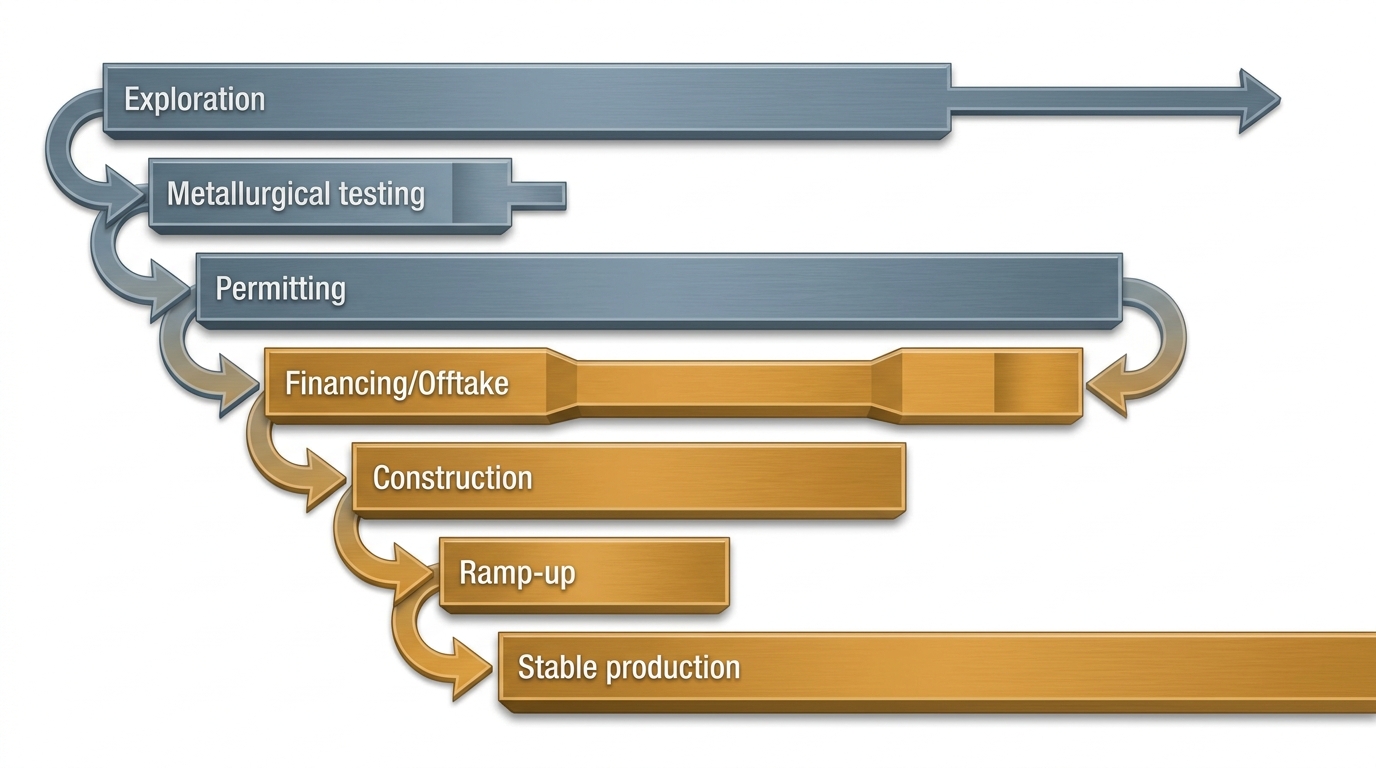
    Editorial timeline diagram illustrating how delays cascade across stages.
    Editorial timeline diagram illustrating how delays cascade across stages.

    Rare earth mine permitting in the US and EU

    Rare earth mine permitting is often the longest single gate in the mining project timeline. The reason is structural: a mine permit is usually not one permit. It is a stack of approvals tied to land use, water, air emissions, waste handling, biodiversity, cultural heritage, transport, and, in some jurisdictions, radioactive materials management. The timeline expands further when the project includes cracking, leaching, or separation rather than a simple concentrate plant, because the regulatory file begins to resemble both a mine and a chemical facility.

    United States

    In the United States, mining permitting in the US can involve federal review under NEPA, state mining approvals, water permits, air permits, wetlands issues, endangered species review, cultural resource work, tribal consultation, and local authorizations. General observations for major greenfield mines often land in a five-to-ten-year range, with longer outcomes where litigation, water conflicts, or land status issues emerge. Rare earth projects can face additional scrutiny when thorium-bearing residues, tailings characterization, or chemical processing units sit inside the project boundary. A common operational finding is that a late-stage data request on waste classification or water treatment can reset multiple workstreams at once, because engineering, environmental documentation, and community review are tightly linked.

    European Union

    In the European Union, recent strategic-minerals policy has aimed to accelerate designated projects, but permitting authority remains heavily dependent on member-state and regional procedures. As a result, a critical minerals project in the EU may benefit from stronger central policy support while still moving through a four-to-eight-year or longer path for environmental assessment, public consultation, Natura 2000 review where relevant, water approvals, and land-use decisions. The practical consequence is similar to the US: policy momentum can improve prioritization, but it does not remove the need for complete files, baseline studies across seasons, and defensible waste and water management plans.

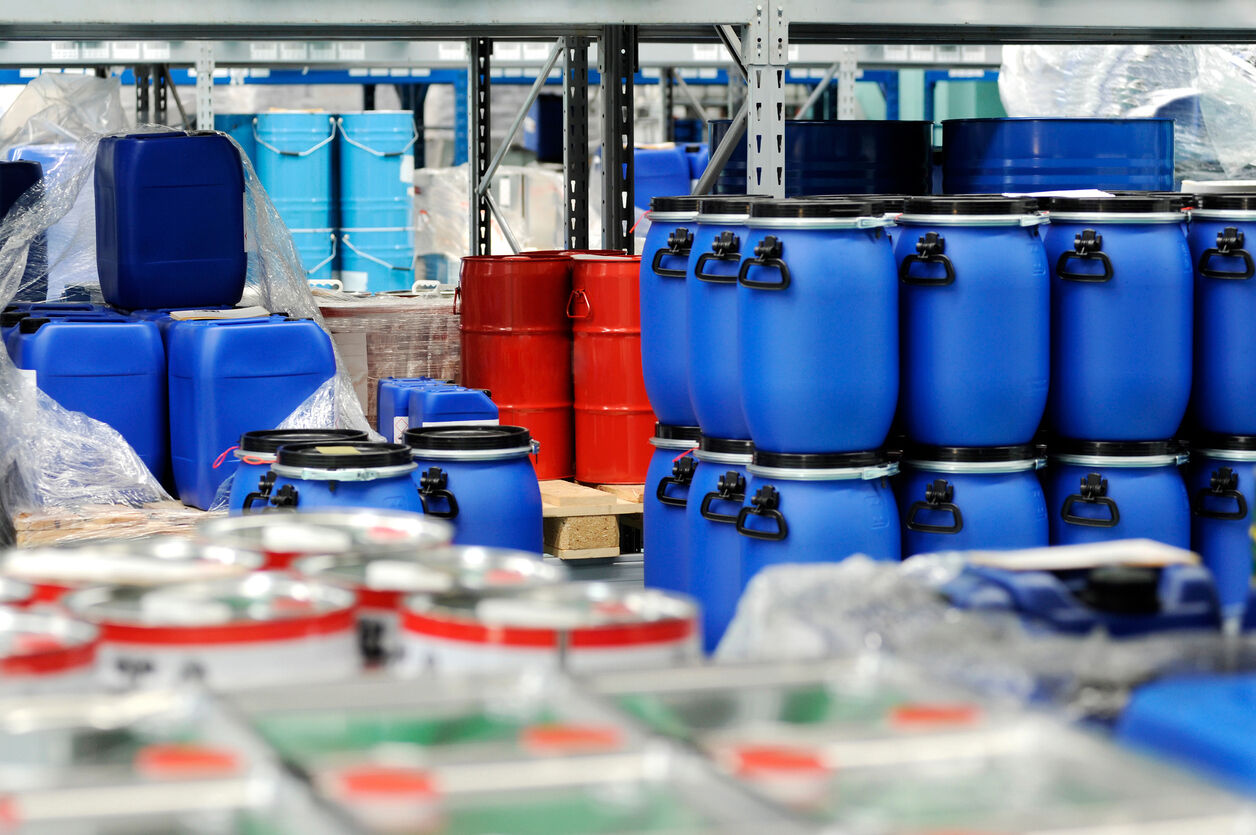
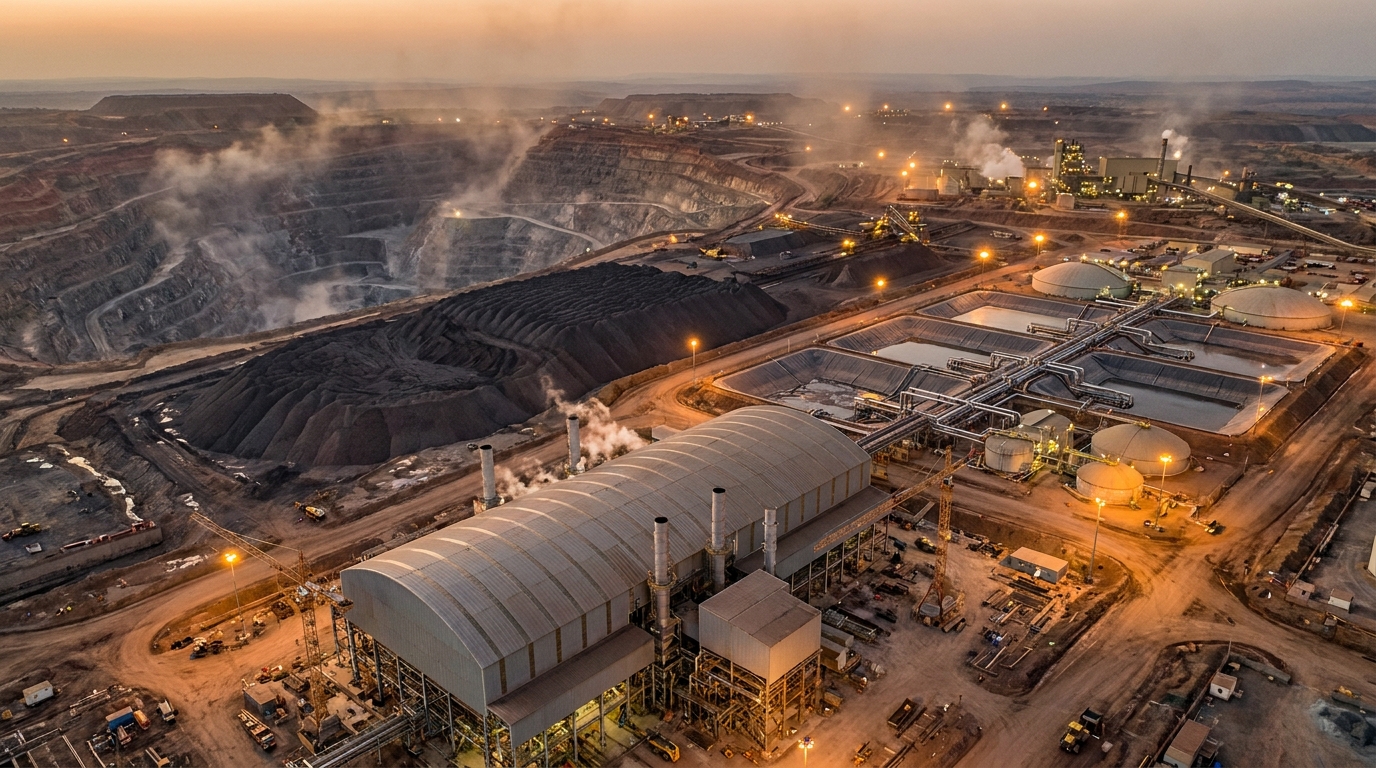
    Illustrative industrial scene for mine-to-processing development complexity.
    Illustrative industrial scene for mine-to-processing development complexity.

    Financing structure and the role of offtake

    Once the technical route and permitting path become clearer, the schedule shifts into bankability. In a rare earth project timeline, financing rarely arrives as one clean event. It more often appears as staged funding aligned with de-risking milestones. This is one reason announced production dates routinely slip: the funding stack is frequently sequential, while public timelines are often presented as if all major capital were already committed.

    • equity from the project sponsor or parent company,
    • strategic equity from industrial partners,
    • government grants, loans, or policy-bank support where available,
    • export credit or equipment-linked support for plant packages,
    • project debt once permits, product quality, and execution risk are sufficiently advanced,
    • offtake-linked prepayments or other structured support in selected cases.

    Offtake plays an important but limited role. It can show that a buyer recognizes the product route, the specification, and the strategic relevance of the material. It can also support discussions with lenders and public funding bodies. But offtake is not the same as full commercial readiness. In rare earths, this distinction is critical because one party may be evaluating a concentrate stream while the downstream user ultimately needs separated oxides, metals, alloys, or magnet inputs with tight impurity limits. An observed mismatch in many Western projects is that the mine development file advances faster than the downstream qualification file. When that happens, the project has a mine schedule and a customer schedule moving at different speeds.

    Construction and ramp-up: where the schedule often doubles back

    General observations for construction place many mining projects in a two-to-four-year build window once permits and funding are largely in hand. Rare earth projects can sit at the longer end when the asset includes beneficiation, cracking, leaching, solvent extraction, refining, or integration into metal and alloy steps. The apparent simplicity of a mine build can therefore be misleading. Roads, power, water systems, tailings facilities, reagent storage, laboratories, residue handling, and quality-control systems all have to be operational before the first saleable output becomes routine.

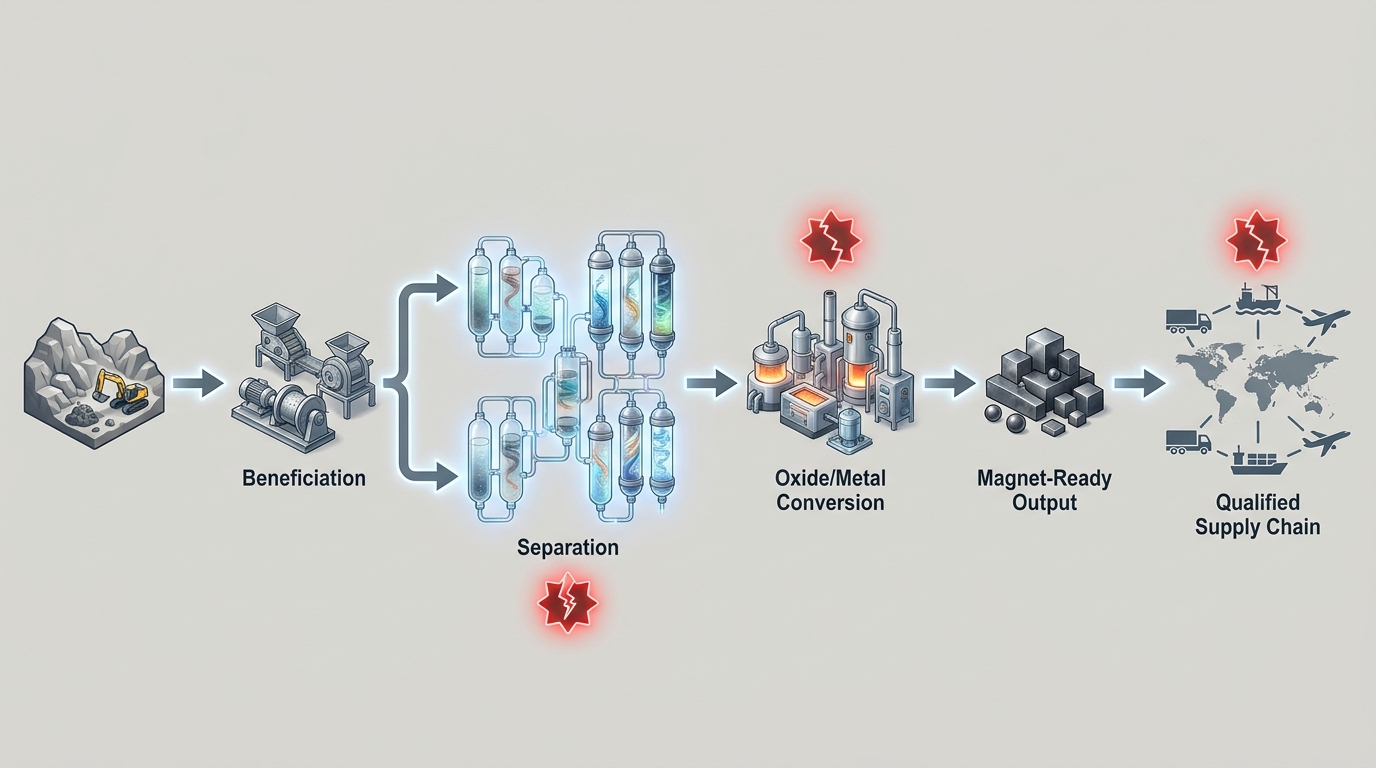
    System diagram showing multiple conversion/qualification gates.
    System diagram showing multiple conversion/qualification gates.

    Ramp-up is often even less appreciated. Six to twenty-four months is a common observation for the move from first production to stable throughput, and complex chemical circuits can exceed that range. A familiar discovery moment in commissioning is that first concentrate, first mixed rare earth carbonate, or first separated oxide does not automatically mean qualified product. Throughput can be below design, recoveries can move with ore variability, and impurity control can fail customer qualification at a late stage. In practical terms, the schedule is not finished when the plant runs; it is finished when the plant runs consistently, the product meets specification, and the logistics chain can support regular deliveries.

    Why announced production dates routinely slip

    • Sequential dependencies: permitting, financing, construction, and qualification often look parallel in presentations but behave sequentially in execution.
    • Metallurgical surprises: laboratory results can weaken at pilot or demonstration scale, especially around recoveries, reagent balance, or impurity removal.
    • Waste and water issues: tailings design, water treatment, and radioactive byproduct management are frequent sources of redesign.
    • Funding in tranches: a staged financing process can create stop-start development, with each pause pushing engineering, procurement, and hiring further out.
    • Equipment and contractor friction: late delivery, redesign after factory testing, or underperformance during installation can move commissioning by months.
    • Downstream qualification lag: mine output may exist before a converter, alloy producer, or magnet customer accepts the material at commercial scale.
    • Geopolitical and trade exposure: cross-border processing routes, export controls, sanctions, and customs treatment can alter the practicality of an originally planned supply chain.

    Observed ways timeline risk is handled

    Several management patterns appear repeatedly across critical minerals projects. One is phased development, where mine-to-concentrate starts are separated from full downstream integration. Another is use of toll processing or third-party separation while domestic refining capacity is being built. A third is earlier customer qualification work, sometimes before the final plant is complete, so that product specifications are not discovered too late. Parallel environmental baseline work is also common, because seasonal datasets can become a hard schedule limiter. Each of these approaches reduces one type of uncertainty while leaving other trade-offs in place, particularly around traceability, jurisdictional exposure, and the dependence on external processors.

    The broader lesson from the rare earth project timeline is straightforward: these projects are long because they are multi-system industrial programs, not just mines. The brutal part of the schedule is not a single bottleneck. It is the accumulation of small and large gates across geology, chemistry, permitting, capital structure, construction, and customer qualification. That is why critical minerals project announcements often look linear while actual development remains uneven, and why stable production dates in Western supply chains tend to arrive later than initial plans suggest.

  • Substitution Reality Check: A Supply-Chain Resilience Framework for Cobalt, Dysprosium, Gallium,

    Substitution Reality Check: A Supply-Chain Resilience Framework for Cobalt, Dysprosium, Gallium,

    In disruption reviews, the phrase “substitution available” often collapses once the part number, temperature envelope, certification status, and processing route are examined. Across batteries, magnets, semiconductors, catalysts, and tooling, the operational issue is rarely whether a mineral has a theoretical replacement. The more reliable question is narrower: which application can absorb a chemistry change, a lower loading, or a larger component without creating a new bottleneck elsewhere in the chain.

    • Substitution is usually application-specific rather than mineral-wide; cobalt in batteries is a very different case from cobalt in superalloys.
    • Many headline “replacements” are actually intensity reductions, architecture changes, or formulation shifts rather than full mineral exit.
    • Qualification, traceability, and export-control exposure often determine whether a substitute is commercially real.
    • Failure modes tend to appear as lower thermal stability, lower power density, shorter life, larger component size, or a new dependency on another constrained material.

    A practical frame for critical minerals substitution

    A workable assessment frame has five layers. The first is functional role: what the mineral is doing in the system. Cobalt stabilizes and supports performance in some cathode systems; dysprosium raises coercivity in NdFeB magnets; gallium enables device performance in GaN and other compound semiconductors; PGMs drive catalytic reactions; tungsten contributes density, hardness, and high-temperature stability. If the function is not defined precisely, substitution analysis becomes too abstract to be useful.

    The second layer is the performance window. A substitute may work at one voltage range, one temperature band, or one duty cycle and fail outside it. The third layer is the process and qualification burden. In observed industrial practice, a bench-tested replacement often stalls when customer approval files, product change notices, material declarations, and reliability validation are opened. Automotive, aerospace, chemical processing, and defense applications are usually the slowest to change because the mineral is embedded in a certified system, not just a bill of materials.

    The fourth layer is geography and processing concentration. A substitute can reduce exposure to one country and increase exposure to another. A recurring discovery in supply-chain reviews is that “substitution” sometimes exchanges one mine-level risk for a more concentrated refining or component-manufacturing risk. The fifth layer is failure mode visibility: whether degradation appears immediately or only after thermal cycling, corrosive exposure, vibration, or long service life. That distinction matters because delayed failure is often more disruptive than outright nonperformance at qualification.

    Cobalt: the clearest chemistry switch, but not a full demand exit

    Among the minerals in this group, cobalt has the most visible substitution path because LFP vs NMC is already a large-scale industrial choice. Lithium iron phosphate (LFP) removes both cobalt and nickel from the cathode. Nickel-manganese-cobalt chemistries (NMC) retain cobalt, even as loading per kWh has been reduced in many designs. This is one of the clearest examples of critical minerals substitution moving beyond theory.

    The substitution boundary is not universal, however. LFP fits many mass-market EV platforms and much stationary storage, where cycle life and safety profile often outweigh absolute energy density. Cobalt-bearing chemistries remain more relevant where range, weight, cold-weather behavior, or pack volume are tighter constraints. Outside batteries, cobalt remains embedded in some superalloys and specialty metallurgical uses where substitution is materially harder.

    The main failure mode in cobalt substitution is not chemical incompatibility; it is system-level compromise. The substitute battery may require a different pack architecture, volume allocation, or thermal strategy. In practical terms, that means the supply-chain analyst is not reviewing only cathode chemistry. The review extends to enclosure design, vehicle platform assumptions, and customer acceptance of performance trade-offs. One consistent market observation is that LFP has not “eliminated” cobalt demand; it has segmented demand by use case.

    Mineral-by-application substitution map (conceptual).
    Mineral-by-application substitution map (conceptual).

    Dysprosium: rare earth substitution is mostly intensity reduction

    Dysprosium sits close to the hard limit of rare earth substitution. In NdFeB permanent magnets, Dy is used mainly to improve coercivity, helping the magnet resist demagnetization at elevated temperature. That makes it particularly relevant in traction motors, wind turbines, industrial drives, and defense systems where heat and magnetic stability matter simultaneously.

    The most important development in dysprosium substitution is not a clean replacement with a non-rare-earth material. It is grain-boundary diffusion, which allows magnet producers to place heavy rare earth content where it contributes most rather than distributing it uniformly through the magnet. In supply-chain terms, this is intensity reduction, not elimination. The magnet still depends on rare earth inputs, but the Dy loading can fall materially in favorable designs.

    The failure modes are tightly linked to temperature and motor geometry. A lower-Dy magnet can pass early testing and still lose margin in high-heat duty cycles or under aggressive operating conditions. Another recurring discovery is that alternative motor architectures presented as rare earth alternatives-such as ferrite motors, induction motors, wound-field systems, or synchronous reluctance designs-shift the problem into size, efficiency, or control-system complexity rather than removing it entirely. Heavy rare earth processing concentration, especially in China, remains part of the exposure even when Dy intensity falls.

    Gallium: substitution by device architecture, not by simple material swap

    Gallium substitution is becoming more visible because power electronics design has opened a genuine comparison between GaN and SiC. In some converters, chargers, industrial drives, and EV power applications, SiC substituting GaN can make technical sense. That does not mean the two materials are interchangeable across all devices. Their advantage depends on switching frequency, voltage class, thermal behavior, packaging, electromagnetic performance, and reliability targets.

    LFP vs NMC substitution context (visual metaphor).
    LFP vs NMC substitution context (visual metaphor).

    The operational relevance increased after Chinese export licensing measures on gallium sharpened attention on compound-semiconductor dependency. Yet the substitution story remains narrow. GaN still holds strong positions in high-frequency applications, compact power supplies, and several RF-oriented designs. SiC can relieve gallium exposure in some power categories, but often with different module dimensions, different thermal assumptions, and a different qualification path.

    A common failure mode is the assumption that wafer-level substitution automatically works at the system level. In practice, parasitics, heat sinking, control strategy, and certification can change with the device family. This makes gallium a useful example of how substitution often becomes an electronics redesign project, not a commodity switch.

    Platinum group metals: chemistry sets a hard ceiling

    Platinum group metals present a different pattern. Substitution exists, but chemistry narrows the field. Palladium has historically displaced platinum in some autocatalyst formulations, and some industrial processes can use base-metal catalysts in place of PGMs when process tolerance is wide enough. Even so, the term “replaceable” becomes misleading once activity, selectivity, poisoning resistance, and durability are considered together.

    The main distinction is between loading reduction and true substitution. A catalyst system may cut platinum or palladium intensity through formulation changes and still remain fully PGM-dependent. A more radical substitution toward nickel, iron, cobalt, or copper catalysts can work in selected chemical environments, but often only within a narrow operating window. In emissions control, fuel cells, electrolyzers, and several specialty chemical processes, the performance penalty from non-PGM systems still matters.

    Supply concentration adds another layer. South Africa and Russia remain structurally important in several PGM flows, so the supply-chain question is not simply whether a catalyst alternative exists, but whether it survives the required duty cycle and regulatory regime. One repeated lesson from catalyst qualification files is that the substitute can function in the lab and still fail on service life or contamination tolerance.

    Grain-boundary diffusion concept for Dy intensity reduction.
    Grain-boundary diffusion concept for Dy intensity reduction.

    Tungsten: partial substitution, persistent physical advantage

    Tungsten substitution is easier to claim than to execute because tungsten’s value comes from an unusual combination of density, hardness, wear resistance, and high-temperature performance. Ceramics, cermets, advanced steels, and other heavy materials can replace tungsten in selected cutting, tooling, or counterweight applications, but generally not without a property penalty somewhere in the system.

    In cutting tools, alternative materials may work for specific machining conditions and still underperform on toughness or wear in broader production runs. In counterweights and defense-related uses, replacement often means larger volume for equivalent mass or reduced dimensional efficiency. In shielding and high-temperature environments, a substitute may be workable in limited settings while losing margin on durability or compactness. Processing concentration, with China playing a central role in tungsten refining and downstream products, keeps the supply risk visible even where end-use flexibility exists.

    What substitution usually means in real supply chains

    Across these five materials, the pattern is consistent. Substitution rarely arrives as a universal breakthrough. It usually appears in one of four forms: a chemistry switch in a defined product class, as seen in parts of the lfp vs nmc battery split; an intensity reduction, as seen with grain-boundary diffusion for dysprosium; an architecture change, as seen in some motor and power-electronics designs; or a formulation rebalance, as seen in several PGM applications. Tungsten shows the final category: partial replacement with clear physical trade-offs.

    That is why the phrase “Can rare earths be substituted?” has no single answer. Some can be displaced in selected designs, some can be diluted, and some remain anchored by performance requirements that are still hard to replicate. The most reliable substitution analysis stays close to the end use, the qualification file, the processing geography, and the failure mode. In operational terms, that is where substitution claims stop being slogans and start becoming measurable supply-chain reality.

  • Physical Strategic Metals: Custody, Purity, and Resale Risk Framework

    Physical Strategic Metals: Custody, Purity, and Resale Risk Framework

    In operational terms, physical strategic metals are not a simple catalog purchase. The live question is usually whether a specific lot can move cleanly from producer to holder, into custody, and back into a recognizable resale channel without losing marketability. In that setting, the phrase “how to buy physical metals” describes a chain of verification steps: deliverable form, purity evidence, title clarity, custody design, and the depth of the dealer or industrial network willing to take the material back.

    A recurring discovery in practice is that the failure point often sits outside the metal itself. An ingot with strong chemistry but weak documentation can become harder to move than a lower-profile lot carrying an intact chain of custody. Another recurring discovery is that “physical rare earth” frequently refers to oxides, salts, powders, or other application-specific materials rather than a universally fungible bar. That difference shapes purity review, storage handling, and resale options from the outset.

    Key takeaways

    • Marketability usually follows three conditions: a recognizable deliverable form, a trusted assay trail, and a resale network broader than the original seller.
    • High-purity standards in physical strategic metals matter, but impurity profile, lot identity, and packaging integrity often matter just as much in secondary handling.
    • Among observed custody structures, allocated storage from day one generally creates the clearest title record for later transfer or resale.
    • LBMA-style assay discipline remains the reference model even when the metal is not bullion: independent verification, lot traceability, sealed handling, and weight reconciliation.
    • Rare earth products and certain specialty metals tend to carry specification risk that is materially different from gold, silver, platinum, or palladium.

    1. Defining the metal universe and the deliverable form

    The first analytical layer is the form in which the metal exists. Gold, silver, platinum, and palladium generally circulate in widely recognized bar formats with established refinery marks and mature vault practices. Many industrial strategic metals do not. Nickel may appear as briquettes or cathodes; cobalt as metal or chemicals; gallium and germanium in specialized forms; tantalum and niobium in units tied closely to industrial processing. Rare earth materials often trade as oxides or separated compounds, where TREO content, impurity thresholds in ppm, and downstream application requirements drive acceptability.

    That distinction matters because resale is form-sensitive. A recognizable deliverable form can be re-evaluated by multiple counterparties. A bespoke form often depends on a narrower buyer set, sometimes industrial rather than financial. In London, Zurich, and Singapore custody practice, standard bullion units tend to move through established warehouse and dealer workflows. By contrast, rare earth oxides and certain specialty materials often require product-specific review of chemistry, packaging, and origin before a buyer even discusses marketability.

    Observed review criteria at this stage

    • Whether the unit is a standard bar, ingot, cathode, oxide, powder, or other product class
    • Whether the form is routinely accepted by more than one dealer or industrial counterparty
    • Whether packaging is part of the commercial identity of the lot
    • Whether storage conditions can preserve the product in its deliverable state

    2. Counterparty review: title, origin, and documentary continuity

    In physical metal transactions, legal identity and documentary continuity often carry as much weight as the assay itself. A robust review normally maps the seller’s legal entity, the jurisdiction governing title transfer, the role of any affiliated vault, and the point at which ownership moves from seller inventory into an identified customer holding. In the language of allocated metals, title attaches to specified bars or lots rather than to a pooled book claim.

    One practical discovery from disrupted supply situations is that paperwork gaps tend to multiply at handoff points: refinery to logistics provider, logistics provider to bonded warehouse, warehouse to vault, or dealer to ultimate holder. When a file contains only a commercial invoice and a generic certificate, secondary dealers often reopen the entire verification process. When a file contains lot numbers, refinery identity, intake records, seal references, and a clean custody statement, handling tends to be more straightforward.

    Allocated custody workflow: secure segregation, tamper-evident handling, and documented intake.
    Allocated custody workflow: secure segregation, tamper-evident handling, and documented intake.

    Origin has also become part of the risk screen. For some strategic materials, sanctions, export controls, dual-use restrictions, or responsible sourcing requirements can affect whether a later buyer is willing to touch the lot. U.S., EU, UK, and Swiss compliance environments can treat origin and route history as material features of the product, especially when the metal sits close to defense, semiconductor, or critical-mineral policy.

    3. Purity review: fineness, impurity profile, and recognized standards

    Purity is often discussed as a single headline number, but marketability usually depends on a wider chemistry package. For bullion, fineness and refinery reputation dominate. For strategic metals, the impurity profile can be decisive. A lot advertised as high purity may still fall outside the preferred range for resale if trace contaminants interfere with an industrial use case. In rare earth products, total rare earth content and oxide balance can matter alongside individual impurity caps.

    This is the point at which high-purity standards in physical strategic metals become more than a marketing phrase. A useful review file typically links each lot to a producer certificate, batch or melt reference, assay date, analytical method, and packaging identity. Without that chain, the market may treat the lot as “subject to requalification,” which often narrows the buyer universe. For platinum-group metals and good-delivery-style bullion, the market leans on established refinery systems. For less standardized materials, acceptance becomes more document-dependent.

    Buyer-side workflow from selection to resale readiness.
    Buyer-side workflow from selection to resale readiness.

    Documentation commonly associated with a marketable lot

    • Producer or refiner name
    • Lot, batch, melt, or serial identifier
    • Declared fineness or chemistry table
    • Assay method or analytical laboratory reference
    • Packaging or seal identifiers
    • Warehouse or vault intake confirmation

    4. Assay discipline: why LBMA-style practice remains the benchmark

    LBMA-style assay practice remains the clearest mental model for physical verification even outside bullion. The value of that model lies in process discipline rather than brand alone: recognized sampling logic, documented analytical methods, tamper-evident handling, and reconciliation between stated and observed weight. In markets where the secondary buyer is cautious, that process can matter more than a standalone certificate.

    In real handovers, incoming review often centers on package integrity, count reconciliation, seal verification, weight confirmation, and document matching. Independent re-assay appears more frequently when packaging has been disturbed, when the lot has crossed several intermediaries, or when the material falls into a niche product class. A common discovery is that a seemingly minor break in seals can push the lot from “warehouse-transferable” to “needs revalidation,” which changes the later resale path.

    5. Custody design: allocated storage from day one and the handover record

    Custody risk begins before settlement completes. Where the metal is held, how it is identified, and whether title is allocated or pooled shape later transferability. Among observed structures, allocated storage from day one produces the clearest ownership trail because the bars or lots are identified immediately and appear on a custody statement tied to the holder. That approach is especially relevant when the same lot may later move to another dealer, another vault, or an industrial buyer.

    The handover itself is best understood as a controlled evidence event. The core elements are familiar across professional vaulting environments: sealed arrival, courier identification, package condition review, weight or count reconciliation, lot confirmation, exception logging, and final receipt into the vault or bonded warehouse. In strategic metals outside traditional bullion, storage conditions can also become part of deliverability. Some products are more sensitive to moisture, oxidation, contamination, or packaging damage, and a degraded container may affect resale even when the chemistry is still sound.

    Purity and acceptance inspection: visual cues and verification tools.
    Purity and acceptance inspection: visual cues and verification tools.

    Cross-border storage adds another layer. Customs treatment, bonded status, sanctions screening, and local property law can all affect how easily title transfers later. In jurisdictions with active commodity logistics infrastructure, documentary quality tends to determine whether a transfer is treated as routine or escalated for deeper review.

    6. Resale mapping: dealer network depth and the secondary path

    Resale analysis starts with a simple distinction: whether the lot can be re-priced by a network or only by the original seller. A resale dealer network with more than one credible route usually signals stronger marketability. In precious metals, that network is typically broad. In specialty metals and rare earth products, the network may consist of a smaller group of industrial merchants, processors, or specialist dealers that recognize only certain forms and quality files.

    A useful resale map often includes the original dealer, independent secondary dealers, vault-to-vault transfer channels, and any industrial counterparties known to handle the same form. Another common discovery is that the secondary market places heavy weight on continuity: original packaging intact, recent custody statement, recognized assay, and no ambiguity around title. When one of those elements is missing, the material may still move, but the path becomes narrower and slower.

    7. Typical failure modes observed in physical strategic metals

    • Form mismatch: the product exists in a technically valid form that only a small industrial niche accepts.
    • Assay insufficiency: the certificate states purity but does not establish recognized testing discipline or sample traceability.
    • Broken custody chain: title, storage, or transport records contain gaps that later buyers reopen.
    • Packaging degradation: seals, labels, or protective packaging are damaged, moving the lot into requalification.
    • Origin sensitivity: export controls, sanctions exposure, or responsible-sourcing concerns reduce the potential buyer set.
    • False equivalence with bullion: a physical rare earth lot is treated as if it were a standard bar, even though market practice is specification-driven.

    Closing frame

    Across physical strategic metals, the most stable analytical pattern is consistent: deliverable form first, chemistry and assay second, title and custody continuity third, resale network last. Those elements reinforce one another. A strong lot is not merely pure; it is legible to the next holder. For that reason, custody, purity, and resale are not separate workstreams but parts of the same operational file. Where the market offers standardized bars and mature dealer networks, the file is simpler. Where the market relies on oxides, powders, or tightly specified industrial units, the file becomes more technical and the resale path more selective.

  • Samarium-Cobalt in Defense: Thermal Advantage, Material Trade-Offs, and Supply Chain Risk Framework

    Samarium-Cobalt in Defense: Thermal Advantage, Material Trade-Offs, and Supply Chain Risk Framework

    In defense and aerospace component reviews, samarium-cobalt usually appears when the operating environment is more punishing than the magnet drawing first suggests. The recurring pattern is not peak room-temperature pull, but stability under heat, vibration, vacuum exposure, and long storage intervals. That is why the question “what is samarium cobalt” is usually tied to a second question: why this material still remains in missiles, aerospace actuators, sensors, and precision motors when NdFeB is more common elsewhere. In practice, an SmCo magnet occupies the high-reliability end of the permanent-magnet spectrum, where thermal margin and resistance to demagnetization often outweigh maximum magnetic output at ambient conditions.

    Key takeaways

    • Samarium-cobalt is a rare-earth permanent magnet family centered on SmCo5 and Sm2Co17, with distinct trade-offs in coercivity, remanence, and magnetic stability.
    • Among defense magnets, SmCo remains relevant because it is widely treated as a high temperature magnet class with strong resistance to demagnetization in harsh duty cycles.
    • Samarium supply is typically tied to LREE oxide streams from broader rare-earth separation, while cobalt introduces a separate concentration risk in mining, refining, and traceability.
    • Observed failure modes often come from qualification gaps, brittle processing losses, documentation breaks, and hidden single-source dependencies rather than from magnet chemistry alone.
    • Recent supply-chain discussion has centered on non-Chinese separation capacity, cobalt traceability, and the long qualification path for aerospace-grade magnet components.

    What samarium-cobalt is in practical terms

    Samarium-cobalt is a sintered rare-earth permanent magnet material made from samarium and cobalt, generally with additional alloying elements in commercial grades. The two core families are SmCo5, often called the 1:5 family, and Sm2Co17, the 2:17 family. Both are known for strong magnetic anisotropy, which helps the magnet hold its magnetization under opposing fields and elevated temperatures. In operational terms, that is the reason SmCo is associated with guidance hardware, compact electromechanical assemblies, and other environments where magnetic drift is harder to tolerate.

    A useful way to frame samarium uses is by consequence rather than by volume. Samarium appears in several industrial contexts, but permanent magnets are among the most strategically sensitive because the material ends up inside systems where field stability and thermal endurance matter directly to function. That distinction explains why samarium-cobalt has remained visible in aerospace and defense even though it is not the default choice for mass-market motors or consumer devices.

    SmCo5 versus Sm2Co17: the material split that matters

    The divide between SmCo5 and Sm2Co17 is not just a chemistry label. It shapes the magnetic behavior, the processing route, and the qualification logic. SmCo5 is the older material family and is commonly recognized for excellent coercivity and magnetic stability. In practical reviews, it is often associated with applications where resistance to demagnetization is the dominant requirement. Sm2Co17, by contrast, generally offers higher remanence and a higher energy product than SmCo5 while retaining much of the thermal and demagnetization resilience that makes SmCo attractive in the first place.

    One recurring discovery in magnet qualification work is that design teams sometimes remember the “SmCo” label but not the family-specific behavior. That can create confusion later, especially when a subassembly originally built around Sm2Co17 is treated as interchangeable with SmCo5. In documentation reviews, the decisive point is usually the actual operating envelope: field strength needed in the available volume, demagnetization margin, temperature exposure, and tolerance for magnetic aging. The material name alone rarely captures those differences.

    Why missiles and aerospace systems still use SmCo

    The defense case for samarium-cobalt is mainly environmental. Missile and aerospace hardware can experience rapid thermal changes during launch or flight, localized hot spots from adjacent electronics, vibration, shock, and limited cooling volume. A magnet that performs well on a room-temperature datasheet can become less attractive when those conditions are introduced. SmCo remains important because it is broadly regarded as a high temperature magnet platform with better magnetic retention at elevated temperatures than many NdFeB grades, especially once long-duration exposure and demagnetization risk are included in the picture.

    How SmCo magnets are housed and why thermal/demagnetization conditions matter
    How SmCo magnets are housed and why thermal/demagnetization conditions matter

    That explains why SmCo continues to appear in missile guidance subsystems, fin actuators, precision motors, inertial devices, aerospace sensors, and compact servo assemblies. The material is not universally stronger than NdFeB, and that is not the point. The point is stability when the system is hot, space-constrained, and mechanically stressed. In many defense magnets, thermal confidence matters more than extracting the highest possible ambient-field performance from the smallest package.

    The operating temperature advantage and the limits around it

    Commercial magnet literature consistently places samarium-cobalt in the high-temperature category relative to NdFeB, but exact limits vary by grade, geometry, magnetic circuit, and surrounding materials. That last clause matters. In real assemblies, the magnet is only one thermal element in the chain. Adhesives, insulation systems, neighboring electronics, and mechanical interfaces often become the true limit before the magnet chemistry does. A familiar discovery in aerospace assemblies is that the “SmCo temperature margin” exists on paper, while the packaging stack remains the weak point.

    This is one reason the phrase high temperature magnet needs operational context. SmCo’s advantage is real, but it is system-dependent. A well-designed SmCo motor rotor, sensor bias magnet, or actuator element can preserve magnetic performance under conditions that challenge NdFeB. A poorly integrated assembly can still fail through cracking, adhesive degradation, thermal mismatch, or incomplete demagnetization analysis. In practice, the magnet choice and the package design are inseparable.

    Supply chain perimeter: where samarium comes from

    For supply-chain analysis, the first important fact is that samarium is rarely a standalone mine story. It is typically produced through broader rare-earth mining and separation systems, with feedstocks such as bastnäsite and monazite yielding mixed rare-earth concentrates. Samarium then emerges from downstream separation as part of an LREE oxide flow rather than a simple direct line from mine to finished magnet. That is why samarium production is best understood as tied to LREE oxides and to the availability of separation capacity, reagents, permits, and metallization capability.

    Side-by-side concept comparison of SmCo5 vs Sm2Co17 stability
    Side-by-side concept comparison of SmCo5 vs Sm2Co17 stability

    This matters because a samarium-cobalt supply chain can appear diversified at the magnet plant level while remaining concentrated upstream in rare-earth separation. A magnet fabricator may sit in one jurisdiction, the alloy stage in another, and the oxide separation step in another still. Recent industry attention has focused heavily on that hidden concentration, especially where defense programs seek traceable inputs outside China but still rely on processing steps that remain difficult to replicate at scale.

    Cobalt concentration adds a second strategic risk layer

    Samarium-cobalt is also a cobalt story. Cobalt mining has long been associated with concentrated upstream exposure, particularly through the Democratic Republic of the Congo, while refining capacity is heavily concentrated in China. For defense-grade magnet supply chains, that creates a separate risk layer from rare-earth separation. Even when samarium availability is manageable, cobalt traceability, refining geography, and purity control can still shape qualification outcomes.

    The practical implication is that an SmCo magnet supply chain is never a single-material chain. It sits at the intersection of rare-earth separation, cobalt metallurgy, powder preparation, sintering, machining, magnetization, and compliance documentation. Export controls, sanctions screening, environmental scrutiny, and end-use certification can all become relevant depending on route and jurisdiction. In recent reviews, the documentation burden has often been as consequential as the physical material flow.

    Observed failure modes in SmCo supply chains

    • Family mismatch: substitution between SmCo5 and Sm2Co17 without a fresh review of coercivity, remanence, and thermal behavior.
    • Hidden single-source exposure: multiple distributors tied back to the same oxide separator, cobalt refiner, or alloy house.
    • Brittleness and yield loss: SmCo is mechanically brittle, so grinding, machining, and handling can create chipping, crack initiation, or elevated scrap during qualification builds.
    • Documentation gaps: incomplete lot traceability, chemistry certificates, or magnetic-property records delaying aerospace approval even when the physical magnet is available.
    • System-level thermal misunderstanding: the magnet survives the heat load, but adhesives, platings, or adjacent components do not.
    • Geopolitical route disruption: export restrictions, sanctions exposure, or logistics breaks affecting cobalt or rare-earth processing stages rather than final magnet assembly.

    A notable operational pattern is that shortages are not always visible as “no material available.” They often show up as partial availability with uncertain traceability, or as technically acceptable material that does not align with prior qualification records. For aerospace and missile programs, that distinction can be the difference between continuity and a prolonged revalidation cycle.

    Generic SmCo supply-chain pathways and where risks propagate
    Generic SmCo supply-chain pathways and where risks propagate

    Observed risk-management options in the market

    Across high-reliability programs, several management patterns appear repeatedly. One is multi-jurisdiction qualification, where oxide, alloy, and final magnet stages are not all tied to a single country. Another is selective buffering at the finished-component stage rather than at intermediate chemistry stages, especially where machining and magnetization create long approval paths. A third is design branching, in which some subsystems preserve an NdFeB path for moderate environments while the hotter or more mission-critical locations remain locked to SmCo.

    Documentation hardening is another common pattern. Material declarations, chemistry records, demagnetization data, and lot-level traceability often become central artifacts rather than administrative attachments. In recent supply-chain work, the strongest differentiator has frequently been not nominal capacity, but the ability to connect samarium separation, cobalt source, alloy batch, and final magnetic properties into a coherent qualification record.

    What samarium-cobalt is used for

    In practical terms, samarium-cobalt is used where magnetic performance has to survive a demanding environment. Defense and aerospace examples include missile control actuators, guidance components, gyroscopic and inertial assemblies, high-reliability sensors, compact motors, and servo mechanisms. Outside defense, samarium uses include specialty industrial motors, instrumentation, medical systems, and other assemblies where heat and magnetic stability outweigh the priority of lowest-cost magnet volume.

    The enduring relevance of samarium-cobalt comes from that combination of material behavior and supply-chain complexity. Technically, it remains one of the established answers to heat, demagnetization, and long-life stability. Commercially, it depends on two sensitive upstream chains at once: LREE separation for samarium and geopolitically concentrated cobalt refining. Any public discussion of SmCo in defense is so incomplete without both halves of the picture.

  • Strategic Metals Storage: Jurisdictions, Custody Models, and Failure Modes Compared

    Strategic Metals Storage: Jurisdictions, Custody Models, and Failure Modes Compared

    Strategic metals storage tends to look straightforward until a transfer, audit, customs review, or liquidation event tests the file. In day-to-day operations, the decisive issue is rarely the door thickness of a metal vault. The decisive issue is whether title, specification, location, and release mechanics remain coherent when the material leaves the warehouse or changes hands. That distinction becomes sharper for strategic inventories such as refined precious metals, industrial metals with strategic relevance, and some rare earth storage programs involving oxides, alloys, or intermediate products.

    A practical comparison usually rests on three layers: the jurisdictional wrapper, the custody model, and the documentary stack supporting insurance and exit liquidity. Geneva, Singapore, and Delaware each sit in a different part of that map. Geneva is often associated with mature vaulting and trading infrastructure. Singapore is frequently linked to free port storage, transshipment efficiency, and Asia-facing logistics. Delaware is commonly examined through the lens of domestic U.S. custody, warehouse utility, and legal familiarity rather than as a classic free-port jurisdiction.

    Key takeaways

    • Allocated metal custody and unallocated exposure are different legal and operational animals; the distinction often determines whether an inventory is a direct property interest or a claim on an institution.
    • Free zone status can ease customs handling, but free port storage does not by itself solve title ambiguity, assay mismatch, or insurance exclusions.
    • For rare earth storage and other specification-sensitive materials, assay certificates, lot numbering, and contamination controls often matter as much as physical security.
    • Exit liquidity depends on more than market depth; releasability, load-out mechanics, sanctions screening, and customs classification often control the real timeline.

    Operational perimeter: what counts as strategic metals storage

    In practice, strategic metals storage covers more than bullion bars. The storage population can include standard precious metals, high-purity industrial metals, concentrates or intermediate products, and niche materials held for working inventory or disruption management. The product form changes the risk profile immediately. A serialized bullion bar usually travels with recognized refinery marks, assay conventions, and familiar release procedures. A mixed rare earth oxide, by contrast, may sit under a different documentary burden, with value linked to TREO content, impurity thresholds expressed in ppm, and packaging conditions that protect lot integrity. Lithium-linked intermediates described in LCE terms raise a similar issue: quantity alone does not settle merchantability if the specification stack is incomplete.

    One recurring discovery from storage reviews is that facilities with similar perimeter security can differ sharply in inventory intelligibility. One site may maintain lot-by-lot traceability, chain-of-custody records, and independent audit support. Another may offer strong physical protection but weak reconciliation between warehouse receipt, assay file, and actual releasable stock. For strategic metals storage, that gap often becomes visible only when a counterparty asks for transfer, split lots, or physical withdrawal.

    Custody models compared: unallocated, allocated, and segregated

    Unallocated exposure

    Unallocated storage usually means an account holder has a claim to metal rather than title to identified bars or lots. This structure can support trading fluidity and administrative simplicity, particularly for standardized material. The trade-off is balance-sheet exposure to the storage institution or intermediary. In a stress event, the operational question becomes whether physical deliverability matches the account balance and whether insolvency treatment preserves direct access to metal.

    For plain bullion, the market is accustomed to that distinction. For strategic metals, the gap can be wider because non-standard lots are harder to replace quickly and harder to match precisely by specification. A pooled statement showing a metal balance may say little about impurity profile, accepted packaging, or the provenance documents needed for onward transfer.

    Allocated metal custody

    Allocated metal custody links the holder to identified bars, drums, pallets, cartons, or other lots listed on an inventory schedule. This model usually supports stronger title clarity, cleaner insurance schedules, and more defensible audit trails. It is especially relevant when the stored product is not fully fungible. A named lot with an assay certificate, packing list, and warehouse location is easier to reconcile than a general entitlement to an equivalent weight.

    Three-layer framework overview of jurisdiction, custody model, and exit design
    Three-layer framework overview of jurisdiction, custody model, and exit design

    Within strategic metals storage, allocated custody often functions as the baseline format when the material may later move across borders, transfer to another owner, or support a formal stock verification process. The operational benefit is not elegance; it is evidence.

    Segregated and hybrid structures

    Segregated storage goes one step further by physically separating a holding from other clients’ metal. This format appears more often where contamination risk, handling sensitivity, or client-specific provenance rules are material. Hybrid structures also appear in practice: for example, allocated ownership with shared room storage, or segregated handling only for selected lots. The key variable is how the warehouse agreement describes title, access, substitution rights, and reconciliation procedures.

    Provider types and free-zone wrappers

    • Private vault operator: usually centered on physical security and controlled access, often strongest for high-value compact materials.
    • Institutional depository: commonly adds structured reporting, independent audits, bar or lot schedules, and more formal release workflows.
    • Bonded warehouse or free zone facility: often used when customs treatment, deferred import formalities, or re-export flexibility sit at the center of the storage design.
    • Industrial warehouse: more common for bulky or process-linked materials, where handling capability matters as much as vault architecture.

    Free port storage can be helpful when material is expected to transit internationally, remain under customs control, or move between jurisdictions without immediate domestic import treatment. Even so, free zone status is only one wrapper. A weak custody model inside a free zone still leaves title and release problems unresolved. That is a common misunderstanding in market discussions around strategic metals storage.

    Geneva, Singapore, and Delaware: the main comparison points

    Geneva is often evaluated as a mature storage and trading node. The attraction generally lies in institutional familiarity, long-standing vault infrastructure, and a legal environment associated with careful documentary standards. Geneva tends to suit holdings where neutrality, audit discipline, and downstream tradability matter more than immediate industrial dispatch.

    Allocated custody emphasis: physical security, inventory controls, and assay/audit workflow
    Allocated custody emphasis: physical security, inventory controls, and assay/audit workflow

    Singapore is frequently associated with efficient logistics, customs clarity, and a strong role in regional transshipment. For Asia-facing supply chains, free port storage in or around Singapore can fit inventories that may be re-exported, redistributed, or repositioned with relatively little administrative friction. The jurisdiction is often discussed in connection with high-value goods warehousing because the logistics ecosystem is built for speed, compliance, and controlled handling.

    Delaware enters the comparison from a different angle. It is not generally viewed as a classic free-port equivalent, but it can be relevant for U.S.-anchored ownership structures, domestic warehousing logic, and legal familiarity around title and secured interests. In practice, Delaware tends to be part of a domestic custody conversation rather than a transshipment or customs-arbitrage conversation.

    A useful way to read the three locations is by dominant operating pattern. Geneva often aligns with institutional custody and internationally recognizable documentation. Singapore often aligns with logistics efficiency and regional mobility. Delaware often aligns with domestic legal coherence and U.S. settlement convenience. None of those traits automatically settles the storage decision; product form and exit route usually carry equal weight.

    Insurance underwriting basis and the documentary stack

    Insurance underwriting for strategic metals storage usually turns on identifiability, handling conditions, and the legal form of ownership. Underwriters tend to view allocated inventories more cleanly because the insured subject can be mapped to specific lots, weights, purity levels, serial numbers where applicable, and known storage locations. A listed bar schedule or lot schedule is easier to underwrite than a general claim on a pool of metal.

    For non-standard material, the documentary stack often includes assay certificates, packing lists, warehouse receipts, transport records, and periodic independent audit reports. In rare earth storage, the assay file may carry the real commercial meaning of the lot: TREO basis, elemental distribution, moisture references where relevant, and impurity limits in ppm. In that setting, a warehouse receipt without a matching analytical trail can leave the inventory formally stored but operationally hard to transfer.

    Jurisdictional comparison network diagram (icon-only)
    Jurisdictional comparison network diagram (icon-only)
    • Identity evidence: serial numbers, lot numbers, marks, seal references, and location mapping.
    • Specification evidence: assay certificate, refinery or processor origin, purity statement, and impurity profile.
    • Condition evidence: packaging status, tamper indicators, and handling restrictions.
    • Verification evidence: independent audit record, reconciliation report, and chain-of-custody continuity.

    A frequent discovery in underwriting reviews is that “insured” can mean very different things depending on the wording. One policy may respond to physical loss of identified inventory. Another may sit higher up the chain and respond only through institutional liability. That difference matters most when the stored product is hard to replace or difficult to re-assay without delay.

    Failure modes observed in practice

    • Title ambiguity: account statements exist, but the legal file does not clearly separate customer property from the custodian’s balance sheet.
    • Specification drift: the metal in storage remains present by weight, but the assay, contamination profile, or packaging condition no longer supports the expected exit route.
    • Customs reclassification: a product stored under one description faces a different treatment when released or exported.
    • Insurance mismatch: coverage attaches to the warehouse operation generally, but not clearly to the identified lot or transit leg.
    • Release friction: load-out rights, inspection windows, sanctions screening, or administrative approvals slow the move from “owned” to “releasable.”
    • Concentration risk: too much inventory, documentary dependence, or political exposure sits in one jurisdiction, one operator, or one route.

    Exit liquidity considerations

    Exit liquidity in strategic metals storage is often discussed as if it were purely a market question. In operational terms, it is more often a release question. How easily a lot can be sold, transferred, or withdrawn depends on whether title is clean, whether the receiving party accepts the assay basis, whether the jurisdiction supports prompt release, and whether customs or compliance checks reopen the file at the point of movement.

    Standardized precious metals generally benefit from broader acceptance across vault networks and trading channels. Strategic and specialty materials can be more path-dependent. A lot stored near an end-use region may have stronger practical liquidity than an equivalent lot in a neutral jurisdiction if the onward route is simpler. Conversely, a neutral storage hub with superior documentation may support faster title transfer even when the physical movement occurs later. That is why metal vault selection and jurisdiction selection are rarely separable from intended exit mechanics.

    Viewed through that lens, Geneva, Singapore, and Delaware are less competitors than distinct operating environments. The comparison becomes clearer when each location is matched against product form, legal title architecture, documentation quality, and the realism of the eventual release pathway. For strategic metals storage, those four elements usually explain the resilience of the arrangement far better than a headline description of the warehouse alone.

  • The Hidden Bottleneck: A Supply-Chain Risk Framework for Critical Minerals Refining

    The Hidden Bottleneck: A Supply-Chain Risk Framework for Critical Minerals Refining

    In disruption reviews across battery and magnet supply chains, the break rarely appears at the mine gate. It usually appears later, when a concentrate with acceptable grade cannot be converted into a qualified chemical, separated oxide, sulfate, or anode material on the timetable assumed by downstream plants. That operating reality explains why critical minerals refining carries more geopolitical weight than mine ownership alone.

    • Commonly cited public estimates place China at around 90% of rare earth separation, about 60-70% of lithium chemical refining, and roughly 75-80% of cobalt refining, alongside a dominant position in graphite anode material processing.
    • The recurring chokepoint is not geology by itself, but conversion: solvent extraction, purification, precipitation, crystallization, spheronization, coating, and qualification.
    • Mine headlines can overstate resilience. A new source of feedstock does not remove dependence if the material still travels into Chinese conversion plants or precursor lines.
    • Observed failure modes cluster around impurity control, reagent and utility dependence, environmental permitting, residue handling, and slow downstream qualification.

    Why refining defines control more clearly than mining

    Mining creates feedstock. Refining creates usable material. Between those two points sits the industrial layer that removes impurities, separates chemically similar elements, controls particle morphology, and produces the exact specification a battery, magnet, alloy, or electronics manufacturer can qualify. In practice, that layer is often the hardest part to replicate because it depends on cumulative process know-how, stable utilities, high-purity acids and reagents, compliant waste treatment, and customers willing to qualify output at ppm, or parts-per-million, impurity thresholds.

    A recurring discovery in operational assessments is that mine-level metrics such as TREO grade in rare earths or LCE headlines in lithium say less than expected about resilience. TREO, or total rare earth oxides, can look attractive while the distribution of magnet rare earths and the burden of separation remain unfavorable. LCE, or lithium carbonate equivalent, can signal scale at the resource level while conversion into battery-grade hydroxide or carbonate remains constrained elsewhere. The center of gravity shifts from resource abundance to process capability.

    How the chokepoint appears in four mineral chains

    Rare earth refining shows the pattern most clearly. China rare earth processing retains the dominant position in separation, with public estimates commonly clustering around 90% of global separation capacity. That share matters because mined mixed rare earth concentrate is not yet a magnet input. The difficult step is separating near-identical lanthanides through long solvent extraction circuits, then converting selected oxides into metals, alloys, and magnets. In practice, a rare earth mine outside China can still leave the system dependent on Chinese separation if no alternative route exists for NdPr and heavier elements such as dysprosium and terbium.

    Lithium refining follows the same logic. Spodumene concentrate from Australia or brine-derived intermediates from South America do not directly supply a cathode plant. They first move through chemical conversion into battery-grade lithium carbonate or lithium hydroxide. Public estimates often place Chinese lithium refining in the 60-70% range, with variation by product and reporting year. A common discovery during supply-chain reviews is that mine commissioning receives more attention than conversion ramp-up, yet qualification failures in lithium refining can delay usable output even when mined feedstock is available.

    Cobalt refining adds a different layer of concentration. Mine production is tied heavily to copper and nickel systems, especially in the Democratic Republic of Congo, but refining into battery-grade cobalt sulfate is concentrated in China. Public estimates commonly place China’s cobalt refining share around 75–80%. The operational choke point is purification and crystallization to a specification accepted by precursor manufacturers. Traceability, jurisdictional risk, and transport complexity matter, but chemical conversion remains the decisive point where feedstock becomes usable battery material.

    Refining processes as the chokepoint in critical minerals supply chains (no text labels).
    Refining processes as the chokepoint in critical minerals supply chains (no text labels).

    Graphite is often underestimated because the strategic issue is farther downstream than mining. Battery makers do not consume flake graphite as-mined. They consume anode material: purified spherical graphite, coated spherical graphite, or synthetic graphite products meeting demanding morphology and purity standards. China dominates graphite anode material refining through purification, spheronization, coating, and integration with battery-material manufacturing. This is one of the clearest examples of a chain where new mining outside China does not, by itself, solve the bottleneck.

    Why China dominates critical minerals refining

    The concentration is not explained by geology alone. China built durable advantages in process industries that become stronger with repetition and scale. Solvent extraction circuits in rare earth refining, impurity control in lithium refining, sulfate production in cobalt refining, and anode finishing in graphite all benefit from years of plant learning. The more often a plant solves filtration issues, reagent balance problems, residue handling, or product-spec drift, the harder it becomes for a new entrant to match consistency.

    Industrial clustering also matters. Refining plants operate more reliably when acids, alkalis, reagents, power, water treatment, waste disposal, laboratories, and downstream customers sit within the same industrial ecosystem. China assembled those ecosystems around magnets, cathodes, precursor materials, anodes, electronics, and electric-vehicle manufacturing. That clustering shortened the distance between chemical conversion and final qualification. It also reduced the operational penalty when a process line needed troubleshooting or a product needed reformulation for a specific customer.

    Another discovery from actual supply disruptions is that documentary readiness can be as important as metal content. Export controls, customs classifications, chain-of-custody declarations, safety data sheets, environmental permits, and traceability files can interrupt shipments even when physical production is available. China’s mature processing base often sits inside established documentation routines for these flows, whereas emerging plants in other jurisdictions may still be building those systems.

    Conceptual framework showing refining as the hidden bottleneck.
    Conceptual framework showing refining as the hidden bottleneck.

    Why Western mining projects do not remove the dependence

    The phrase “mine supply” can obscure where vulnerability actually sits. A lithium mine in Australia, a rare earth project in the United States, a graphite mine in Africa, or a cobalt source outside China improves optionality at the feedstock level. It does not automatically create separated oxides, battery-grade lithium chemicals, cobalt sulfate, or coated spherical graphite in the same jurisdiction. If those conversion steps still occur in China, dependence remains embedded in the chain.

    This gap appears repeatedly when upstream projects reach production before downstream refining is ready. Concentrate can be shipped, but product qualification lags. Residue management systems may still be under review. Reagent purity or utility stability may not match process assumptions. In rare earths especially, the route from mine concentrate to separated oxides and then to magnet metal is long enough that one missing processing stage can preserve the original chokepoint almost intact.

    Assessment frame: the signals that matter in refining risk

    A practical assessment of critical minerals refining usually turns on five layers. The first is process complexity: the number of stages between feedstock and final specification, including solvent extraction, roasting, leaching, precipitation, crystallization, purification, calcination, spheronization, and coating. The second is dependency on inputs such as sulfuric acid, caustic soda, specialty reagents, water quality, and uninterrupted power. The third is environmental and residue management, since wastewater, tailings, fluorine-bearing streams, or other by-products can become the real source of delay.

    The fourth layer is qualification risk. Battery, magnet, and specialty-alloy manufacturers often require long validation cycles before new material enters a production line. A refinery can so exist physically while remaining commercially irrelevant to the downstream system if output is not yet qualified. The fifth layer is route concentration: whether a material flow still depends on one country, one processing cluster, one port, or one customs channel. Australia-to-China spodumene flows and Congo-to-China cobalt intermediate flows illustrate how mining diversity can coexist with refining concentration.

    Downstream material specificity (anode material / refined outputs) at the micro scale.
    Downstream material specificity (anode material / refined outputs) at the micro scale.

    Observed failure modes are also fairly consistent across minerals. Product purity can drift outside accepted ppm limits. Recovery rates can vary by feedstock blend. Waste circuits can limit throughput before the core chemical line does. Qualification can fail because particle size distribution, morphology, or trace contaminants differ from an incumbent supplier’s output. Documentary gaps can hold cargo even when plant operations are stable. These are refining problems, not mining problems, and they often determine whether a nominally diversified chain is truly resilient.

    Observed responses in practice

    Across jurisdictions, several management patterns have appeared without eliminating the underlying difficulty. Some chains pursue integrated mine-to-chemical projects so that feedstock and conversion develop together. Others build partial regional capacity first, such as mixed rare earth carbonate processing, intermediate lithium conversion, or graphite purification ahead of full anode production. Some systems rely on allied-country processing networks rather than a single domestic site. Recycling and scrap recovery also appear more often in planning because they can supply refined units with less exposure to raw feedstock concentration, although recycled streams still require sophisticated separation and purification.

    Catch-up outside China looks most plausible where an existing chemical industry, stable utilities, waste-treatment infrastructure, and downstream manufacturing already coexist. Even then, the hard part is consistency rather than construction alone. A refinery can be commissioned long before it becomes a trusted source for a cathode line, a magnet producer, or an anode plant. That distinction is central to any reading of critical minerals refining: capacity on paper and qualified supply in practice are not the same thing.

    The hidden bottleneck, then, is not hidden because it is obscure. It is hidden because mining still dominates the public narrative while refining determines the practical balance of power. In lithium, rare earth refining, cobalt refining, and graphite anode material processing, the decisive leverage sits in conversion, separation, and qualification. That is where concentration persists, where disruptions spread fastest, and where supply-chain resilience is either confirmed or disproved.

  • Rare Earth Supply Chain Resilience: Mine-to-Magnet Bottlenecks, Qualification Evidence, and Failure

    Rare Earth Supply Chain Resilience: Mine-to-Magnet Bottlenecks, Qualification Evidence, and Failure

    Operationally, rare earth disruptions rarely begin with the headline narrative around electrification, defense demand, or strategic materials. They usually begin much earlier: a concentrate that behaves differently in pilot work than in the flowsheet, an impurity profile that complicates solvent extraction, an oxide that misses customer purity expectations, or a magnet qualification program that runs longer than the upstream project assumed. In practice, the central distinction is not “rare earth demand is strong” versus “rare earth demand is weak.” The meaningful distinction is whether a supply chain node has moved from geological promise into repeatable industrial performance.

    Key takeaways

    • Rare earth resilience is usually determined less by resource size than by recoverable NdPr content, impurity handling, separation capability, and qualification with downstream users.
    • Mine-to-magnet integration can reduce dependency on external processors, but each additional step introduces new commissioning, compliance, and quality-control risk.
    • Many juniors stall between pilot data and commercial supply because metallurgy, permitting, radionuclide management, or financing assumptions fail to scale together.
    • Offtake agreements and government backing are informative only when linked to product specification, qualification status, documentary obligations, and a credible project sequence.

    Analytical scope: what is actually being evaluated

    A useful analytical frame treats a rare earth company or project as a chain of dependent industrial steps rather than as a single mining asset. The relevant unit of analysis is often the full path from ore to separated oxides, then to metals, alloys, and in some cases magnets. That path matters because total rare earth oxides, or TREO, can overstate commercial relevance when the recoverable magnet basket is narrow or when heavy processing is needed before saleable material exists. In most industrial applications, the focus remains on NdPr for permanent magnets, with dysprosium and terbium adding value where heat resistance matters.

    In observed supply chains, the main jurisdictions often play different roles. China remains central in separation and magnet manufacturing. Australia has hosted important mine development and concentrate supply. Malaysia has appeared in intermediate processing routes. The United States, Japan, and the European Union have increasingly emphasized downstream qualification, public support, and alternative processing capacity. That geographic split means the same project can appear robust at mine level yet remain exposed at the separation or magnet stage.

    The most informative review generally breaks the system into five criteria: ore quality and mineralogy, processing proof, compliance and documentation, downstream qualification, and geopolitical exposure. A recurring discovery moment in practice comes when an attractive TREO figure is revisited after recoveries, gangue behavior, radionuclide handling, and customer purity requirements are layered onto the original story. The commercially relevant stream often becomes much narrower than the early resource narrative suggested.

    Criteria that separate a supply-ready asset from a promotional one

    The first criterion is mineralogical tractability. Rare earth chemistry is rarely forgiving. Monazite, bastnäsite, ionic clay feed, and other host types do not scale in the same way, and the presence of thorium, uranium, phosphate, or iron can reshape the whole processing route. Laboratory recoveries are informative, but pilot-scale continuity often reveals the real difficulty: reagent intensity, phase instability, residue management, and oxide purity drift. Where only bench data exists, operational uncertainty usually remains high.

    The second criterion is separation evidence. Mining and concentration are only the beginning. Commercial readiness depends on whether mixed rare earth streams can be separated into saleable oxides at consistent purity. This is where many projects encounter the hidden bottleneck. Solvent extraction circuits are complex, contamination can migrate across stages, and small deviations in feed chemistry can alter product quality. In practice, a project with modest mining simplicity but strong separation proof can be more resilient than a larger deposit that still relies on third-party processing assumptions.

    The third criterion is documentary and compliance readiness. Observed burdens often include certificates of analysis, chain-of-custody records, origin documentation, radionuclide handling plans, transport classification, chemical registrations such as REACH in Europe where relevant, and customer-specific traceability packages. For defense-linked or strategic applications, end-use scrutiny may also expand. Rare earth projects sometimes appear technically ready but remain commercially constrained because product traceability and compliance records lag behind physical production.

    Visual map of the full mine-to-magnet value chain and key bottlenecks
    Visual map of the full mine-to-magnet value chain and key bottlenecks

    The fourth criterion is downstream qualification. Magnet supply chains are specification-driven. An oxide can meet an internal assay target and still fall short in a metal, alloy, or magnet plant because impurity tolerances are tight and process stability matters as much as headline purity. One of the clearest practical dividing lines is whether material has moved beyond engineering samples into sustained qualification with named downstream counterparties. That evidence usually carries more weight than broad statements about future demand.

    The fifth criterion is structural exposure across jurisdictions. A mine in a stable jurisdiction may still depend on separation capacity in another region, shipping routes with export-control sensitivity, or a magnet customer base concentrated in one country. The supply chain so needs to be mapped by node, not by mine location alone. Concentrate routes, toll processing arrangements, and final magnet conversion can each reintroduce geopolitical risk even after upstream diversification appears complete.

    Failure modes repeatedly observed in rare earth development

    Several failure modes recur with unusual consistency. The first is the metallurgy gap: a project moves from attractive geology into pilot work and discovers lower recoveries, more difficult impurity rejection, or a less favorable NdPr yield than the original narrative implied. The second is the scaling gap: unit operations function individually but fail to integrate into a stable commercial sequence. Rare earth projects often look coherent on a flowsheet long before they look coherent in a continuous plant.

    A third failure mode is radionuclide and residue management. Monazite-linked projects in particular can carry thorium or uranium handling burdens that reshape permitting and waste strategy. This is not a side issue. It can influence site design, transport approvals, community acceptance, and the choice between domestic processing and export to an established processor.

    Separation bottleneck and impurity removal in staged processing
    Separation bottleneck and impurity removal in staged processing

    A fourth failure mode is the qualification lag. In many industrial materials chains, commercial announcements arrive before the product is truly interchangeable with incumbent supply. Rare earths are a clear example. Oxides, metals, and magnets may each require distinct qualification. Where the public narrative focuses on “production” but downstream acceptance still sits in testing, the supply chain remains exposed to delay. This is one reason many juniors never reach meaningful production despite years of apparent progress: the process plant, the documents, and the customer qualification path do not mature at the same pace.

    A fifth failure mode is capex timeline reality. Rare earth projects frequently expand in scope as they move from mine-only plans to separation, metal making, or full mine-to-magnet integration. Each expansion can be strategically understandable, yet it also changes plant complexity, construction sequencing, and commissioning burden. In operational terms, the difficulty is not merely the size of capex; it is the widening gap between an early development timetable and the later reality of engineering, permitting, commissioning, and product qualification.

    Offtake agreements, government backing, and the meaning of “strategic”

    Offtake agreements are often treated as shorthand for validation, but their analytical value varies widely. In practice, the main distinctions are whether the arrangement is binding or non-binding, whether product specifications are defined, whether qualification remains a condition precedent, and whether the counterparty is a true end user, a trader, or a strategic intermediary. A recurring discovery moment appears when an announced offtake is reviewed closely and turns out to be contingent on future permits, future plant completion, or future product testing. The label alone rarely resolves commercial risk.

    Government backing also requires nuance. Public support in the United States, Japan, Australia, and the European Union has increasingly appeared in critical minerals and strategic processing initiatives. The resilience impact is strongest when backing is specific: project financing support, grants for downstream buildout, strategic procurement, export-credit participation, or public facilitation of permitting and infrastructure. The resilience impact is much weaker when the support is rhetorical or politically visible but operationally undefined.

    The term “strategic” is therefore best interpreted carefully. Strategic relevance can improve access to institutions and counterparties, but it does not erase technical risk. A project may be highly relevant to non-China supply diversification and still remain fragile if separation evidence is limited, if qualification is incomplete, or if documentary compliance is underdeveloped.

    How delays compound across project development stages
    How delays compound across project development stages

    Observed risk-management configurations in the sector

    Several operating patterns appear repeatedly where resilience has improved. One is staged integration: concentrate first, then separation, then metals or magnets after customer qualification strengthens. Another is toll processing or partner processing during early years, which can reduce exposure to building every downstream step at once, although dependency on third-party capacity remains. A third pattern is jurisdictional diversification, where mining, separation, and magnet conversion are distributed across allied or lower-risk regions rather than concentrated in one country.

    Additional configurations include mixed customer portfolios across industrial and strategic users, downstream joint ventures for metal or magnet conversion, and public-private structures where government backing supports a difficult early phase that private capital alone often avoids. Inventory buffering and dual-route qualification also appear in some supply chains, especially where one route relies on China-linked processing and another route is being developed in the United States, Japan, Europe, or Australia. None of these configurations removes technical risk; they mainly redistribute it across time, counterparties, and jurisdictions.

    Mine-to-magnet integration deserves separate treatment because it is frequently presented as the end-state for resilience. Operationally, it can indeed improve traceability, reduce third-party dependence, and make a supplier more relevant to industrial policy. Yet each added step creates a new failure surface: oxide purity, metal losses, alloy consistency, sintering behavior, coating performance, and end-product qualification. The integrated story is strongest when each stage is evidenced independently rather than assumed to follow automatically from an upstream resource.

    Closing frame

    The rare earth sector tends to reward analytical discipline more than thematic enthusiasm. The practical question is rarely whether rare earths matter. Their role in magnets, defense systems, robotics, and electrification is already well established. The practical question is whether a given project or supplier has crossed the industrial thresholds that convert TREO in the ground into qualified material in a customer process. Once the analysis is framed that way, the decisive signals usually become clear: recoverable magnet content, separation proof, documentary readiness, real qualification, credible offtake structure, specific government backing, and a project sequence that respects capex timeline reality.

  • What Is Neodymium? A Supply Chain Framework for the Magnet Metal Behind EVs and Wind

    What Is Neodymium? A Supply Chain Framework for the Magnet Metal Behind EVs and Wind

    In day-to-day manufacturing reviews, neodymium rarely appears first as a polished metal sample. It usually appears as NdPr oxide feed availability, metal conversion capacity, magnet grade qualification, and thermal requirements inside a traction motor or wind generator. That operating context explains why the question “what is neodymium” is wider than a chemistry definition. In industrial terms, neodymium is the rare earth element best known for enabling high-performance permanent magnets, and its importance comes from the chain around it: separated oxides, refined metal, alloy production, finished NdFeB magnet output, and then the motor, generator, sensor, or actuator that turns material science into usable force.

    • Commercial relevance usually sits in NdPr oxide, metal conversion, and NdFeB magnet manufacturing rather than in pure neodymium metal alone.
    • A common point of confusion is the difference between NdPr oxide, neodymium metal, and the finished neodymium magnet; each sits at a different supply-chain stage.
    • EV traction motors and direct-drive wind turbines concentrate demand because they value compact, high-torque permanent magnets.
    • Observed failure modes often come from downstream bottlenecks such as separation, metal-making, heavy rare earth additions, and magnet qualification rather than from mine output alone.

    What neodymium is in industrial terms

    Neodymium, symbol Nd and atomic number 60, is a lanthanide rare earth element. In physical terms it is a soft, silvery metal, but that description only captures a small part of its commercial role. The industrial significance of neodymium comes from magnet performance. When combined with iron and boron in the NdFeB system, it helps create the strongest widely used permanent magnets in modern manufacturing.

    A recurring discovery in supply-chain discussions is that “rare earth availability” and “magnet availability” are not the same thing. Ore bodies may be described in TREO, or total rare earth oxides, yet a high TREO figure does not automatically translate into a strong neodymium or praseodymium output profile. Another discovery is that neodymium is often discussed as a stand-alone metal even though many commercial transactions and plant configurations are organized around intermediates and alloys rather than around pure metal inventories.

    Where the commercial value sits: NdPr oxide, metal, and finished magnets

    For most readers asking what is neodymium, the most useful clarification is that the supply chain has several distinct material forms.

    • NdPr oxide is the separated rare earth oxide stream that usually contains neodymium and praseodymium together. In practical market terms, this is the main feedstock used in magnet supply chains.
    • Neodymium metal is the refined metal form used in downstream alloying and specialty applications. It sits further along the chain and reflects metallization capability, not just mine or separation output.
    • NdFeB magnets are the finished magnetic materials made from neodymium, iron, and boron, often with small additions of dysprosium or terbium in higher-temperature grades.

    This distinction matters because a disruption at one stage does not always appear at another stage immediately. An operation can have mine output and still lack separated NdPr oxide. Another operation can have oxide but lack metal conversion or alloying capacity. A motor producer can have access to magnets yet remain exposed to a narrow set of qualified grades or coatings. In practice, the phrase “neodymium supply” often compresses several bottlenecks into one label, even though the stress point may sit in separation chemistry, metallization, or magnet finishing.

    NdFeB magnet basics: why a neodymium magnet is not just “a strong magnet”

    The standard industrial magnet family here is NdFeB, short for neodymium-iron-boron. The magnetic phase is commonly associated with Nd2Fe14B, which gives the material its very high magnetic strength relative to size. That strength-to-volume advantage is the reason a neodymium magnet has become central in compact motors, actuators, speakers, robotics, and automation systems.

    Two production routes dominate commercial discussions.

    • Sintered NdFeB is produced through powder metallurgy. It generally delivers the highest magnetic performance and is the form most closely associated with demanding applications such as EV traction motors and many permanent-magnet generator designs.
    • Bonded NdFeB mixes magnetic powder with a polymer binder and shapes it by molding or similar routes. It is useful where design flexibility and complex geometries matter, but its magnetic performance is usually lower than sintered material.

    That sintered-versus-bonded distinction is important because public discussion often treats all neodymium magnets as interchangeable. In real industrial use, they are not. A bonded magnet used in a compact sensor or automotive auxiliary system does not solve the same engineering problem as a sintered magnet in a high-performance traction motor. The end-use sector so shapes the relevant supply-chain risk: powder characteristics, thermal behavior, coating quality, and high-temperature rare earth additions can matter as much as raw oxide availability.

    How NdFeB magnets are built for high-performance motors and generators.
    How NdFeB magnets are built for high-performance motors and generators.

    Neodymium uses: from electronics to heavy industrial systems

    The simplest answer to “what is neodymium used for?” is that it is used primarily in permanent magnets. Those magnets then appear across a very wide range of products. Common neodymium uses include speakers, headphones, hard disk drives, power tools, industrial servomotors, pumps, sensors, actuators, robotics, automation equipment, EV traction motors, and wind turbine generators.

    The scale shift now attracting the most attention comes from electrified transport and renewables. Earlier consumer electronics demand was spread across many small units. EVs and wind, by contrast, concentrate magnet demand into large industrial systems where qualification standards, traceability, thermal margins, and manufacturing consistency become more visible. That is one reason public industrial policy in jurisdictions such as the United States, the European Union, Japan, South Korea, and Australia increasingly treats magnets as a strategic manufacturing input rather than as a niche specialty material.

    Why neodymium is so closely linked to EVs

    The phrase neodymium EV appears so often because many electric vehicles use permanent-magnet motors that value compact size, torque density, and efficiency. In those architectures, NdFeB magnets allow a motor to deliver strong performance in a limited package envelope. That matters in passenger vehicles where mass, space, thermal control, and drive efficiency all interact with vehicle design.

    General industry observations often place rare earth content for an EV traction motor in a range from hundreds of grams to a few kilograms, depending on motor architecture, vehicle size, and whether the platform uses one motor or multiple motors. That is not a universal number. Some EVs use induction or other magnet-light architectures, and magnet formulations can vary depending on praseodymium balance and the use of dysprosium or terbium in higher-temperature grades. Still, the broad pattern is clear: EV demand links neodymium not just to the motor itself, but to a chain of oxide separation, metal conversion, alloying, sintering, machining, coating, and final motor assembly.

    Another recurring discovery is that the phrase “neodymium magnets are in every EV” overstates the case. They are in many EVs, not all EVs. The reason that distinction matters is analytical rather than semantic. A market with several motor architectures behaves differently from a market with only one dominant architecture. Substitution exists, but performance trade-offs and redesign burdens also exist, which is why magnet demand remains structurally important even when alternative motor choices are available.

    Neodymium-to-magnet supply chain pathways feeding EVs and wind.
    Neodymium-to-magnet supply chain pathways feeding EVs and wind.

    Wind demand and the special role of direct-drive turbines

    Wind power is the other major demand pillar. Here the central distinction is between geared turbines and direct-drive turbines. Direct-drive designs typically rely more heavily on permanent magnets because they eliminate the gearbox and use a large generator operating at lower rotational speeds. In practical terms, that makes direct-drive installations far more relevant to neodymium demand than a simple count of turbines alone would suggest.

    Public technical discussion varies on exact material intensity because turbine rating, generator design, and supplier choices differ. What remains consistent is the structural effect: direct-drive wind can create large, concentrated orders for magnet material. That concentration changes how demand is felt across the chain. A consumer-electronics market spreads usage across many small units, while a wind program can pull material through alloying and magnet capacity in large project waves.

    Structural supply context: where the real bottlenecks tend to appear

    Neodymium supply risk is often described as a mining story, but in practice it is a processing and manufacturing story as well. The full chain usually includes mining, concentration, cracking and leaching, solvent extraction and separation, NdPr oxide production, metal-making, alloying, magnet manufacturing, and then integration into motors or generators. Each stage has its own technical barriers and qualification demands.

    A frequent public-market observation is the geographic concentration of downstream capability. Mining and concentrate production exist across several jurisdictions, including China, Australia, and the United States. However, separation, metal conversion, alloying, and magnet production have historically remained far more concentrated, especially in China. Japan also retains long-standing materials and magnet expertise, while Europe and North America are major end-demand regions in automotive and energy equipment. One trade pattern that appears repeatedly in public disclosures is material leaving one jurisdiction as concentrate or intermediate, passing through East Asian processing and magnet ecosystems, and then returning to Western manufacturing bases as finished magnet material or integrated components.

    That structure creates several recognizable failure modes. One is the assumption that diversified mine supply automatically equals diversified magnet supply. Another is the belief that oxide availability resolves all downstream exposure, when metallization, high-purity alloy control, sintering, machining, coating, and grade qualification may still be concentrated. A further complication comes from dysprosium and terbium, which are often added to some high-temperature NdFeB grades. In that setting, the neodymium story is not only about neodymium; it is also about access to heavy rare earth inputs that help magnets retain performance under higher thermal loads.

    Real-world context: neodymium magnets inside wind and EV hardware.
    Real-world context: neodymium magnets inside wind and EV hardware.

    Recycling adds a second structural theme. End-of-life magnets from electronics, industrial equipment, EVs, and wind systems represent a potential secondary source, and public discussion increasingly treats recycling as part of long-term supply resilience. Yet recycling has its own constraints: collection, disassembly, contamination control, and processing routes all determine whether magnet scrap becomes reusable feedstock. The operational lesson is that recycling is highly relevant, but it does not erase the complexity of the primary chain.

    Questions that often surface in neodymium coverage

    What is neodymium used for?

    Neodymium is used mainly in permanent magnets, especially NdFeB magnets, which then go into motors, generators, sensors, audio equipment, robotics, automation systems, and many compact high-performance devices. Its commercial importance comes from magnetic performance rather than from broad use of the pure metal by itself.

    Why are neodymium magnets in every EV?

    That phrasing is too broad. Neodymium magnets are in many EVs, not every EV. Where they are used, the logic is straightforward: permanent-magnet motors offer strong torque density and efficient packaging. Where they are not used, an alternative motor architecture usually reflects a different engineering trade-off rather than an absence of demand for high-performance motors.

    How much neodymium does a wind turbine use?

    There is no single number that fits all turbines. Material intensity depends heavily on turbine rating and generator design. The most important analytical distinction is whether the turbine uses a direct-drive permanent-magnet system. Direct-drive designs generally make wind far more relevant to neodymium demand than geared designs do.

    In one sentence, neodymium is a rare earth element whose industrial value comes mainly from enabling NdFeB magnets, and those magnets now sit at the center of many EV, wind, automation, and electronics supply chains. That is why the simplest definition of what is neodymium quickly becomes a broader explanation of processing stages, magnet forms, demand concentration, and manufacturing dependencies.