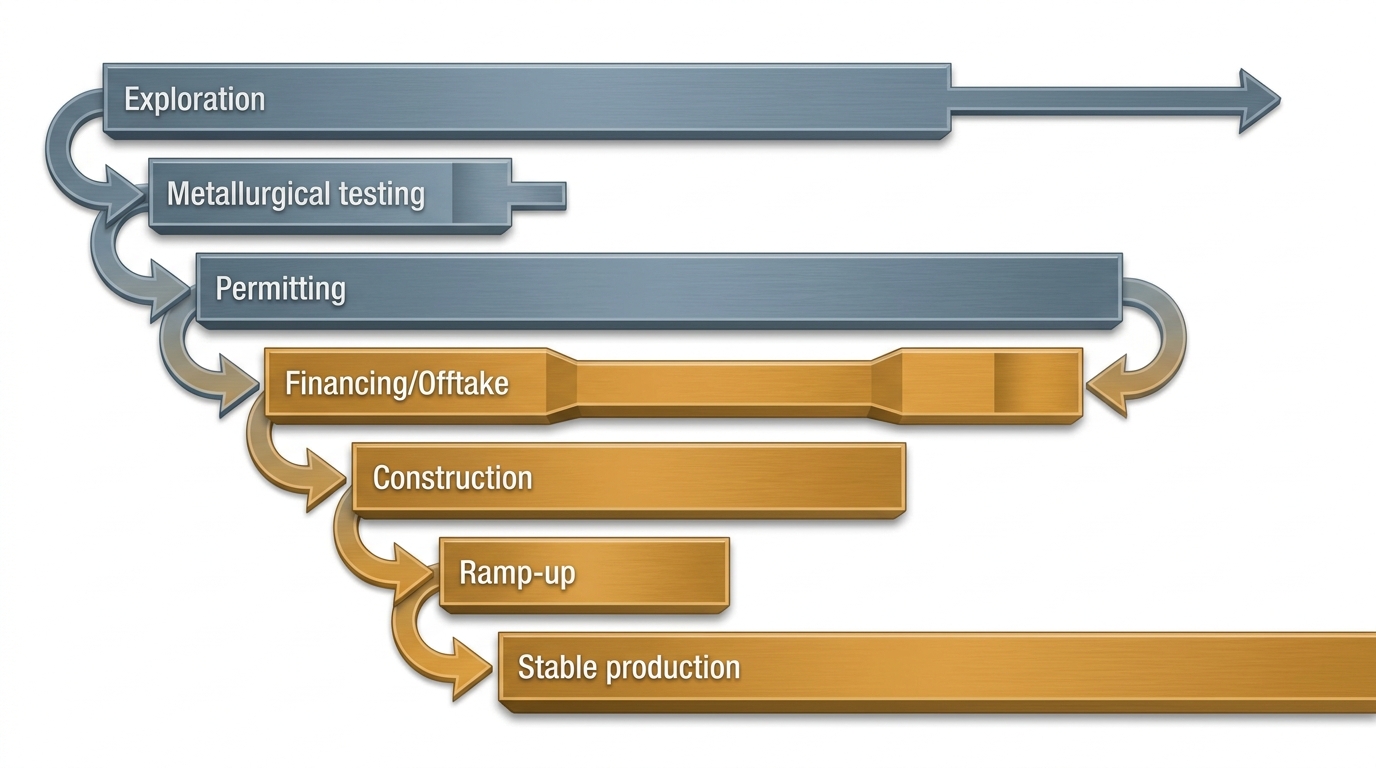
In operating reviews of a critical minerals project, the first public production date is rarely the real start of the schedule. The practical clock starts earlier, when the deposit, the process route, the waste profile, the permitting path, and the downstream product specification begin to interact. That is why a rare earth project timeline in North America or Europe often extends into a decade-plus development window, and why Western mine-to-magnet chains regularly approach 10-15 years from discovery to stable commercial output. The long duration is not explained by mining alone. It comes from a sequence of gates that are technical, regulatory, financial, logistical, and chemical at the same time.
- The longest delays usually appear before construction: ore characterization, metallurgical proof, environmental baseline work, and permit sequencing.
- Rare earth mine permitting is slower than many base-metal analogues when thorium, tailings classification, water handling, or downstream chemical processing are part of the file.
- Offtake can validate market interest, but it does not remove the need for proven recoveries, product qualification, and a financeable processing route.
- Construction is only one segment of the mining project timeline; commissioning and ramp-up often absorb the schedule slippage that had accumulated earlier.
- Recent US and EU policy has increased strategic attention on domestic supply chains, yet mining permitting in the US and the EU still operates on multi-year administrative and legal timelines.
Where the rare earth project timeline actually starts
Operationally, the timeline begins with the question of whether the ore can become a saleable downstream product on a repeatable basis. For rare earths, that question is more demanding than a simple resource statement. The distribution of light versus heavy rare earths matters because not all oxides contribute equally to downstream value chains. Mineralogy matters because bastnaesite, monazite, ionic clay, and mixed mineral systems behave differently in beneficiation and separation. Recoveries matter twice: once in concentration, and again in solvent extraction or another separation pathway. A deposit can appear large on paper and still remain schedule-fragile if impurity removal, radionuclide handling, or product purity is unresolved.
A recurring discovery moment in project reviews appears when early market attention is focused on total rare earth oxide, or TREO, while later engineering work shows that the real bottleneck sits in recoverable and separable units. Another appears when heavy rare earth content attracts attention, but the process route proves more difficult than anticipated. A third is the realization that long-life operation is not a headline attribute by itself; it must be supported by mine sequencing, water availability, waste storage design, and a process flowsheet that remains stable across ore variability.
General industry observations place the early geological, metallurgical, and pilot-test phase in a multi-year range, often with one to four years for exploration and resource definition and another one to three years for metallurgical programs and process design, sometimes overlapping. In rare earths, the overlap does not always shorten the schedule because pilot campaigns frequently send teams back to redesign comminution, flotation, cracking, leaching, impurity removal, or solvent extraction stages.
Rare earth mine permitting in the US and EU
Rare earth mine permitting is often the longest single gate in the mining project timeline. The reason is structural: a mine permit is usually not one permit. It is a stack of approvals tied to land use, water, air emissions, waste handling, biodiversity, cultural heritage, transport, and, in some jurisdictions, radioactive materials management. The timeline expands further when the project includes cracking, leaching, or separation rather than a simple concentrate plant, because the regulatory file begins to resemble both a mine and a chemical facility.
United States
In the United States, mining permitting in the US can involve federal review under NEPA, state mining approvals, water permits, air permits, wetlands issues, endangered species review, cultural resource work, tribal consultation, and local authorizations. General observations for major greenfield mines often land in a five-to-ten-year range, with longer outcomes where litigation, water conflicts, or land status issues emerge. Rare earth projects can face additional scrutiny when thorium-bearing residues, tailings characterization, or chemical processing units sit inside the project boundary. A common operational finding is that a late-stage data request on waste classification or water treatment can reset multiple workstreams at once, because engineering, environmental documentation, and community review are tightly linked.
European Union
In the European Union, recent strategic-minerals policy has aimed to accelerate designated projects, but permitting authority remains heavily dependent on member-state and regional procedures. As a result, a critical minerals project in the EU may benefit from stronger central policy support while still moving through a four-to-eight-year or longer path for environmental assessment, public consultation, Natura 2000 review where relevant, water approvals, and land-use decisions. The practical consequence is similar to the US: policy momentum can improve prioritization, but it does not remove the need for complete files, baseline studies across seasons, and defensible waste and water management plans.
Financing structure and the role of offtake
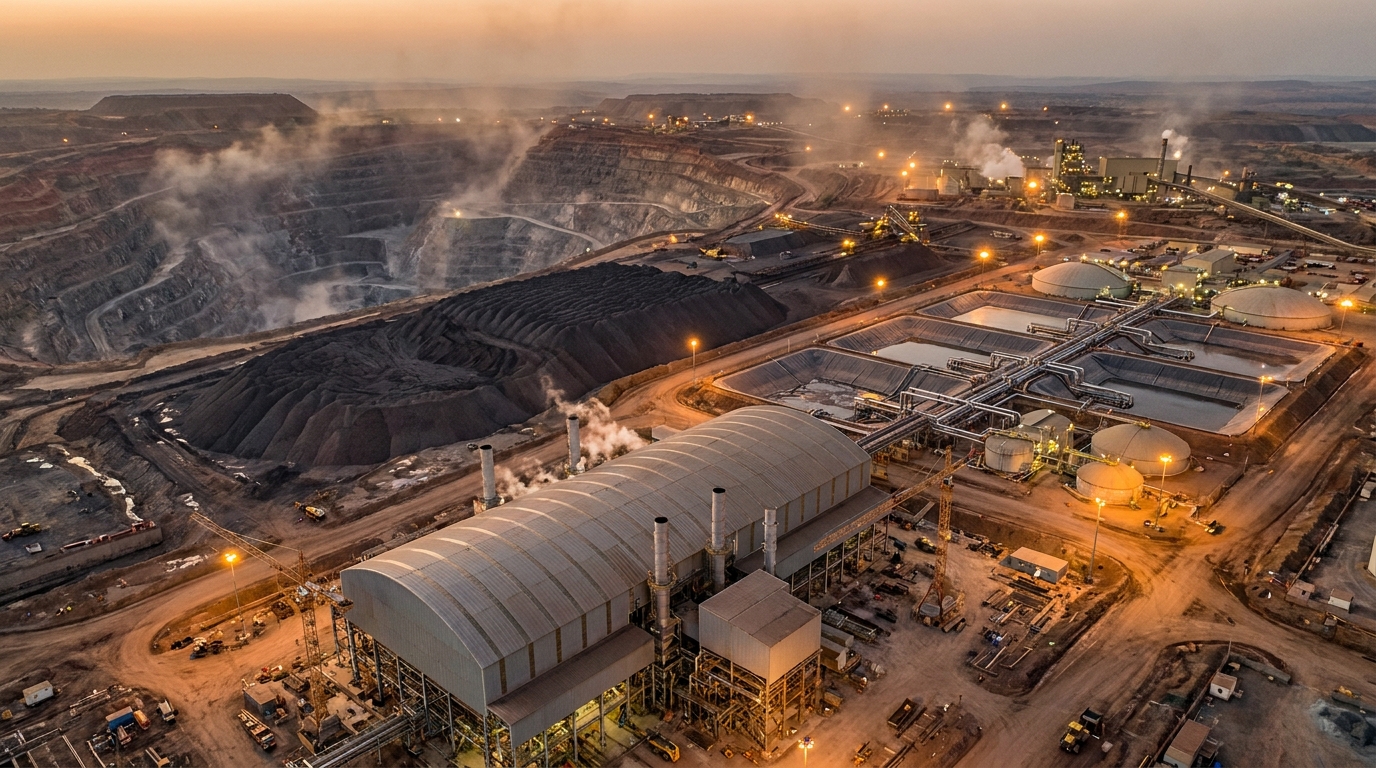
Once the technical route and permitting path become clearer, the schedule shifts into bankability. In a rare earth project timeline, financing rarely arrives as one clean event. It more often appears as staged funding aligned with de-risking milestones. This is one reason announced production dates routinely slip: the funding stack is frequently sequential, while public timelines are often presented as if all major capital were already committed.
- equity from the project sponsor or parent company,
- strategic equity from industrial partners,
- government grants, loans, or policy-bank support where available,
- export credit or equipment-linked support for plant packages,
- project debt once permits, product quality, and execution risk are sufficiently advanced,
- offtake-linked prepayments or other structured support in selected cases.
Offtake plays an important but limited role. It can show that a buyer recognizes the product route, the specification, and the strategic relevance of the material. It can also support discussions with lenders and public funding bodies. But offtake is not the same as full commercial readiness. In rare earths, this distinction is critical because one party may be evaluating a concentrate stream while the downstream user ultimately needs separated oxides, metals, alloys, or magnet inputs with tight impurity limits. An observed mismatch in many Western projects is that the mine development file advances faster than the downstream qualification file. When that happens, the project has a mine schedule and a customer schedule moving at different speeds.
Construction and ramp-up: where the schedule often doubles back
General observations for construction place many mining projects in a two-to-four-year build window once permits and funding are largely in hand. Rare earth projects can sit at the longer end when the asset includes beneficiation, cracking, leaching, solvent extraction, refining, or integration into metal and alloy steps. The apparent simplicity of a mine build can therefore be misleading. Roads, power, water systems, tailings facilities, reagent storage, laboratories, residue handling, and quality-control systems all have to be operational before the first saleable output becomes routine.
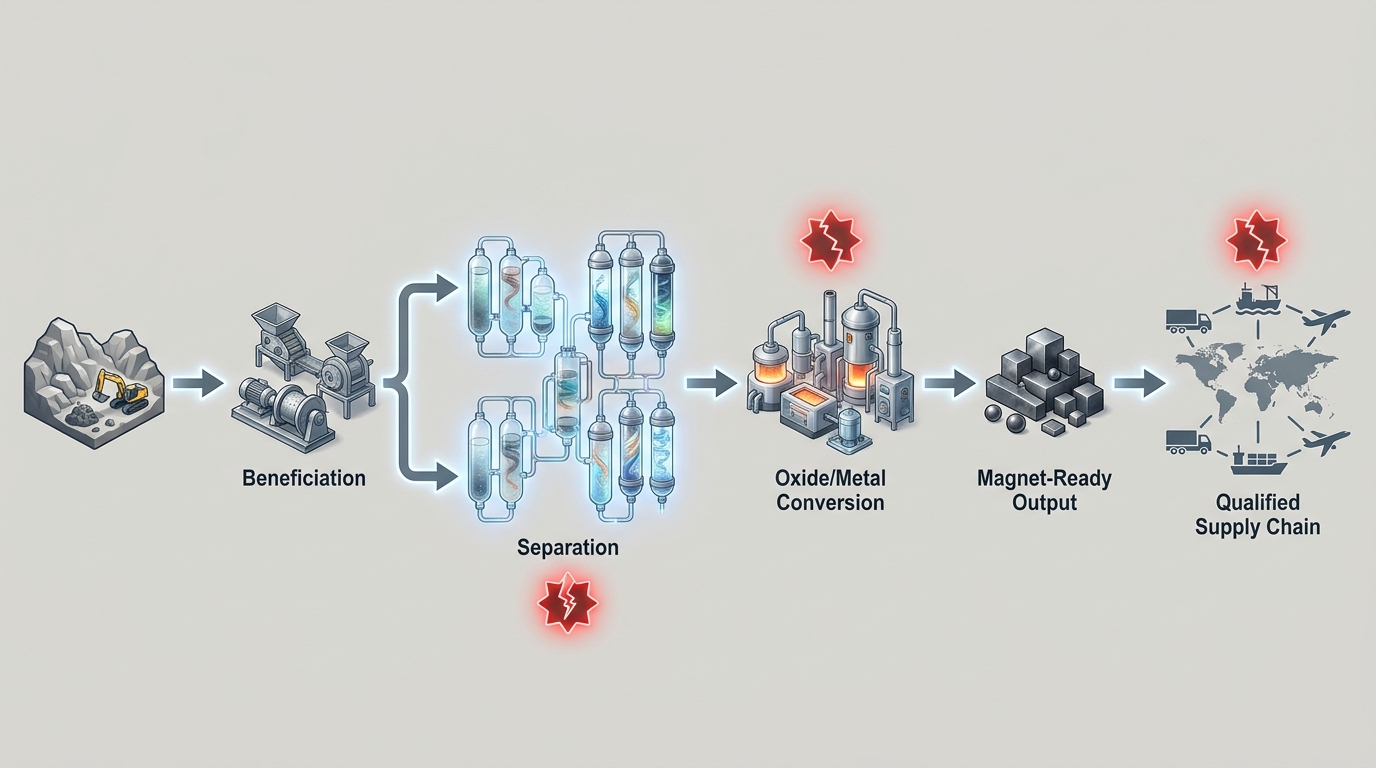
Ramp-up is often even less appreciated. Six to twenty-four months is a common observation for the move from first production to stable throughput, and complex chemical circuits can exceed that range. A familiar discovery moment in commissioning is that first concentrate, first mixed rare earth carbonate, or first separated oxide does not automatically mean qualified product. Throughput can be below design, recoveries can move with ore variability, and impurity control can fail customer qualification at a late stage. In practical terms, the schedule is not finished when the plant runs; it is finished when the plant runs consistently, the product meets specification, and the logistics chain can support regular deliveries.
Why announced production dates routinely slip
- Sequential dependencies: permitting, financing, construction, and qualification often look parallel in presentations but behave sequentially in execution.
- Metallurgical surprises: laboratory results can weaken at pilot or demonstration scale, especially around recoveries, reagent balance, or impurity removal.
- Waste and water issues: tailings design, water treatment, and radioactive byproduct management are frequent sources of redesign.
- Funding in tranches: a staged financing process can create stop-start development, with each pause pushing engineering, procurement, and hiring further out.
- Equipment and contractor friction: late delivery, redesign after factory testing, or underperformance during installation can move commissioning by months.
- Downstream qualification lag: mine output may exist before a converter, alloy producer, or magnet customer accepts the material at commercial scale.
- Geopolitical and trade exposure: cross-border processing routes, export controls, sanctions, and customs treatment can alter the practicality of an originally planned supply chain.
Observed ways timeline risk is handled
Several management patterns appear repeatedly across critical minerals projects. One is phased development, where mine-to-concentrate starts are separated from full downstream integration. Another is use of toll processing or third-party separation while domestic refining capacity is being built. A third is earlier customer qualification work, sometimes before the final plant is complete, so that product specifications are not discovered too late. Parallel environmental baseline work is also common, because seasonal datasets can become a hard schedule limiter. Each of these approaches reduces one type of uncertainty while leaving other trade-offs in place, particularly around traceability, jurisdictional exposure, and the dependence on external processors.
The broader lesson from the rare earth project timeline is straightforward: these projects are long because they are multi-system industrial programs, not just mines. The brutal part of the schedule is not a single bottleneck. It is the accumulation of small and large gates across geology, chemistry, permitting, capital structure, construction, and customer qualification. That is why critical minerals project announcements often look linear while actual development remains uneven, and why stable production dates in Western supply chains tend to arrive later than initial plans suggest.
Leave a Reply