Japan and South Korea are moving toward a more structured rare earth relationship built around supply security, industrial continuity, and allied coordination with Australia. The substantive change is not a single treaty or headline project; it is the emergence of a supply-chain axis linking Japanese policy finance, Australian upstream and midstream capacity, and South Korean magnet and manufacturing demand. For critical minerals planning, that is more consequential than isolated announcements because it strengthens multiple links in the chain at once.
- Japan’s rare earth strategy remains anchored in JOGMEC, which links financing, stockpiling, overseas participation, and offtake support.
- South Korea’s role is centered on NdFeB magnet manufacturing and downstream industrial demand rather than domestic mining.
- Lynas and the Kalgoorlie processing route give the Japan-Australia-Korea framework a physical non-Chinese supply backbone.
- The immediate risk remains concentration in separation, heavy rare earths, and magnet qualification, even as diversification broadens.
- Key signals to monitor include additional offtake structures, heavy rare earth processing progress, and any expansion of Korean magnet capacity.
Why this matters now
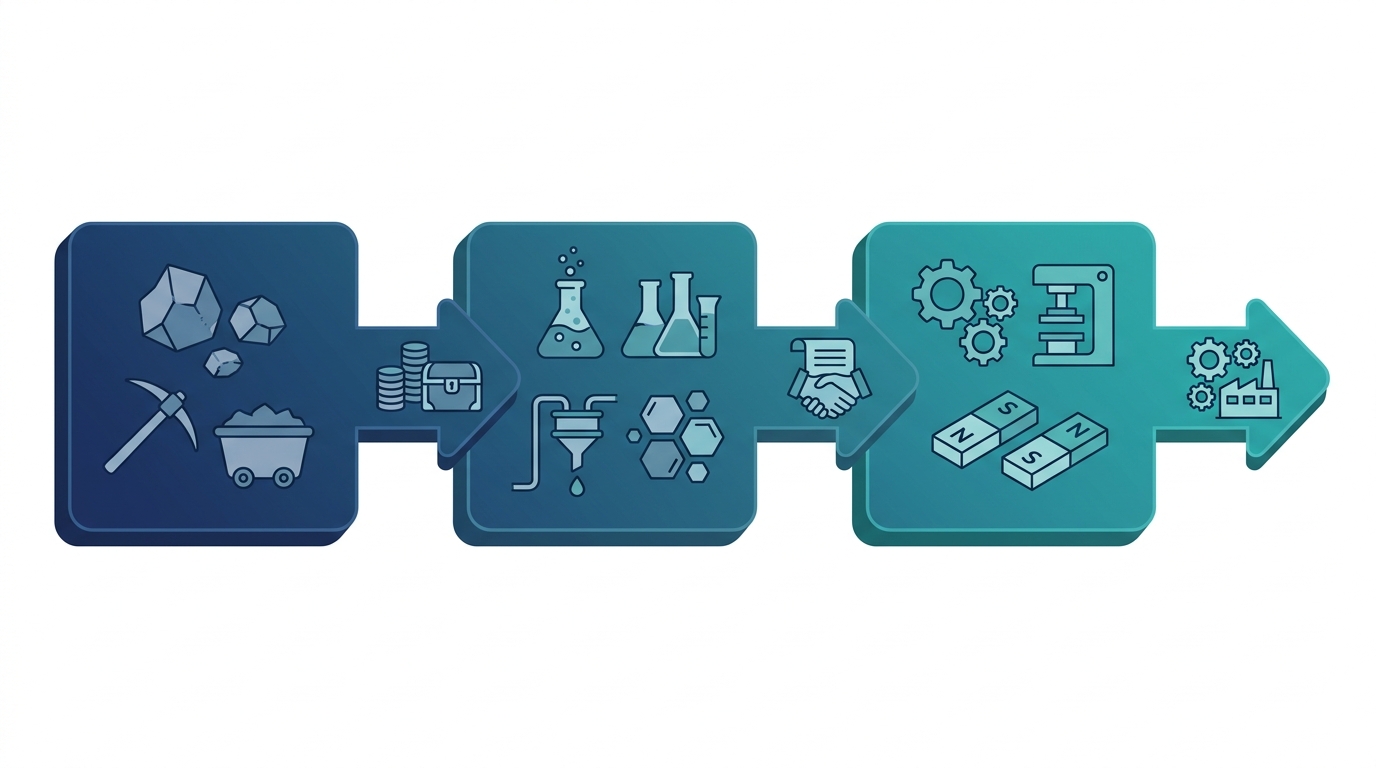
Rare earth security is often framed as a mine supply problem. In practice, the harder issue is continuity from ore to separated oxides, metals, alloys, magnets, and qualified industrial components. Japan and South Korea occupy different positions in that chain, but those positions are increasingly complementary. Japan has the more established state-backed model for de-risking supply. South Korea has dense manufacturing exposure in motors, electronics, batteries, automotive systems, and other magnet-intensive sectors. Australia contributes the most credible allied upstream base through Lynas and related processing infrastructure.
This creates a structural pattern rather than a symbolic partnership. Japan reduces project risk and anchors non-Chinese supply through institutional tools. Korea provides sustained downstream pull and magnet relevance. Australia provides material flow outside Chinese control. The result does not replace China, and no such claim is supported by the available material, but it does reduce fragility in the most sensitive part of the supply chain.
JOGMEC’s model: why Japan remains the policy anchor
The core of the japan rare earth model is JOGMEC, the Japan Organization for Metals and Energy Security. Its significance lies in institutional design. Rare earth projects are difficult to finance through normal commercial logic because they face long development periods, technical complexity, concentrated processing, and geopolitical risk. JOGMEC addresses that gap through a mix of financing support, overseas project participation, stockpiling, and supply-chain resilience measures.
That framework became especially important after the 2010 rare earth shock, when Japan treated supply dependence as a strategic vulnerability rather than a routine procurement issue. The lasting lesson was that offtake and financing are linked. Long-term security depends less on opportunistic spot buying than on institutional commitments that make alternative supply chains bankable. This is why jogmec rare earth policy is often treated as a model: it spans upstream mining, processing, strategic inventories, and industrial continuity rather than focusing on one segment alone.
For Japan-South Korea cooperation, this matters because the Japanese side already has an operating policy mechanism. The bilateral pattern is therefore not starting from zero. It is extending a Japanese architecture into a wider allied network that can include Australian production and Korean downstream conversion.
South Korea’s role: the magnet and manufacturing node
South Korea is often described mainly as exposed to rare earth disruption. That description is incomplete. Its strategic importance lies in manufacturing density and in the role of korea rare earth magnets, especially NdFeB magnets. NdFeB is the highest-performance commercial permanent magnet family and is essential across electric drive systems, robotics, industrial automation, storage devices, and defense-adjacent applications.
The available material does not provide a verified figure for Korean NdFeB magnet capacity, so a precise capacity estimate is not specified in the elements provided. Even without a published number here, the structural point is clear: South Korea is not only a buyer of rare earth inputs. It is a conversion and integration base where magnetic materials become qualified components for larger industrial systems. That gives Korea importance at the middle and downstream stages of the chain, where substitution is difficult and qualification cycles can be long.
This is where japan korea critical minerals cooperation becomes practical. Japan brings policy finance, established diversification experience, and materials expertise. Korea brings high-volume industrial pull and a major manufacturing platform. Those strengths are different, but they reinforce each other.
Lynas, Kalgoorlie, and the Australia link
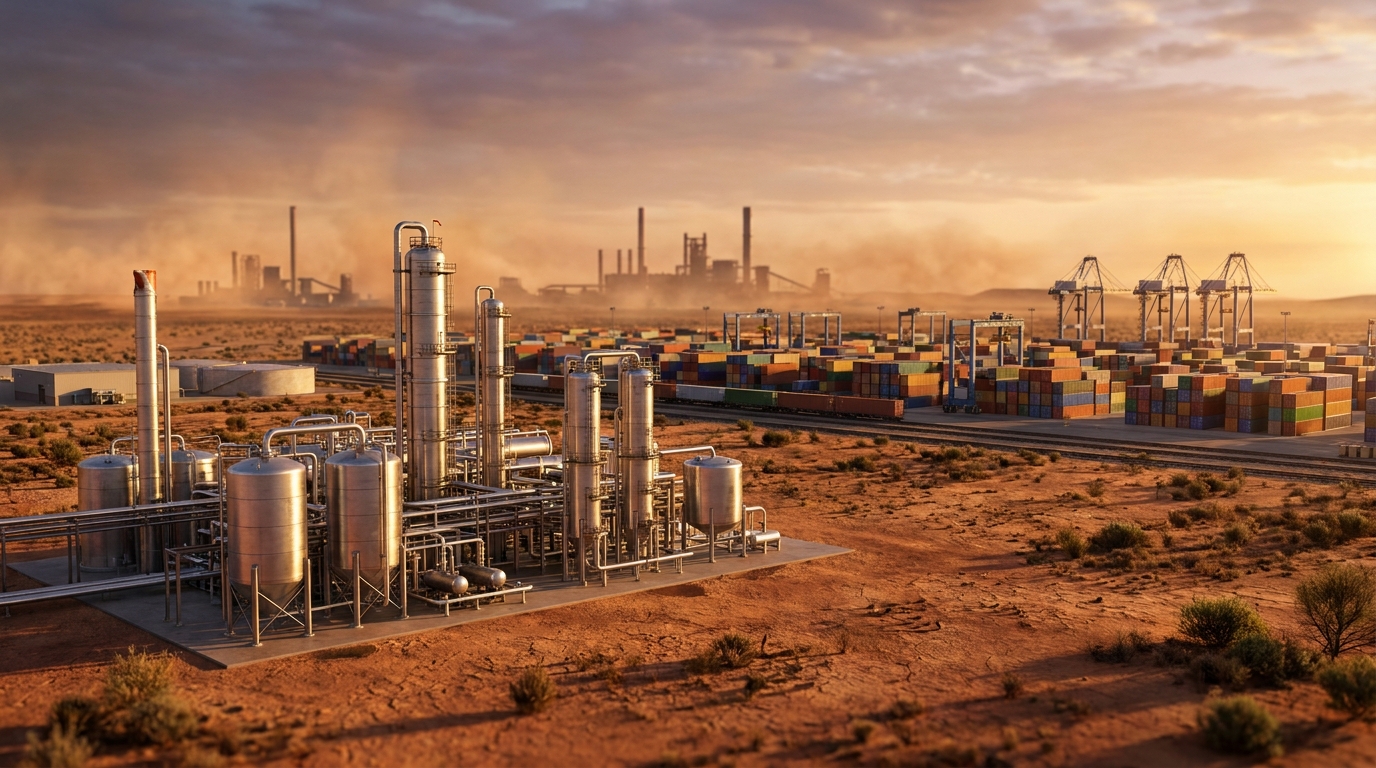
The third pillar is Australia, particularly Lynas. In non-Chinese rare earth supply chains, lynas japan ties are important because they show how Japanese demand, policy support, and Australian production have been connected over time. The critical point is not only mining at Mount Weld but also the processing route that includes Kalgoorlie. Kalgoorlie matters because it shifts part of the value chain closer to the mine and supports a more diversified refining architecture.
This has implications beyond Japan. A functioning Kalgoorlie-linked corridor improves the credibility of non-Chinese supply for regional manufacturers, including Korean magnet and component producers. It also highlights the logic of trilateral alignment: Australia provides material, Japan helps underwrite continuity, and Korea can absorb qualified output into industrial production.
What defines the structural cooperation pattern
Four elements define the emerging axis. First, supply security is being built through long-term structures, not episodic market access. Second, policy covers the full chain, from resource access to processing and stockpiles. Third, the arrangement is alliance-compatible without requiring identical institutions in each country. Fourth, the operational goal is continuity of qualified material into manufacturing, not symbolic diversification alone.
That pattern is under-covered because most rare earth reporting still centers on export controls or bilateral diplomatic rhetoric. For industrial and policy audiences, the more relevant question is whether a non-Chinese chain can stay technically viable and commercially continuous. Japan-South Korea cooperation is significant precisely because it addresses that question through functionally different but connected roles.

Risks and signals to watch
The main constraint remains concentration in separation, heavy rare earth processing, and magnet-grade qualification. A broader allied chain still faces execution risk if one stage remains too narrow or too slow. ESG and compliance scrutiny also remain relevant, particularly where traceability, processing jurisdiction, and defense-linked end uses intersect. None of those risks disappear simply because diversification improves.
Signals that would confirm further consolidation of this axis include additional JOGMEC-supported supply arrangements, clearer evidence of Korean NdFeB capacity expansion, deeper Lynas-linked processing integration, and more explicit coordination around stockpiles or downstream materials. Signals of stress would include delays in processing scale-up, bottlenecks in heavy rare earth availability, or disruptions that force a return to more concentrated sourcing.
The central takeaway is straightforward. Japan and South Korea are no longer best understood as separate rare earth cases. They are increasingly part of a structural supply-chain axis in which Japanese policy finance, Korean manufacturing capability, and Australian upstream supply reinforce one another. For critical minerals strategy, that is a material shift in how resilience is being built across the region.
Leave a Reply