In disruption reviews, the phrase “substitution available” often collapses once the part number, temperature envelope, certification status, and processing route are examined. Across batteries, magnets, semiconductors, catalysts, and tooling, the operational issue is rarely whether a mineral has a theoretical replacement. The more reliable question is narrower: which application can absorb a chemistry change, a lower loading, or a larger component without creating a new bottleneck elsewhere in the chain.
- Substitution is usually application-specific rather than mineral-wide; cobalt in batteries is a very different case from cobalt in superalloys.
- Many headline “replacements” are actually intensity reductions, architecture changes, or formulation shifts rather than full mineral exit.
- Qualification, traceability, and export-control exposure often determine whether a substitute is commercially real.
- Failure modes tend to appear as lower thermal stability, lower power density, shorter life, larger component size, or a new dependency on another constrained material.
A practical frame for critical minerals substitution
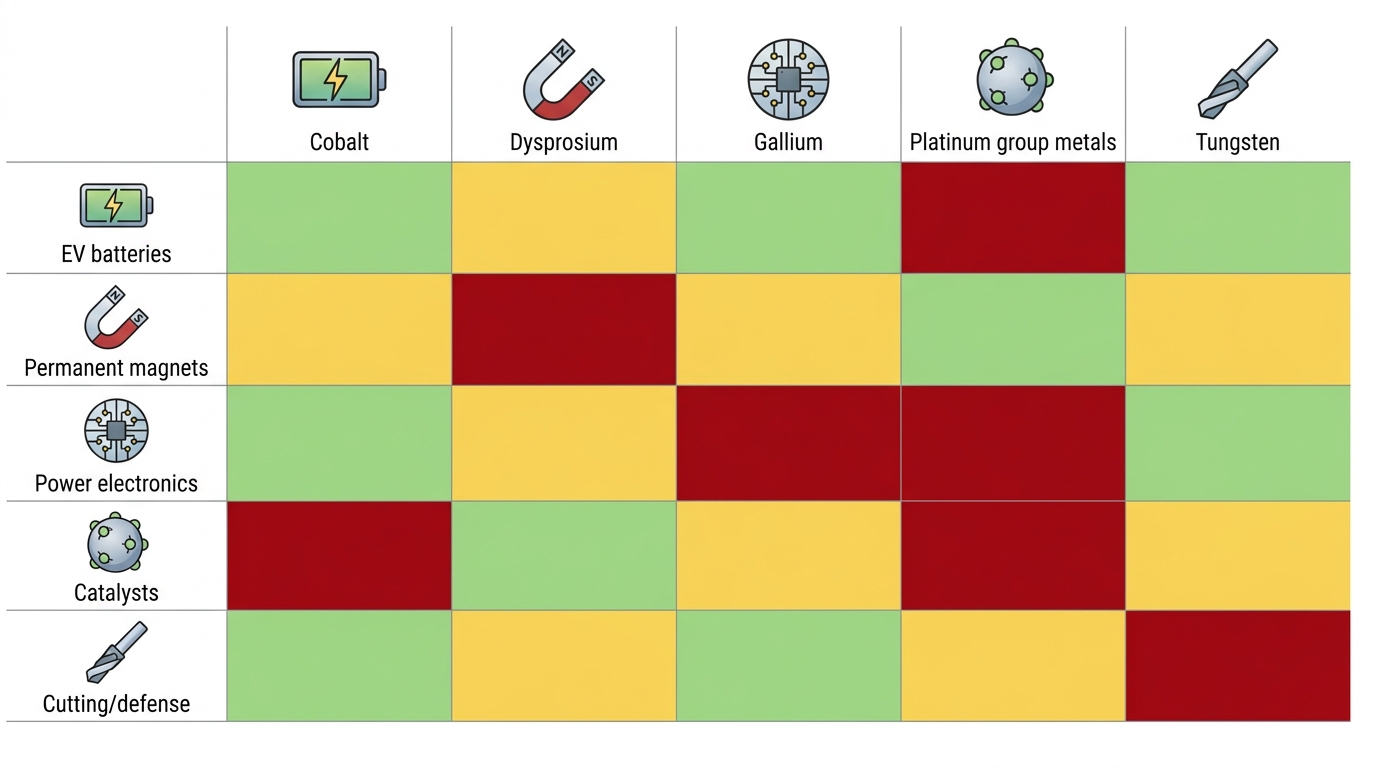
A workable assessment frame has five layers. The first is functional role: what the mineral is doing in the system. Cobalt stabilizes and supports performance in some cathode systems; dysprosium raises coercivity in NdFeB magnets; gallium enables device performance in GaN and other compound semiconductors; PGMs drive catalytic reactions; tungsten contributes density, hardness, and high-temperature stability. If the function is not defined precisely, substitution analysis becomes too abstract to be useful.
The second layer is the performance window. A substitute may work at one voltage range, one temperature band, or one duty cycle and fail outside it. The third layer is the process and qualification burden. In observed industrial practice, a bench-tested replacement often stalls when customer approval files, product change notices, material declarations, and reliability validation are opened. Automotive, aerospace, chemical processing, and defense applications are usually the slowest to change because the mineral is embedded in a certified system, not just a bill of materials.
The fourth layer is geography and processing concentration. A substitute can reduce exposure to one country and increase exposure to another. A recurring discovery in supply-chain reviews is that “substitution” sometimes exchanges one mine-level risk for a more concentrated refining or component-manufacturing risk. The fifth layer is failure mode visibility: whether degradation appears immediately or only after thermal cycling, corrosive exposure, vibration, or long service life. That distinction matters because delayed failure is often more disruptive than outright nonperformance at qualification.
Cobalt: the clearest chemistry switch, but not a full demand exit
Among the minerals in this group, cobalt has the most visible substitution path because LFP vs NMC is already a large-scale industrial choice. Lithium iron phosphate (LFP) removes both cobalt and nickel from the cathode. Nickel-manganese-cobalt chemistries (NMC) retain cobalt, even as loading per kWh has been reduced in many designs. This is one of the clearest examples of critical minerals substitution moving beyond theory.
The substitution boundary is not universal, however. LFP fits many mass-market EV platforms and much stationary storage, where cycle life and safety profile often outweigh absolute energy density. Cobalt-bearing chemistries remain more relevant where range, weight, cold-weather behavior, or pack volume are tighter constraints. Outside batteries, cobalt remains embedded in some superalloys and specialty metallurgical uses where substitution is materially harder.
The main failure mode in cobalt substitution is not chemical incompatibility; it is system-level compromise. The substitute battery may require a different pack architecture, volume allocation, or thermal strategy. In practical terms, that means the supply-chain analyst is not reviewing only cathode chemistry. The review extends to enclosure design, vehicle platform assumptions, and customer acceptance of performance trade-offs. One consistent market observation is that LFP has not “eliminated” cobalt demand; it has segmented demand by use case.
Dysprosium: rare earth substitution is mostly intensity reduction
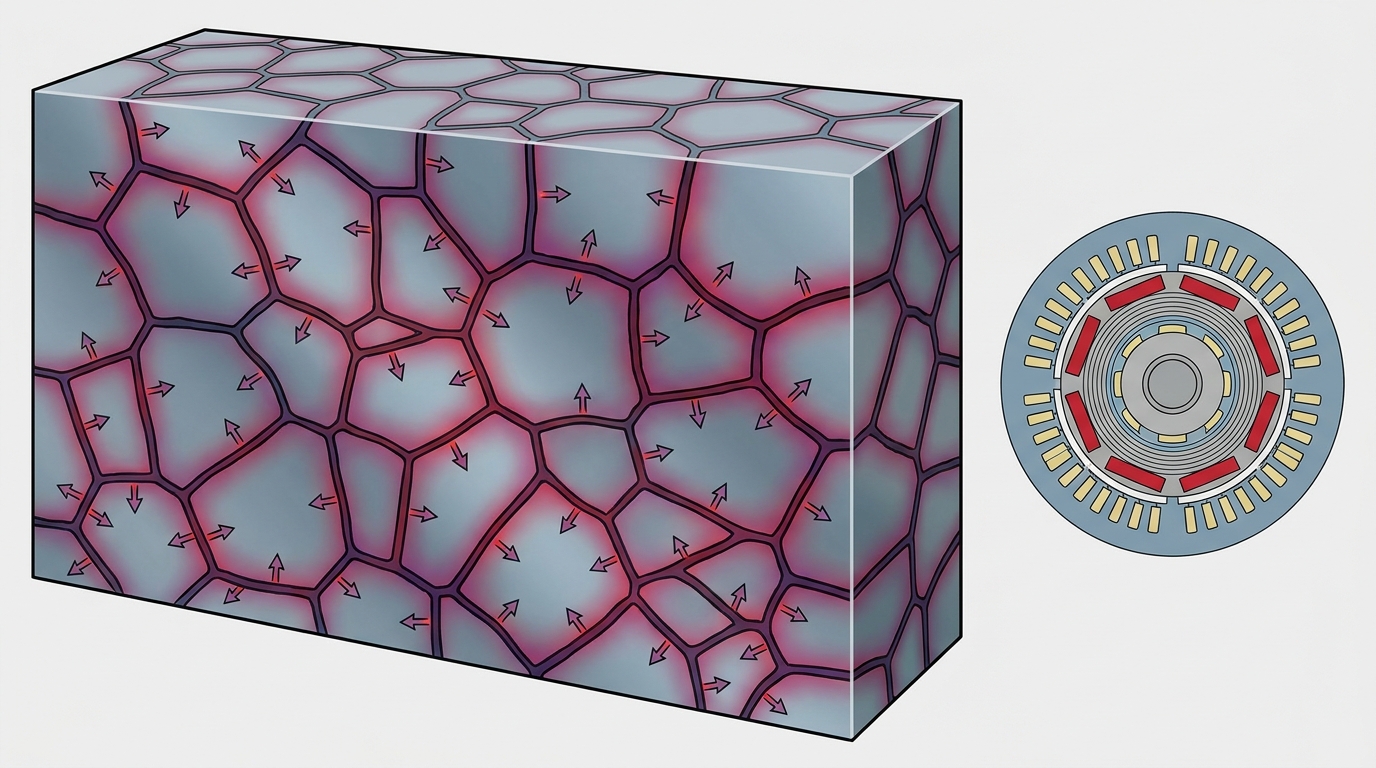
Dysprosium sits close to the hard limit of rare earth substitution. In NdFeB permanent magnets, Dy is used mainly to improve coercivity, helping the magnet resist demagnetization at elevated temperature. That makes it particularly relevant in traction motors, wind turbines, industrial drives, and defense systems where heat and magnetic stability matter simultaneously.
The most important development in dysprosium substitution is not a clean replacement with a non-rare-earth material. It is grain-boundary diffusion, which allows magnet producers to place heavy rare earth content where it contributes most rather than distributing it uniformly through the magnet. In supply-chain terms, this is intensity reduction, not elimination. The magnet still depends on rare earth inputs, but the Dy loading can fall materially in favorable designs.
The failure modes are tightly linked to temperature and motor geometry. A lower-Dy magnet can pass early testing and still lose margin in high-heat duty cycles or under aggressive operating conditions. Another recurring discovery is that alternative motor architectures presented as rare earth alternatives-such as ferrite motors, induction motors, wound-field systems, or synchronous reluctance designs-shift the problem into size, efficiency, or control-system complexity rather than removing it entirely. Heavy rare earth processing concentration, especially in China, remains part of the exposure even when Dy intensity falls.
Gallium: substitution by device architecture, not by simple material swap
Gallium substitution is becoming more visible because power electronics design has opened a genuine comparison between GaN and SiC. In some converters, chargers, industrial drives, and EV power applications, SiC substituting GaN can make technical sense. That does not mean the two materials are interchangeable across all devices. Their advantage depends on switching frequency, voltage class, thermal behavior, packaging, electromagnetic performance, and reliability targets.
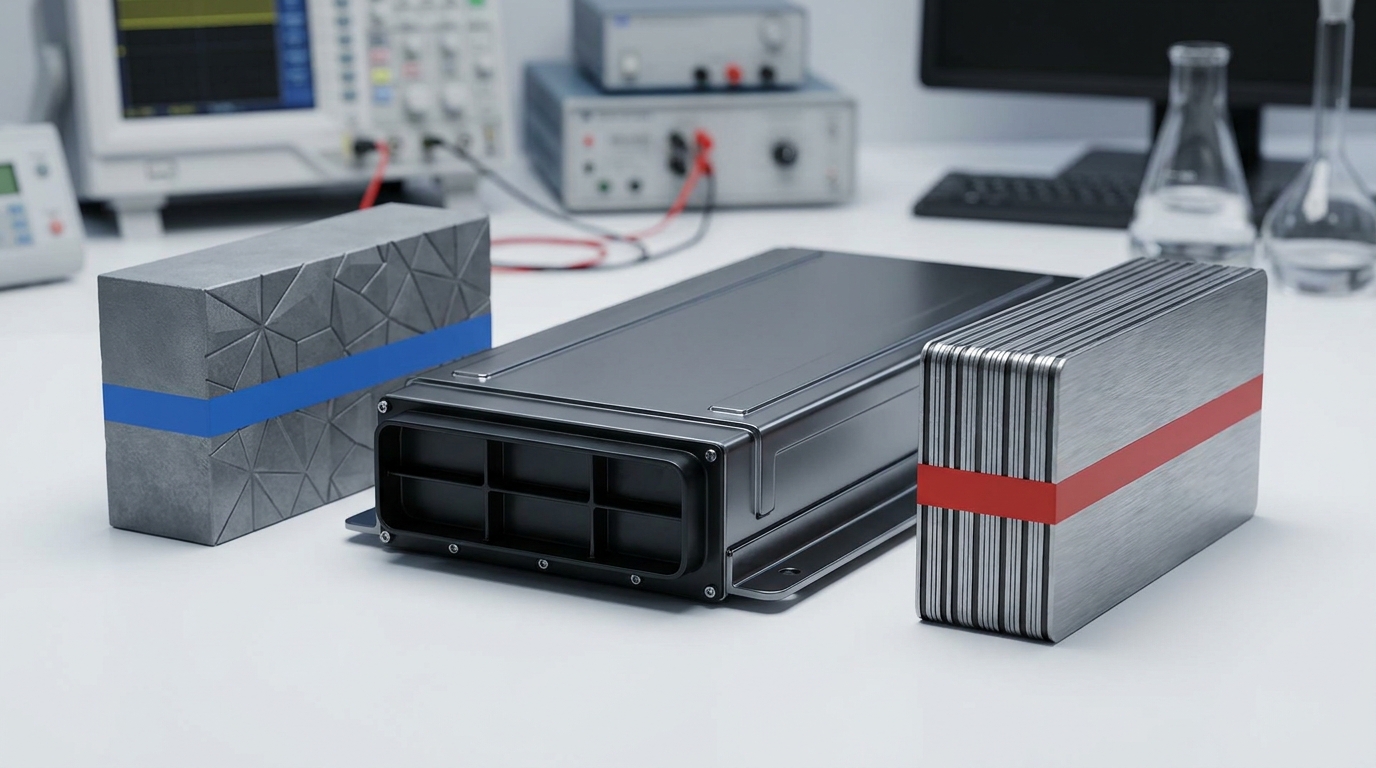
The operational relevance increased after Chinese export licensing measures on gallium sharpened attention on compound-semiconductor dependency. Yet the substitution story remains narrow. GaN still holds strong positions in high-frequency applications, compact power supplies, and several RF-oriented designs. SiC can relieve gallium exposure in some power categories, but often with different module dimensions, different thermal assumptions, and a different qualification path.
A common failure mode is the assumption that wafer-level substitution automatically works at the system level. In practice, parasitics, heat sinking, control strategy, and certification can change with the device family. This makes gallium a useful example of how substitution often becomes an electronics redesign project, not a commodity switch.
Platinum group metals: chemistry sets a hard ceiling
Platinum group metals present a different pattern. Substitution exists, but chemistry narrows the field. Palladium has historically displaced platinum in some autocatalyst formulations, and some industrial processes can use base-metal catalysts in place of PGMs when process tolerance is wide enough. Even so, the term “replaceable” becomes misleading once activity, selectivity, poisoning resistance, and durability are considered together.
The main distinction is between loading reduction and true substitution. A catalyst system may cut platinum or palladium intensity through formulation changes and still remain fully PGM-dependent. A more radical substitution toward nickel, iron, cobalt, or copper catalysts can work in selected chemical environments, but often only within a narrow operating window. In emissions control, fuel cells, electrolyzers, and several specialty chemical processes, the performance penalty from non-PGM systems still matters.
Supply concentration adds another layer. South Africa and Russia remain structurally important in several PGM flows, so the supply-chain question is not simply whether a catalyst alternative exists, but whether it survives the required duty cycle and regulatory regime. One repeated lesson from catalyst qualification files is that the substitute can function in the lab and still fail on service life or contamination tolerance.
Tungsten: partial substitution, persistent physical advantage
Tungsten substitution is easier to claim than to execute because tungsten’s value comes from an unusual combination of density, hardness, wear resistance, and high-temperature performance. Ceramics, cermets, advanced steels, and other heavy materials can replace tungsten in selected cutting, tooling, or counterweight applications, but generally not without a property penalty somewhere in the system.
In cutting tools, alternative materials may work for specific machining conditions and still underperform on toughness or wear in broader production runs. In counterweights and defense-related uses, replacement often means larger volume for equivalent mass or reduced dimensional efficiency. In shielding and high-temperature environments, a substitute may be workable in limited settings while losing margin on durability or compactness. Processing concentration, with China playing a central role in tungsten refining and downstream products, keeps the supply risk visible even where end-use flexibility exists.
What substitution usually means in real supply chains
Across these five materials, the pattern is consistent. Substitution rarely arrives as a universal breakthrough. It usually appears in one of four forms: a chemistry switch in a defined product class, as seen in parts of the lfp vs nmc battery split; an intensity reduction, as seen with grain-boundary diffusion for dysprosium; an architecture change, as seen in some motor and power-electronics designs; or a formulation rebalance, as seen in several PGM applications. Tungsten shows the final category: partial replacement with clear physical trade-offs.
That is why the phrase “Can rare earths be substituted?” has no single answer. Some can be displaced in selected designs, some can be diluted, and some remain anchored by performance requirements that are still hard to replicate. The most reliable substitution analysis stays close to the end use, the qualification file, the processing geography, and the failure mode. In operational terms, that is where substitution claims stop being slogans and start becoming measurable supply-chain reality.
Leave a Reply